This week, Rheinmetall CEO Armin Papperger made news with a blunt interview in The Atlantic about the changing face of defense manufacturing. The article, titled Building Tanks While the Ukrainians Master Drones, is worth reading. It presents Papperger, who has led Rheinmetall since 2013, as a critic of modern warfare, who still believes tanks and high-end armaments remain central to defense.
His tone is sharp. “What is the innovation of Ukraine?” Papperger asked journalist Simon Shuster. “They don’t have some technological breakthrough. They make innovations with their small drones, and they say, ‘Wow!’ And that’s great. Whatever. But this is not the technology of Lockheed Martin, General Dynamics, or Rheinmetall.”
He went further, claiming that much of Ukraine’s manufacturing comes from “housewives with 3D printers” building drones in their kitchens.
Reaction was swift.
“If every housewife in Ukraine can really make drones, then every housewife in Ukraine can be the CEO of Rheinmetall,” said Ukrainian President Volodymyr Zelenskyy this week.
Shuster, for his part, was not kind to Rheinmetall in his reporting. He described one of its new factories in terms that undercut Papperger’s critique, drawing an implicit comparison to the improvised workshops he dismissed:
The factory was far from finished when I arrived at the hangar where Rutte had given his speech. The place was mostly empty an hour before lunchtime, and the floor managers told me that installing the robots needed to automate production would take months. Meanwhile, a surprising amount of the labor was being done by hand. One worker used a large blowtorch to heat the rod used to bend artillery shells into shape. “That’s not how it’s supposed to look,” his boss told me. “It’s supposed to be automated.”
In another part of the factory, a worker used a wooden stick, like a tongue compressor at a doctor’s office, to scrape excess bits of explosive out of the grooves inside each shell, ensuring that the base would screw on smoothly. The explosive mixture, resembling castor sugar, lay on the floor in paper sacks. One of my guides encouraged me to touch the stuff once it had been pressed into one of the shells. Then he laughed and said that I should be careful at the airport going home. The residue on my fingers might set off bomb detectors at security. “Just make sure to wash your hands with soap,” he told me.
Near the height of these assaults, in March 2023, Papperger traveled to Kyiv to see how he could help. He arrived in Zelensky’s compound to find the doors and windows barricaded with sandbags to guard against a Russian siege. Dressed in a blue hoodie, the German guest asked what he could do for the Ukrainians, and Zelensky urged him to build an ammunition plant in Ukraine to produce 1.5 million shells every year. “You got it. No problem,” Papperger recalls responding. There was just one issue, he added: “Do you have money?” Such a plant would cost billions of dollars. “I can build it,” Papperger told Zelensky. “But where is the business case?”
Kinetic effect
Without diminishing the plight of Ukraine and the dangers facing its men, women, and children, Armin Papperger’s comments are indicative of a larger trend spreading through the defence industry. While incumbents like “Lockheed Martin, General Dynamics, or Rheinmetall” are building for wars fought five years ago, Ukraine is manufacturing for the wars of tomorrow.
Papperger also frames the issue as a technical and business problem, something akin to the early battles in personal computing or mobile phones between Nokia, Apple, and Samsung. His reaction echoes DEC CEO Ken Olsen’s famous 1974 remark: “There is no reason for any individual to have a computer in their home.” Olsen, like Papperger, was wrong.
Papperger himself echoed that mindset when he spoke to a German business magazine, saying: “There are a lot of these narratives circulating right now that claim future wars will be fought exclusively with drones. I think that’s nonsense.”
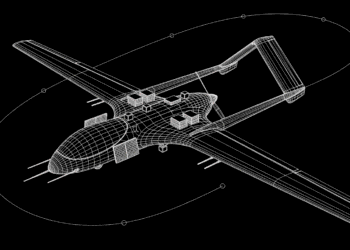
It’s a position that is especially odd, given that at the same time that Pepperger is saying all of this, his company is also investing in the new age of drones. Last year, it backed Auterion, one of the big startups building operating systems for drones, in its Series B. The two are collaborating on drone development and building military operating systems (which would, presumably, incorporate multiple next-generation systems). All the same, the sums in that investment and partnership are going to be just a fraction of Rheinmetall’s annual turnover, which was nearly €10 billion in FY 2025.
Indeed, what incumbents refuse to admit — perhaps because too much of their current revenues remain anchored in their legacy businesses — is that technology has moved beyond the need to protect large numbers of troops in the field.
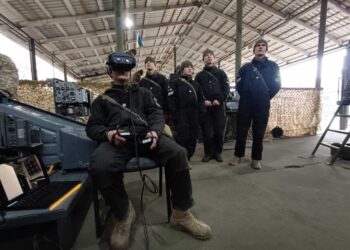
Most countries, primarily the United States and Israel, focus on air defense while investing heavily in anti-missile, not anti-drone, systems. Russia’s tendency to send troops into a meat grinder is now being countered by Ukraine’s ability to keep its best FPV drone operators far from the front, allowing them to inflict damage without the same level of risk to life.
The chances of a large-scale European tank war are slim, and Rheinmetall knows it. Much of what is being built now leans as much on optics and perceived safety as on battlefield necessity.
This is not to say modern military technology is ineffective. There are persistent reports of new weapons and targeting systems being tested in places like Venezuela, including devices that allegedly caused guards to bleed from their ears. These claims remain unverified, but they reinforce a broader point: modern warfare is shifting away from troop carriers and toward jets, missiles, and small, highly trained units equipped with next-generation systems.
At the same time, Ukraine is succeeding with or without Rheinmetall’s help. Artem Moroz of the investment and accelerator group Brave1 noted that Ukraine may soon reach a 95 percent success rate in intercepting Russian missiles and drones.
“In March, Ukraine intercepted 89.9% of all incoming missiles and strike drones. 6,600 targets launched. 641 more enemy targets neutralized compared to February,” he said. “The ‘small air defense’ system is multi-layered: AI-powered autonomous turrets, interceptor drones, and mobile fire groups. It wasn’t designed once and deployed. It is being redesigned constantly, in real time, under real fire.”
“The interception target is 95%,” he added. “Ukraine is closing in.”

Ukrainian defence tech CEO Oleksandr Yakovenko wrote a long Tweet to Papperger and laid out the current situation in a manner that mirrors Steve Jobs’ original ad welcoming IBM to the personal computer race:
When you referred to Ukrainian drone manufacturers as “Ukrainian housewives with 3D printers” you revealed just how deeply the European defense establishment still fails to understand the nature of modern warfare. This is not about emotion. It is about battlefield reality. Here are the facts your industry refuses to acknowledge: In 2025 alone, Ukrainian drones carried out 819,737 confirmed strikes. They caused 90 percent of all Russian combat losses, more than all other weapons systems combined. TAF alone produces up to 100к FPV drones monthly. In any given 90-day period, my company’s products alone achieve more confirmed strikes than your entire fleet of equipment has across its full combat history in every conflict. And most importantly, I built this company and achieved these results in two years, not fifty. Think about that. Our drones generate more kinetic effect in three months than your flagship platforms have in half a century. Why? Because the battlefield has changed, and your business model has not.
Again, there is nothing unserious about the current global situation. This is not a story of a large, established manufacturer facing a scrappy startup. It is a conflict between old systems and new ones and lives are at stake.
Rheinmetall cannot build drones the way Ukraine can because its manufacturing base is built around large contracts and scaled deployments. Papperger answers to shareholders, while Ukrainian “housewives” are focused on defending their families. The incentives are not the same, and the outcomes reflect that.
Ukraine has long operated at the edge of technological change, from its early role as an outsourcing hub to its current position as a testing ground for modern warfare. To dismiss that, especially by a CEO who could learn from it, is not just shortsighted, it is insulting.
Eventually Rheinmetall apologized on Papperger’s behalf, a move that was more likely aimed at the company’s “billion dollar” customers vs. Ukraine.
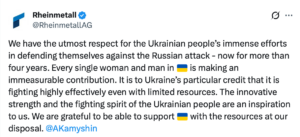
“We have the utmost respect for the Ukrainian people’s immense efforts in defending themselves against the Russian attack – now for more than four years,” the company wrote. “Every single woman and man in is making an immeasurable contribution. It is to Ukraine’s particular credit that it is fighting highly effectively even with limited resources. The innovative strength and the fighting spirit of the Ukrainian people are an inspiration to us. We are grateful to be able to support with the resources at our disposal.”
In the end Ukraine is showing the world how to fight the next war. The biggest question is whether men like Papperger are listening.