
The US has become a somewhat unpredictable neighbour to Canada, with President Trump’s threats of annexation and spiking tariffs looming from south of the border, and his strong-arm tactics to take over Greenland bringing dark clouds in the north. A startup has now raised some funding as it looks to help Canada put its own destiny firmly in its own hands, by way of better systems of defence.
Dominion Dynamics, as the startup is called, has raised 21 million Canadian dollars (US$15 million) to build out a platform optimised for the extreme conditions of arctic communications and reconnaissance.
Dominion’s very existence is a sign of the times. It is one of the first defence tech startups to emerge out of Canada, and one of the first defence companies out of the country full stop, coming at a time when many countries are being compelled to reckon with their own sovereign resilience. That’s no small feat for any country, and it is one that Canada is appearing to be pursuing in earnest.
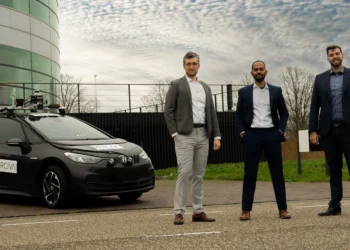
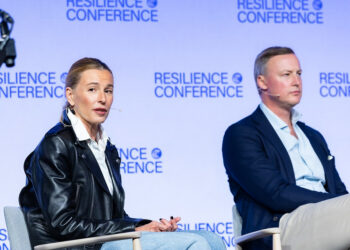
 “I’m seeing the beginning of an ecosystem, but it’s a tanker that is taking a while to turn,” said Eliot Pence, the founder and CEO of Dominion (pictured, right), in an interview with Resilience Media. “Investors have never invested because the country hadn’t even purchased much in the way of defence.”
The startup’s early efforts are already attracting some very interesting backers, mostly Canadian with a key exception. Georgian is leading the round, with participation from British Columbia Investment Management Corporation and they are joined by one US firm, Bessemer Venture Partners — already big name in technology VC, and an increasingly big name in defence tech investing. The funding is being made an at undisclosed valuation and brings the total raised by Dominion $18.8 million, including earlier seed/pre-seed investment.
The interest in what Dominion is doing and the appetite to back them partly comes from what the company is building.
Its flagship product is called Auranet and it aims to be a groundbreaking, better system of “COTS” (commercial off-the-shelf) sensors to monitor and communicate in arctic conditions, with a larger platform around that which incorporates AI and other data analytics. It covers land, sea, air and space domains and aims to provide data and information from remote areas that have previously never had persistent security and communications — a critical gap, Pence points out.
The platform is not designed as command and control as such, but the larger opportunity is to build something that could control a potentially much larger set of devices, including those used for reconnaissance and others used for defence (which may or may not get built by Dominion itself). Auranet is already being deployed in the Yukon region, with discussions in the works to expand that both in Canada and with NATO allies (consider those with Nordic footprints for a start). The interest might also be partly down to who is doing the building.
Dominion currently has 15 employees, all have a connection to Canada, and in theory most are veterans of one sort or another. One-third are veterans of the armed forces, Pence said, and others have come from the likes of Amazon, Google and Anduril, giving a key triangulation of experience to the small team. “You can’t run this without folks who have been in the hot seat,” said Pence.
It is also currently hiring. “It turns out Canadians are fine working for a defence company,” he said, but more than that, he added, “They want to work for an ambitious company.”
Pence himself has very relevant experience, too, as an early employee at Anduril, currently the most highly valued defence startup in the world, who saw the company forming and growing from the ground up. His last job there was running the neo-prime’s whole international business.
It was that exposure to the wider market that got Pence on the radar of the Canadian government.
Soon after the last US Presidential election (when Trump was re-elected) Pence was still at Anduril and based out of California when he was summoned to the Candian embassy in Washington. Could he, they asked, sketch out what he thought Canada should be doing with their own defence strategy? The question was prompted most likely by Trump’s talk of Canadian “statehood”, Greenland and the rest and was more a thought exercise at first.
Pence ended up producing a long written report read closely by officials there and in Ottawa. Out of that, an entrepreneurial light bulb went off. Why write about what Canada should and could do, he thought, when I could go and try to build that myself?
And thus Dominion was born.
The company’s focus today is software and sensors. No plans to build costly kinetics at this point, although ultimately Pence believes (and seems to hope) that such products will be pursued by an increasing number of entrepreneurs in the country.
For now, building better communications infrastructure and analytics is a big enough challenge for the young startup because of the extreme conditions.
As one example of that, he noted that airstrips are built on permafrost in the northern reaches of Canada. “That means they morph over time,” making sensors on those airstrips very challenging to keep calibrated in a consistent way. Another challenge is a simple lack of existing infrastructure. Pence said that mesh networks figure strong in Dominion’s architecture.
Investors are attracted in part here to the large opportunity outside of hardware in markets with (so far) very little activity, giving startups and their backers an opportunity to gain market share quickly without the costs that competition bring (those costs are a big issue in consumer tech and also in very overcrowded categories like drones).
“Defence is no longer just about hardware; it is about software, data, and speed,” said Margaret Wu, Lead Investor at Georgian, in a statement. “In our view, Dominion Dynamics represents the future of the Canadian ecosystem: deep tech, dual-use, and mission-critical. We are backing a team that is fundamentally reimagining how Canada and its allies protect their interests.”