Anduril and Kraken Technology Group have told Resilience Media about defence tech they have developed which the UK Government could choose to deploy to protect the UK’s subsea cables from Russian interference.
The moves come as several defence tech companies hone in on the opportunity and need to build a new generation of AI-powered submarines and other underwater vessels to meet the next generation of threats. Just earlier today, Helsing announced its acquisition of Blue Ocean to expand its own efforts in marine defence.
The defence tech capabilities were shared after the UK Parliament’s Joint Committee on the National Security Strategy called for “more muscular deterrence” measures against threats to the UK’s subsea cables due to raised tensions with Russia, in a report published on 19 September 2025.
The report, Subsea telecommunications cables: resilience and crisis preparedness, said there is “growing concern about malicious reconnaissance and sabotage, including a recent incident involving the Russian spy ship Yantar loitering over UK subsea infrastructure.”
Matt Western, Chair of the Joint Committee on the National Security Strategy, said: “We need stronger physical protections, better options to impose genuine costs for malicious activity, and more comprehensive recovery plans.
“It is conceivable that the UK’s national resilience will be tested in the coming years. We need to be ready.”
Defence tech firms are already testing and demonstrating systems that the UK Government may wish to deploy in the future to provide the capability to, as Western says, “impose genuine costs for malicious activity” on adversaries.
Anduril’s underwater Seabed Sentry and Kraken Technology Group’s unmanned surface vehicle (USV) the K3 SCOUT Medium are both capable of carrying out surveillance and strike missions.
Anduril’s Seabed Sentry can engage in anti-submarine warfare
Anduril’s Seabed Sentry could be deployed to “deter threats to vital underwater infrastructure”, the firm’s UK boss told Resilience Media.
Resilience Media previously covered the unveiling of the system in April 2025, which is a network of mobile, AI-enabled undersea sensors designed for long-term deployment.
These nodes aren’t passive or static. They’re built to move, adapt, and communicate. Operating at depths beyond 500 meters for months or even years, they provide real-time situational awareness in places where current systems go blind.
To reduce latency, each unit has onboard edge compute enabled by way of Anduril’s Lattice AI operating system. It can host 0.5 m³ of payload, and it links directly into autonomous kill chains, giving commanders eyes and ears where traditional platforms can’t go.
Seabed Sentry units have low frequency/very low Frequency (LF/VLF) acoustic communications (ACOMMS) relays, and sensors include passive/active acoustic, environmental, optical, conductivity, temperature, and depth (CTD).
In terms of specific defence missions, Anduril says Seabed Sentry can be deployed for anti-submarine warfare and anti-surface warfare.
Anduril UK General Manager Rich Drake told Resilience Media: “Our modern world depends on undersea cables that carry more than 95% of global communications and financial transactions, yet they remain highly vulnerable to hostile threats.
“Protecting them properly from our adversaries is vital to British resilience, sovereignty, and stability.
“Built in the UK and powered by our Lattice AI software platform, Seabed Sentry can be deployed from autonomous underwater vehicles to help monitor, safeguard, and deter threats to vital underwater infrastructure, ensuring the lifelines of our interconnected world remain secure.”
K3 SCOUT Medium can carry 600kg payload and travel 650NM
Kraken Technology Group has a “family” of USVs that it collectively calls K3 SCOUT. The company told Resilience Media that the USVs could be used as a “bulwark against the rising threat of grey zone warfare”.
The USVs include small and fast variants which are more suitable for missions such as ISR (intelligence, surveillance and reconnaissance) and interception, to larger models like the SCOUT MAX with a range of 2000NM and which can carry a 10,000 kg payload.
Kraken says its K3 SCOUT Medium has already completed testing and evaluation with the MOD and has demonstrated its capabilities at military exercises including Nato’s Task Force-X Baltic and the US Navy’s ANTX CT-25 (Advanced Naval Training Exercise Coastal Trident 2025).
Kraken told Resilience Media that the K3 SCOUT Medium is “fast, autonomous and modular with a length of 8.4m, a speed of up to 55kt, range of 650NM and a 600kg payload capacity.
“This model is priced from £250,000 per unit and Kraken will soon be able to scale to 2000 units of production per annum through industrial partners such as NVL.” (We write more about the NVL partnership here.)
Kraken Technology Group CEO and Founder Mal Crease told Resilience Media: “With geopolitical tensions growing, the UK must defend its subsea cables.
“The K3 SCOUT is modular, agile and versatile – as a sovereign company we want use of our innovative technology to be the bulwark against the rising threat of grey zone warfare.
“We have proven our systems in complex operational conditions, offering both speed and scalability. We stand ready to supply mission-ready capabilities to the UK and NATO partners to help deter hostile actors in our seas and around our critical national infrastructure.”
Stronger maritime security capabilities alone ‘not sufficient’ to protect cables
In its written evidence to the committee’s undersea cables inquiry, which led to the report being published, the European Subsea Cables Association (ESCA) said: “Strengthening maritime security capabilities alone is not a sufficient solution; instead, efforts should focus on bolstering the UK’s repair capabilities, ensuring that subsea cables can be swiftly restored in the event of damage.”
An ESCA spokesperson told Resilience Media: “The current focus on subsea cable infrastructure has already led to meaningful collaboration between industry, governments and defence.
“ESCA’s position is that it is important these efforts continue in order to find the right solutions to enhance cable protection.”
An MOD spokesperson said: “The Strategic Defence Review already addresses many of the issues in this report, by investing in new capabilities to help protect our offshore infrastructure, utilising the latest technology.
“This includes through the UK-led reaction system Nordic Warden, to track potential threats to undersea infrastructure, the high-tech RFA (Royal Fleet Auxiliary) Proteus and Atlantic Bastion – high tech sensors above and below the seas to track submarines.
“We are strengthening our Armed Forces and working with Allies to ensure the UK’s security and resilience 24/7.”
The MOD spokesperson also said that the UK’s “ocean surveillance ship, RFA Proteus, is equipped with world-leading technologies to perform undersea operations, protecting against malicious damage or accidental hazards.
They added that a £15.4 million government contract “is delivering a cutting-edge crewless submarine under Project Cetus. The vessel, XV EXCALIBUR will further advance the UK’s ability to protect our critical national infrastructure and monitor sub-sea activity.”
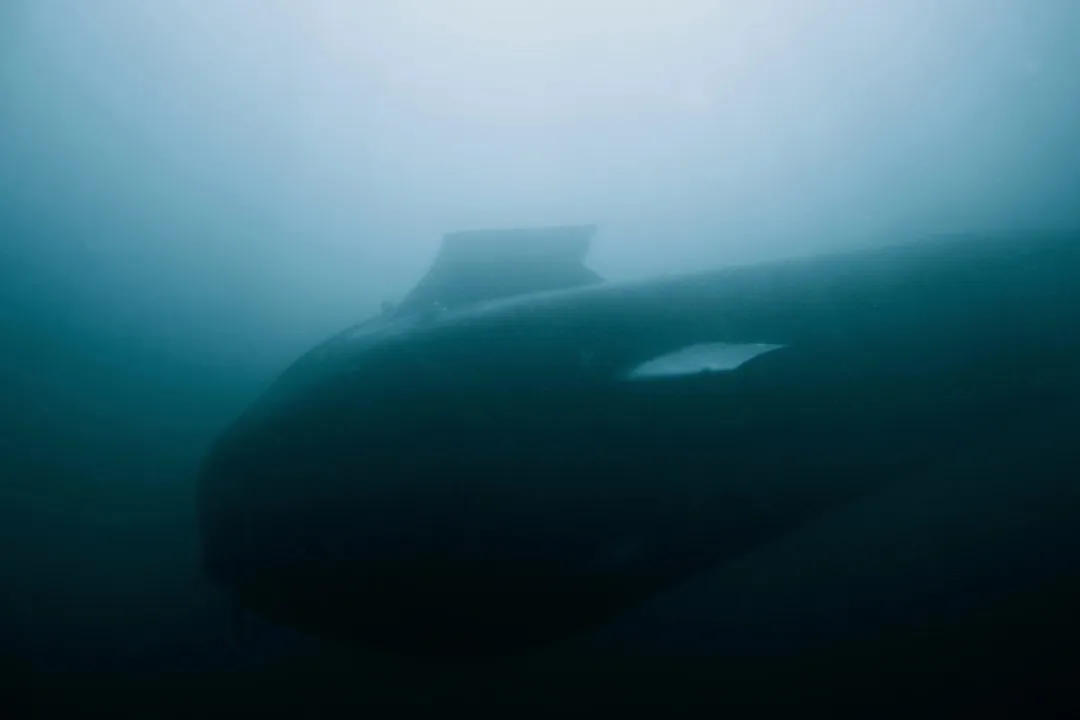
XV EXCALIBUR is the Royal Navy’s first uncrewed submarine. Its May 2025 announcement of the vessel, the navy said the “12m experimental vessel, displacing 19 tonnes and at two metres across, is the culmination of the three-year long Project Cetus, and the largest uncrewed underwater vessel trialled by the navy to date.”