
Belgium is rolling out its own secure messaging platform, as European states step up efforts to bring sensitive communications under domestic control.
The system, known as BEAM, is designed for civil servants and military personnel, with the aim of replacing the informal use of consumer apps such as WhatsApp for official business. Developed by Belgian Secure Communications (BSC), a federal organisation, the system is hosted within national infrastructure and offers end-to-end encryption, according to details published on the BEAM website and reporting from Belga, Belgium’s main news wire.
The system could eventually serve around 750,000 users across federal departments, defence, and other public bodies.
A push for sovereign tech
Belgium’s move sits within a wider European effort to reassert control over critical digital infrastructure. Governments across the bloc have grown wary of dependence on foreign technology providers, particularly for communications and data handling.
Germany, for example, recently set out plans for a “sovereign digital stack,” mandating the use of open standards such as the Open Document Format (ODF) for documents in parts of the public sector. The idea is to keep core systems interoperable, and ensure governments can operate them without relying on external vendors such as Microsoft and Google.
Messaging has become a focal point. For years, public officials across Europe have relied on consumer apps, often outside formal IT oversight. While services such as WhatsApp and Signal offer end-to-end encryption, they give governments limited control over how groups are formed, how data is retained, and where infrastructure is operated — issues that have drawn scrutiny from regulators and policymakers.
BEAM represents an attempt to bring that activity back into systems designed and governed for state use.
Enter the Matrix
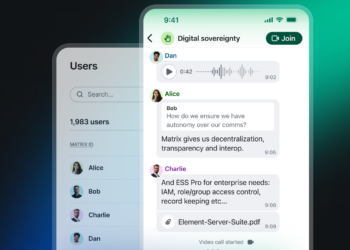
Under the hood, BEAM is built on the Matrix protocol, an open standard for secure, decentralised communication. Matrix allows different servers to communicate with one another, much like email.
The protocol has been gaining traction in government and defence settings, in part because it allows organisations to run their own infrastructure while still connecting to external partners.
Much of the software that implements Matrix is developed by Element, a UK-based company that provides both open-source components and commercial services on top. According to Element co-founder Matthew Hodgson, BEAM currently uses a fork of its open-source stack, including server and client components such as Element Web, Element Call, and Synapse, each of which are available under an open-source AGPL license, which requires organisations to publish any modifications to the code when it’s deployed as a network service.
While BSC has complied with the terms of the license by publishing its changes back to GitHub, Hodgson is urging the Belgian authorities to go further by backing the upstream project.
“We’re talking to them to encourage them to support us financially as the upstream project, whether that’s by using Element’s enterprise distribution, buying support, funding the maintenance and development of roadmap features, or joining The Matrix.org Foundation as a paid member,” he explained to Resilience Media.
The situation highlights a broader tension in open-source development: organizations can build sovereign systems on shared code, but the long-term sustainability of that code depends on continued investment. Hodgson pointed to some of its other public-sector deployments, including projects linked to NATO and the United Nations, where organisations maintain commercial relationships with vendors alongside their use of open-source software.
“We’re hopeful that they will follow the lead of folks like NATO and the UN who understand that investing in the health of the underlying open source project is rather important for the success of their sovereignty initiatives,” he said.
Open source, with conditions
Hodgson says demand from governments has picked up sharply over the past year, as concerns around control and technological resilience have grown. Element is now working with more than 30 governments globally, including multiple deployments across Europe.
“The difference we’ve really noticed over the last 12 months is the urgency from governments,” Hodgson said. “Digital sovereignty has moved from an ideological goal, to a sudden concrete need.”
Recent incidents have accelerated that shift. Hodgson pointed to the exposure of sensitive discussions on Signal in the US earlier this year – dubbed “Signalgate” – as a moment that forced governments to confront their reliance on consumer messaging apps. A subsequent outage affecting Signal, linked to infrastructure issues at Amazon Web Services (AWS), reinforced those concerns by highlighting the dependence of such services on external providers.
“Signalgate was a wake up call for governments that had previously decided to turn a blind eye to the use of consumer apps within governments,” Hodgson said. “That was compounded by the AWS outage that took Signal down with it.”
This “double whammy,” as Hodgson put it, underscored the risks associated with relying on consumer-grade apps.
“Signal is a centralised service, which runs on US big tech,” he said.
But he also points to a set of challenges that go beyond technology. Political and organisational factors often slow projects down, from budget allocation to the influence of large incumbent vendors already embedded in the public sector.
Hodgson said these issues tend to fall into three areas: the continued influence of large technology providers already embedded across government systems; efforts to back domestic suppliers that can still result in new forms of vendor dependence; and a tendency for public bodies to rely on open-source software without contributing to its long-term development.
He added that funding remains a persistent sticking point, particularly when governments are trying to replace tools that were never formally budgeted for in the first place.
“The only reason a government doesn’t have a government-wide sovereign messaging app is that they can’t figure out how to create the budget, or where to place it for a government-wide system,” Hodgson said.
In BEAM’s case, Element is pushing Belgian authorities to formalise its support, whether through enterprise subscriptions, funding development work, or participating in governance tied to Matrix.
Other European projects offer a glimpse of how that relationship can play out.
In Germany, ZenDiS — the organisation behind the OpenDesk office suite — has adopted a model that involves paying vendors behind the open-source components it uses, including Matrix-based communications software provided by Element. The same goes for defence-related projects such as BwMessenger and BundesMessenger, not to mention Sweden’s SAFOS initiative.
All in all, this raises a key question: how to balance autonomy, with the need to sustain the underlying technology.
‘Interoperability as the norm’
Despite those tensions, interoperability remains a central promise of Matrix-based systems. Governments can run their own deployments while still connecting to others, creating what Hodgson describes as a network of networks.
Examples already exist. France’s Tchap platform connects multiple ministries, while Germany’s healthcare system has adopted a Matrix-based standard to enable secure communication across tens of thousands of organisations.
Across Europe, similar systems are joining up, forming what could become a shared communications layer for public-sector organisations — one built on open standards but operated by individual states.
Whether BEAM becomes part of that network, or remains a more self-contained national system, will depend on how far governments are willing to align their systems and support the infrastructure they depend on.
“We built Matrix to be the missing communication layer of the Web, and we’re seeing similar patterns to email (emerge),” Hodgson said. “A massive public federation; lots of private federations too, but with the expectation that interoperability is the norm, not the exception.”