Wednesday 17 December, 2025
Resilience Media
  • About
  • News
  • Resilience Conference
  • Guest Posts
    • Author a Post
  • Subscribe
No Result
View All Result
  • About
  • News
  • Resilience Conference
  • Guest Posts
    • Author a Post
  • Subscribe
No Result
View All Result
Resilience Media
No Result
View All Result

Arondite and Babcock partner to move the British Royal Navy closer to a autonomous fleet

John BiggsbyJohn Biggs
December 11, 2025
in News, Startups
Share on Linkedin

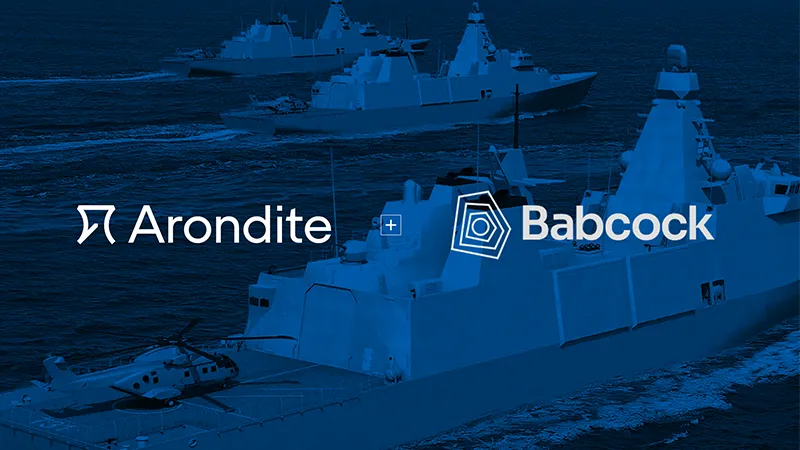
Arondite and Babcock have partnered to bring autonomy into the Royal Navy’s day to day operations. The two UK companies have agreed a strategic collaboration to co develop maritime autonomy systems for the UK and allied navies, with Arondite’s Cobalt operating system at the center.

You Might Also Like

CHAOS Industries joins U.S. Army G‑TEAD Marketplace

Quantum Systems teams up with Frontline to mass-produce Ukrainian combat drones in Germany

Skana wants to shore up coastal defence with amphibious vessel for shallow waters

The partnership sits inside Babcock’s new “ARMOR Force” concept, shown publicly after the First Sea Lord’s speech at the International Seapower Conference. ARMOR Force, short for Autonomous and Remote, Maritime Operational Response Force, is not a single platform. It is a networked mix of crewed ships and uncrewed systems, surface and subsurface, designed to work together as one force package rather than as separate projects.

“The future of maritime power will be defined by an adaptable blend of crewed and uncrewed systems, leveraging disaggregated sensors and effectors,” said ‍Will Blyth, Arondite co-founder and CEO. “We have built Cobalt to tackle exactly this challenge. We are proud to combine our autonomy and mission orchestration capabilities with the world-leading integration, design and build expertise of Babcock, to rapidly deliver the Royal Navy’s vision of a Hybrid Navy.”


Arondite’s Cobalt platform will act as the autonomy and mission control layer for ARMOR Force. In practice that means Cobalt will sit above a fleet of mixed assets, connect their sensors and effectors, and give commanders a single view they can use from ship or shore.

“A key part of our mission is to allow the British Armed Forces to rapidly adopt new technologies. Cobalt has been designed from day one to be completely agnostic, with the ability to rapidly integrate and orchestrate any hardware or software,” said Blyth.

Cobalt is already in service with a number of Royal Navy and British Army units. It supports multi domain mission planning, autonomy orchestration, AI supported sensor fusion and decision support, and human machine teaming across hardware from many suppliers. For the Royal Navy, extending that into a formal “Hybrid Navy” concept gives a path to scale autonomous systems without tying the force to one vendor or one vehicle line.

The companies have been working on early design work since June 2025 and are already running live sea trials as part of the Royal Navy’s Atlantic Bastion demonstrator, alongside a global group of hardware partners.

Both firms frame speed as a central goal. They want to shorten the loop from idea to deployment for new autonomous capabilities, rather than waiting for long, monolithic programmes. That lines up with the Royal Navy’s own push to move faster on a Hybrid Navy and to treat autonomy as a tool for today’s fleet, not a distant future concept.

“The First Sea Lord and his leadership team are driving forward the Hybrid Navy, which is world-leading in terms of how it will harness autonomous and crewed systems to fundamentally change how we fight,” said Sir Nick Hine, Chief Executive of Babcock Marine. “The partnership we are creating with Arondite represents a bold step forward. We are combining advanced autonomy, modular systems, and digital innovation to create a fleet that is more agile, resilient, and ready for tomorrow’s challenges. What we are proposing will keep the Royal Navy at the forefront of global maritime security for decades to come.”

““Babcock are a fantastic partner and we’re incredibly proud of what we’re building together. We’re very different companies but we’re united in our sense of urgency. We’re already in the water, jointly testing capabilities together. ARMOR Force is really ambitious, working to some rapid timelines – it’s really breaking the mould on how maritime kit of this kind has traditionally been developed. But the Royal Navy and our allies need a Hybrid Navy and they need it fast, so we are proud to lead the way,” said Blythe.


Tags: AronditeBabcockthe British Navy
Previous Post

Auterion demonstrates a multi-manufacturer drone strike under real conditions

Next Post

‘This is a revolution’: Inside Ukraine’s plans to seed 7,000+ techies across its military

John Biggs

John Biggs

John Biggs is an entrepreneur, consultant, writer, and maker. He spent fifteen years as an editor for Gizmodo, CrunchGear, and TechCrunch and has a deep background in hardware startups, 3D printing, and blockchain. His work has also appeared in Men’s Health, Wired, and the New York Times. He has written nine books including the best book on blogging, Bloggers Boot Camp, and a book about the most expensive timepiece ever made, Marie Antoinette’s Watch. He lives in Brooklyn, New York. He runs the Keep Going podcast, a podcast about failure. His goal is to share how even the most confident and successful people had to face adversity.

Related News

CHAOS Industries joins U.S. Army G‑TEAD Marketplace

byJohn Biggs
December 16, 2025

CHAOS Industries says it has been added to the U.S. Army’s Global Tactical Edge Acquisition Directorate, or G-TEAD, Marketplace after...

Quantum Systems teams up with Frontline to mass-produce Ukrainian combat drones in Germany

byCarly Page
December 15, 2025

On the heels of raising €180 million earlier in December, German drone maker Quantum Systems has kicked off a new manufacturing operation...

The Alligator

Skana wants to shore up coastal defence with amphibious vessel for shallow waters

byPaul Sawers
December 15, 2025

In a year when the Baltic has turned into a geopolitical house of mirrors, with Russian “shadow fleet” tankers slipping through...

Auterion demonstrates a multi-manufacturer drone strike under real conditions

byJohn Biggs
December 11, 2025

Munich-based Auterion ran what it calls the world’s first multi-manufacturer swarm strike with both FPV munitions and fixed-wing drones working as a...

Helsing teams up with Kongsberg to boost its space strategy

byIngrid Lunden
December 10, 2025

Defence startups that want to increase their chances of winning major government tenders are teaming up with primes. Today, Helsing...

No Anduril is an island: US defence unicorn teams with GKN Aerospace on the Isle of Wight

byIngrid Lunden
December 10, 2025

Anduril — the defence startup valued at over $30 billion earlier this year — has made a big push to position itself not...

Nu Quantum lands record $60M to build UK’s first scalable quantum-networking platform

byCarly Page
December 10, 2025

Cambridge-based Nu Quantum — which develops photonic technology used in quantum computing architectures — has secured a landmark $60 million in Series...

Photo by Maksim Shutov on Unsplash

Lithuania declares state of emergency, calls balloon and drone incursions ‘hybrid attack’

byJulia Gifford
December 9, 2025

The Lithuanian government declared a national state of emergency on Tuesday in response to a sharp increase in balloon and...

Load More
Next Post
Photo by Žilvinas Ka on Unsplash

'This is a revolution': Inside Ukraine’s plans to seed 7,000+ techies across its military

The evolution of state sovereignty and national security in the digital age

Most viewed

UK launches undersea surveillance programme to counter growing Russian threat

Helsing teams up with Kongsberg to boost its space strategy

Quantum Systems closes a €180 million Series C extension, hits a €3 billion valuation

We Are Already Living in a World at War—It’s Time to Act Like It

Can the UK counter Russian laser threats?

Inside the drone revolution: How war has changed and what that means for modern armies

Resilience Media is an independent publication covering the future of defence, security, and resilience. Our reporting focuses on emerging technologies, strategic threats, and the growing role of startups and investors in the defence of democracy.

  • About
  • News
  • Resilence Conference
  • Guest Posts
  • Subscribe
  • Privacy Policy
  • Terms & Conditions

© 2025 Resilience Media

No Result
View All Result
  • About
  • News
  • Resilence Conference
  • Guest Posts
  • Subscribe
  • Privacy Policy
  • Terms & Conditions

© 2025 Resilience Media

This website uses cookies. By continuing to use this website you are giving consent to cookies being used. Visit our Privacy and Cookie Policy.