On February 18-19 in Kyiv, Ukraine’s Brave1 organised the second annual Defence Tech Innovations Forum, bringing together over the course of the two-day event, 3,000 investors, researchers, customers, and startups.
As the forum was starting in the heart of Kyiv, hundreds of people queued up to pass through tight security checks. In the queues, the foreigners who had arrived the previous day looked enthusiastic but tired. A dozen Iranian Shahed-136 drones had targeted Kyiv the night before, greeted by the crackling of anti-air guns. To the residents, this is just the background noise to most evenings. But for those people spending their first night in Kyiv since the war started, most found it hard to sleep through their first air-raid.
Brave1 Defence Tech Innovation Forum 2025 brought to Kyiv people who in the past were reluctant to visit Ukraine. “At a similar event last autumn, I only met the most daring Europeans”, recalled a Ukrainian defence tech startup manager, “now my pockets are full of international business cards with ‘M&A’ on them.”
When another air raid started during the event, you could tell the room was full of foreigners; their phones all screeched with notifications urging them to go to the shelters. Ukrainians have long since disabled such distractions.
The huge conference hall was packed, all the seats were taken and aisles were also filled with people standing. Nataliia Kushnerska, CEO of Brave1, opened the forum by acknowledging the size of the crowd, explaining that they felt they could not refuse entry to the eager applicants, some of whom had travelled from as far as New Zealand.
Mykhailo Fedorov, the Ukrainian Minister of Digital Transformation, and the spearhead of defence tech in the government, took the stage next and was also impressed by the full house. “It appears similar to the Munich Security Conference, but I hope the atmosphere will be more positive,” he joked, before presenting the government’s plans for the Ukrainian defence tech ecosystem.
Fedorov argued that deregulation of the defence industry is the only feasible way forward: “give Ukrainians freedom to develop, and they will do the impossible”.
In the past, taxes for drone and electronic warfare producers have been cut, tariffs for relevant components have been reduced, while the authorisations to import these parts have been abolished. Now these policies also extend into the less crowded niche of explosives, which used to be dominated by state enterprises.
The government incentives go beyond manufacturing. Gamification has been introduced to the distribution of drones to military units. Detachments receive points for hitting Russian forces and then can exchange these credits for drones. The verification of damage is made possible by the fact that most strikes produce multiple videos as evidence.
The proliferation of aerial offensive capabilities is not limited to the frontline. The first panel grappled with an issue that Ukrainians experience every night: fending off air raids. Fedorov’s deputy, Oleksandr Bornyakov, explained that the basic problem is that prior to the full-scale invasion “air defence was designed to fight huge things”.
Take, for instance, the Shahed – it is two-to-three times smaller than any Russian cruise missile. “The radars were not able to locate the drones because of their size, but also because of their low speed which is below the location system’s threshold,” recalled Denys Chumachenko, CTO of DeViro, a Ukrainian fixed-wing UAV producer.
The solution to this problem is a “shift to highly adaptive distributed intelligence-driven systems” which include not only the traditional radars but also UAVs “that would help identify these moving targets,” said Oleksandr Berezhny of Quantum Systems, a German ISR drones producer.
Getting things right is only half of the puzzle. Another piece is doing so at the pace of defence innovation in war time. Berezhny argued that the arms race took on such a velocity that the lifetime of any solution is roughly three months. “This speed of adaptation is what still keeps us alive,” he concluded.
“Adapt or perish” is the motto not only for innovation in the skies but also on the ground. “The objective, as established by the [Ukrainian] Commander-in-Chief, is to substitute frontline personnel by all technologies available,” his deputy, Colonel Andrii Lebedenko, clad in Ukrainian field uniform, reported during the next panel dealing with robotics and autonomy on the battlefield.
To achieve this objective, innovation in navigation, decision support, energy storage and survivability are essential. Ukraine is ready to cooperate in these areas with foreign developers by battle-testing their products and providing frontline feedback for improvement, Colonel Lebedenko said.
As for autonomy, there was not so much to discuss. “We do not have autonomous systems at the frontline just yet,” explained Serhii Kuprienko of Swarmer, a startup developing autonomous coordination between drones. At best, automated systems are deployed. There is a twofold reason for this shortcoming: insufficient investment in defence innovation and the fear of a fully autonomous kill chain.
At the same time, further developments in autonomy may be spurred by the ever-increasing electronic warfare capabilities, which could completely hinder communication between the humans at the control stations and their drones.
A Ukrainian company, Kvertus, is now developing an Electronic Warfare system called Atlas that would cover 1,300 kilometres of the frontline. Its deputy general director, Oleksii Cherniuk, explained that it will not just jam everything around the clock, but instead can spot an object operating at a certain frequency and then specifically jam that vehicle. “All the electronic intelligence and intelligent electronic warfare capabilities should be united in a single system, operated from a single coordination centre,” said Cherniuk.
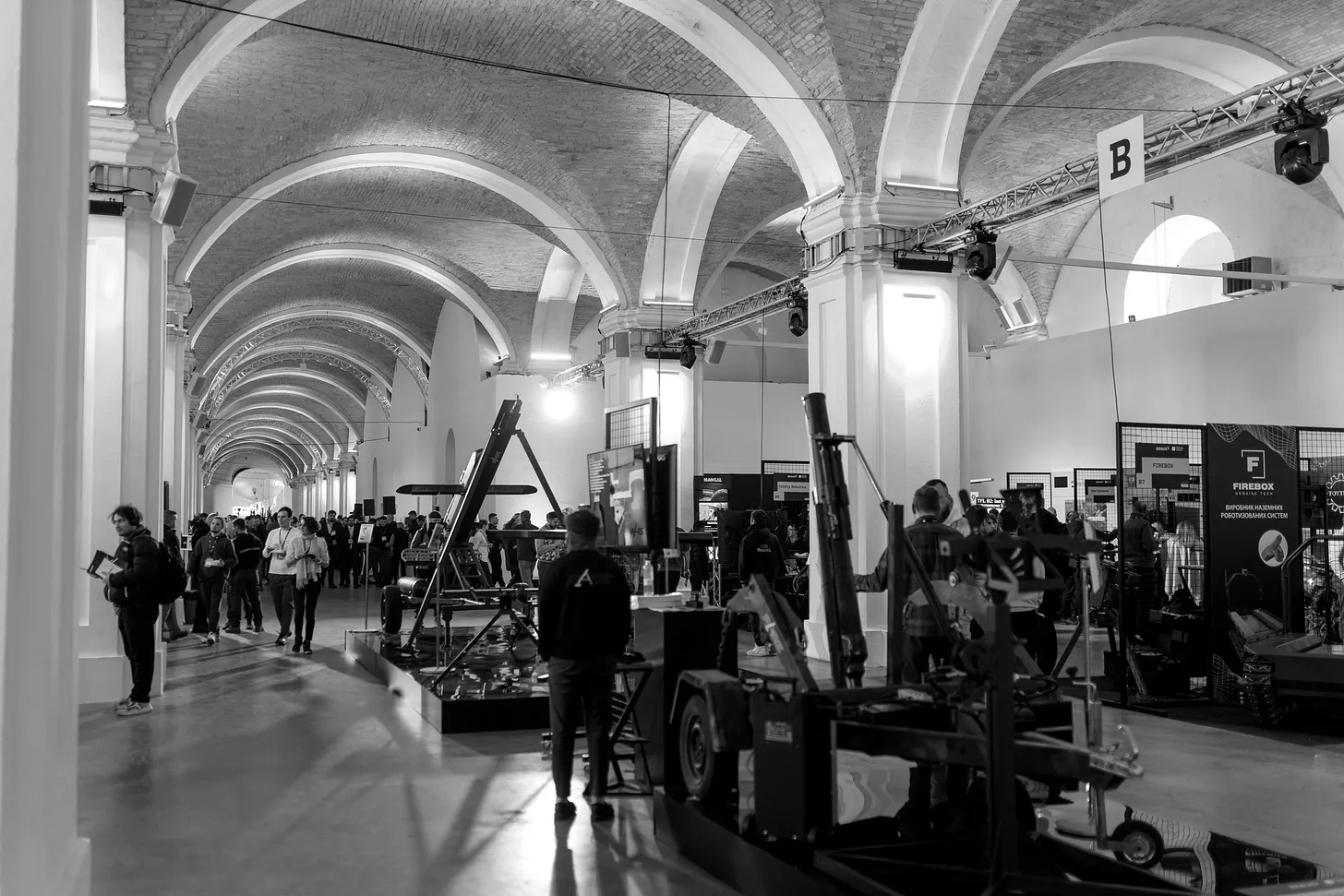
On the second day of the conference, developers, investors, and researchers met at a different location for a showcase of defence tech products. The exhibition area was so vast that one could find both a river drone startup and a digital platform which connects buyers and sellers. Circling around the upbeat crowds, I easily covered 20,000 steps.
Captain Oleksandr Yabchanka, a paediatrician and unmanned ground vehicles expert, argued on a panel that there were “so many developers, so many products, and so few of the latter in our unit,” and he called on the producers to be more proactive in reaching out to the military, as well as in sourcing funds from foreign investors.
But this is not the only issue in the producer-user relations, his co-panelists argued. “The biggest problem is that developers sometimes build capabilities and sell them to the state without understanding the problem this capability will be solving,” explained a representative of the 3rd Assault Brigade, responsible for adoption of UGVs. He called upon the developers to focus on medical evacuations and not just killing the enemy, even if the latter looks better on video. “Don’t you understand that the cart you made to move ammunition cannot transport a wounded fighter?”
The event was all about these real life insights, unique to Ukraine. One foreign investor explained to me that this event is so different from a typical arms fair in Europe because it is not about “men in suits” talking about things they never did. Another foreign manufacturer agreed, telling me that Brave1’s forum felt “very pragmatic.” An officer from the famous 3rd Assault Brigade went on to explain that innovation in wartime is similar to Maslow’s Hierarchy of Needs; exquisite deep-strike capabilities are not going to function without the basic ability to find and “stop the enemy.”
For now, the Russian army is being slowed, but not stopped just a few hundred kilometres away from Kyiv. As the conference drew to the end, the question loomed: will the interest from foreigners support Ukraine’s ability to survive without assistance? This remains to be seen. What was reassuring for all of us Ukrainians was to see so many people from around the world come to Kyiv, during a war, to learn from us and support us.
Oleksandr Ihnatenko is a journalist currently covering the Ukrainian defense tech ecosystem from his home city, Kyiv. His previous work appeared in AIN.ua, Svidomi and Coda Story. He holds a Master’s degree in International Relations from the Central European University, Vienna.