
Calls for a “drone wall” along NATO’s and the EU’s eastern border are on the rise again.
Requests in the past for EU funding for a defence system against drone incursions along the Baltic-Polish border with Russia have been rejected. But the recent, heightened frequency of Russian drones appearing in the airspace of European countries like Estonia, Latvia, Lithuania, Romania, Poland and Denmark have changed people’s tunes and are leading to new calls for walls – drone walls.
Pro-drone wall messaging is coming right from the top: Ursula von der Leyen, in her State of the European address last month, expressed strong support for the concept. EU commissioner for defence and space, Andrius Kubilius, formally launched the EU drone wall initiative at its first meeting on September 26. And then EU leaders repeated support for the drone wall in Copenhagen on October 1.
However, not everyone is convinced.
Despite overall support, some voices are urging caution.
Emmanuel Macron has expressed scepticism that a drone wall will effectively protect the 3,000 km EU border with Russia and Belarus.
And other European leaders have noted that a drone wall would not contribute to curbing other forms of ongoing hybrid warfare – cyber attacks, misinformation campaigns, and more.
Political scientist Christian Moelling has stated that “drones are only the fingers; if you want to win, you must target the head: command, logistics and production capacity.”
Adding to the confusion is a general lack of understanding about what, exactly, a drone wall would entail. For example, would it serve as a monitoring tool to simply jam the frequencies the drones are flying on, or if it would trigger interception activities? These all have been arguments that have been floated to avoid hasty decisions and hasty – and large – investments.
Those on the other side of the argument believe time is of the essence. The need for counter-unmanned aerial systems (C-UAS) – the more formal name for drone walls – is particularly urgent, supporters say, as there are no alternatives in place to combat drone incursions. Current counter-drone capabilities on Europe’s border with Russia rely on manual airspace patrolling and interception.
“Currently, the Baltic countries and Poland all have serious shortages regarding C-UAV capabilities – cheap and effective counter drone technologies are lacking. Therefore an intensive effort is ongoing to develop such systems based on Ukraine’s experience,” Guna Gavrilko, head of military public relations at the Ministry of Defence of Latvia, told Resilience Media.
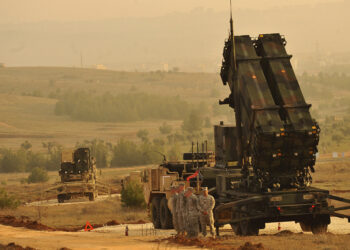
For the moment, some countries have put solutions in place short of drone walls. Gavrilko said that in Latvia, the air-defense units that are stationed at the border are equipped with RBS-70s – a shoulder-launched missile artillery system. Meanwhile, Lithuania has installed anti-drone nets around critical infrastructure.
Startups have been quick to respond to calls for a drone wall. Estonia’s DefSecIntel Solutions, which develops and manufactures mobile autonomous surveillance and detection systems, has announced a partnership with Latvia’s Origin Robotics to offer a technological solution for a drone wall.
Origin’s BLAZE interceptor drone meanwhile is integrated into Defsecintel Solutions’ C-UAS EIRSHIELD, to offer a full-service platform and technology to detect and destroy hostile, low-flying drones using automated systems.

Source: Origin Robotics
“Origin Robotics have a specific interceptor drone which can fly up to 3km in altitude and 15km in range. Because of the range we considered them as a very good fit for the drone wall and counter-UAS solution, because it’s possible to detect drones up to 10 kilometers, and then inside that range is very efficient to take down the drones. That way you can send out an interceptor drone quite early, so you don’t have to wait until they are closer to do the defended line that you are protecting,” said Jaanus Tamm, CEO of DefSecIntel, on the recently announced partnership.
Both of the companies’ products have been deployed and tested in Ukraine with successful outcomes, and they say they are ready to supply Baltic and other European countries.
Other defence innovators have also been active in developing C-UAS capabilities.
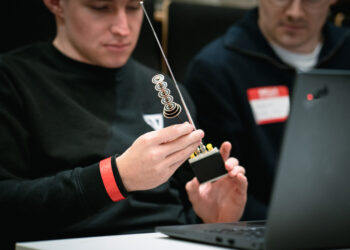
Belss demonstrated their Eraser model i8 drone interceptor system at a counter-drone demonstration in the Selija military range in Latvia on October 3, 2025, alongside Origin Robotics’ BLAZE and Defsecintel Solutions’ C-UAS EIRSHEILD.
Origin Robotics was one of three companies to receive R&D grants from the Ministry of Defence of Latvia – the other two being Frankenburg Technologies and LMT.

Source: Ministry of Defence of Latvia
DefSecIntel was among the companies within the technological consortium of Baltic innovators calling for the drone wall. “It doesn’t matter to us what it’s called or who gets the credit for it,” DefSecIntel representative Getter Oper said. “What’s most important is the capability against hostile drones. And what we saw that was missing was a cost-effective solution against low-flying, cheap drones.”
The rollout of new drone wall-enabling tools will depend on funding, but also the speed of procurement. The EU drone wall initiative discussed in September last week still has a long road ahead of it. The concept will require European Council support, and then the layout of a technical roadmap, before any funding mechanisms can be considered.
Commissioner Andrius Kubilius has floated an estimated one-year lead time. However, even he expressed scepticism for such a short rollout. Meanwhile, the President of Lithuania, Gitanas Nausėda, predicted that the first phase of a European drone wall could be complete by the beginning of the EU’s next budget cycle, in 2028.
Going local
Startups are hoping for faster adoption, perhaps by way of Eastern border nations taking on procurement on their own.
“We have presented the technology to the Baltic states and other European Union members, they are considering what, when, and how to finance all of it, while at the same time having conversations with the European Commission,” Jaanus Tamm, CEO of Defsecintel Solutions, told Resilience Media. “Now, it’s up to governments to decide how fast they can move, and how and when they will start doing their procurement.”
But even on a national level, procurement for border defence could be further complicated by a division of responsibilities among nations’ ministries.
Defence spending is primarily managed by ministries of defence, but border control technically falls under ministries for the interior. Thus, sourcing comments from nations on the state of the drone wall has proven a veritable game of bureaucratic ping pong.
One can only imagine that this confusion can further be extended to procurement efforts. Now that border control topics are so intertwined with national defence, the geopolitical situation will inevitably need closer collaboration between these siloes.
A spokesperson at Latvia’s Ministry of the Interior commented that despite initial funding for the drone wall having been rejected, “we are constantly monitoring and pursuing various funding opportunities. This does not impact existing border security measures that are already being put in place.”
The spokesperson declined to comment on what those additional measures were. However, it is known that Latvia recently became the first Baltic country to implement the acoustic drone detection system, which had been successfully deployed in Ukraine.
However the Ministry of Defence of Latvia’s representative, Guna Gavrilko, was confident in stating that her ministry will have no trouble in securing the necessary technology: “Regardless of decisions in the European Union, Latvia nationally will continue to develop and invest in our drone industry, to develop high technology drone systems, just as we have done so far,” she said. “Regular drone capabilities’ tests allow us to see which industry technologies are compatible with the current battlefield needs, and thus we can immediately acquire these systems for our Armed Forces.”
Gaining the widespread support of the EU will likely be the largest hurdle, as it propels the EU into a topic that it has been avoiding since its inception – the concept of militarising the Union.
In order to gain the estimated €1 billion needed to fund a drone wall, all EU member states would have to express their support. That in itself will be a trial of European solidarity. Meanwhile, startups are on the sidelines, raring to go.