Wednesday 17 December, 2025
Resilience Media
  • About
  • News
  • Resilience Conference
  • Guest Posts
    • Author a Post
  • Subscribe
No Result
View All Result
  • About
  • News
  • Resilience Conference
  • Guest Posts
    • Author a Post
  • Subscribe
No Result
View All Result
Resilience Media
No Result
View All Result

Helsing turns to automaker Schaeffler to scale drones and harden Europe’s supply chains

John BiggsbyJohn Biggs
December 2, 2025
in News, Startups
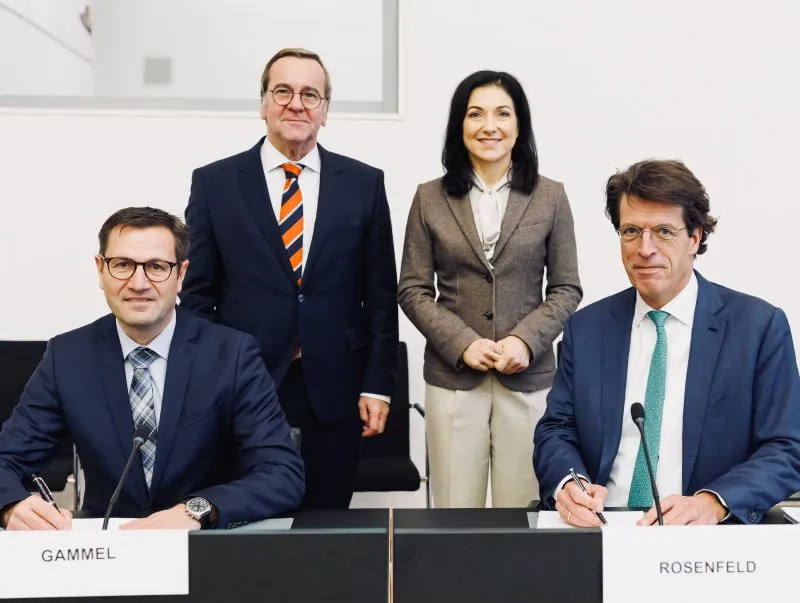
Schaeffler and Helsing CEOs Klaus Rosenfeld and Wolfgang Gammel

Schaeffler and Helsing CEOs Klaus Rosenfeld and Wolfgang Gammel

Share on Linkedin

Helsing and automotive supplier Schaeffler have signed a Memorandum of Understanding that pulls one of Germany’s big industrial names deeper into defence. Under the agreement, Schaeffler will take on manufacturing and procurement of key electronic components for Helsing’s drones and work with the company on securing access to critical semiconductors and raw materials.

You Might Also Like

CHAOS Industries joins U.S. Army G‑TEAD Marketplace

Quantum Systems teams up with Frontline to mass-produce Ukrainian combat drones in Germany

Skana wants to shore up coastal defence with amphibious vessel for shallow waters

The MoU was signed in Berlin by Schaeffler CEO Klaus Rosenfeld and Wolfgang Gammel, Managing Director of Helsing Germany, in front of Defence Minister Boris Pistorius and Economic Affairs Minister Katherina Reiche.

German press reports say Helsing plans to lift output to around 10,000 to 20,000 drones per year from 2026, with surge capacity to 100,000 units in a crisis. Production of the airframes and systems will remain with Helsing, while Schaeffler focuses on the electronics and the upstream supply chain for chips and materials. For Schaeffler, this is a concrete first step after months of signalling interest in a larger move into the defence sector.

“German car suppliers can scale like no other industry and quickly support the development of resilient supply chains,” said Helsing. “The cooperation with Schaeffler enables us to produce fast and reliable mass production.”

For Berlin, the optics are deliberate. Pistorius used the signing to make a broader point.

“We need stronger networking between the civil and defence industries. The MoU between Helsing and Schaeffler is an excellent example for many others,” he said.

Thanks for reading! Subscribe for free to receive new posts and support our work.


Helsing and Schaeffler

Helsing is a Munich-based defence technology company founded in 2021 by Torsten Reil, Gundbert Scherf, and Niklas Köhler. It presents itself as an AI-first defence firm that sells only to democratic governments. The company builds software that ingests data from sensors, drones, and legacy platforms and then feeds back real-time targeting and situational awareness to operators.

The firm has attracted large amounts of capital and political backing. Recent funding rounds led by General Catalyst, Saab, and Daniel Ek’s Prima Materia have pushed its valuation into double-digit billions of euros and made it one of Europe’s most closely watched defence startups. That growth has not come without friction. Bloomberg and others have reported concerns about pricing and reliability from some former staff and military experts, and at least one planned tie-up, with Rheinmetall, has collapsed.

Schaeffler is almost the opposite story. It is not a new name in tech circles but a classic German supplier with more than 75 years of history in bearings, powertrain components, and motion systems. The group employs over 80,000 people and has been a core partner to major automakers, winning repeated awards from customers like General Motors.

Like most large suppliers, Schaeffler has been hit by weak automotive demand, trade tensions, and pressure from Chinese competition. In response, it has started to reposition itself as a broader mobility company. That includes investments in electric drivetrains, robotics, and now defence. In June, CEO Klaus Rosenfeld said openly that the group was examining a sizeable move into defence, arguing that its skills in precision manufacturing, materials, and complex mechanical systems fit the needs of land, sea, and air platforms.

Seen from that angle, the Helsing deal is not a political gesture but part of a wider shift. Schaeffler wants to replace shrinking auto margins with business in sectors where scale manufacturing and reliability still matter and where Europe is trying to rebuild capacity.

By putting Schaeffler in charge of key electronic components and upstream procurement, Helsing is plugging into a company that already manages complex supply networks across continents. Schaeffler knows how to dual-source, how to lock in long-term contracts, and how to keep assembly lines running when shipping lanes and tariff schedules change. That is exactly what ministries mean when they talk about “resilient” supply chains, even if the term has become tired from overuse.
Tags: HelsingSchaeffler
Previous Post

Killing is the core function of ‘defense technology’

Next Post

Is Taiwan’s power grid at a break point?

John Biggs

John Biggs

John Biggs is an entrepreneur, consultant, writer, and maker. He spent fifteen years as an editor for Gizmodo, CrunchGear, and TechCrunch and has a deep background in hardware startups, 3D printing, and blockchain. His work has also appeared in Men’s Health, Wired, and the New York Times. He has written nine books including the best book on blogging, Bloggers Boot Camp, and a book about the most expensive timepiece ever made, Marie Antoinette’s Watch. He lives in Brooklyn, New York. He runs the Keep Going podcast, a podcast about failure. His goal is to share how even the most confident and successful people had to face adversity.

Related News

CHAOS Industries joins U.S. Army G‑TEAD Marketplace

byJohn Biggs
December 16, 2025

CHAOS Industries says it has been added to the U.S. Army’s Global Tactical Edge Acquisition Directorate, or G-TEAD, Marketplace after...

Quantum Systems teams up with Frontline to mass-produce Ukrainian combat drones in Germany

byCarly Page
December 15, 2025

On the heels of raising €180 million earlier in December, German drone maker Quantum Systems has kicked off a new manufacturing operation...

The Alligator

Skana wants to shore up coastal defence with amphibious vessel for shallow waters

byPaul Sawers
December 15, 2025

In a year when the Baltic has turned into a geopolitical house of mirrors, with Russian “shadow fleet” tankers slipping through...

Arondite and Babcock partner to move the British Royal Navy closer to a autonomous fleet

byJohn Biggs
December 11, 2025

Arondite and Babcock have partnered to bring autonomy into the Royal Navy’s day to day operations. The two UK companies have agreed a...

Auterion demonstrates a multi-manufacturer drone strike under real conditions

byJohn Biggs
December 11, 2025

Munich-based Auterion ran what it calls the world’s first multi-manufacturer swarm strike with both FPV munitions and fixed-wing drones working as a...

Helsing teams up with Kongsberg to boost its space strategy

byIngrid Lunden
December 10, 2025

Defence startups that want to increase their chances of winning major government tenders are teaming up with primes. Today, Helsing...

No Anduril is an island: US defence unicorn teams with GKN Aerospace on the Isle of Wight

byIngrid Lunden
December 10, 2025

Anduril — the defence startup valued at over $30 billion earlier this year — has made a big push to position itself not...

Nu Quantum lands record $60M to build UK’s first scalable quantum-networking platform

byCarly Page
December 10, 2025

Cambridge-based Nu Quantum — which develops photonic technology used in quantum computing architectures — has secured a landmark $60 million in Series...

Load More
Next Post
Photo by Timo Volz on Unsplash

Is Taiwan's power grid at a break point?

Stark buys a startup to boost its manufacturing muscle

Most viewed

UK launches undersea surveillance programme to counter growing Russian threat

Helsing teams up with Kongsberg to boost its space strategy

Quantum Systems closes a €180 million Series C extension, hits a €3 billion valuation

We Are Already Living in a World at War—It’s Time to Act Like It

Can the UK counter Russian laser threats?

Inside the drone revolution: How war has changed and what that means for modern armies

Resilience Media is an independent publication covering the future of defence, security, and resilience. Our reporting focuses on emerging technologies, strategic threats, and the growing role of startups and investors in the defence of democracy.

  • About
  • News
  • Resilence Conference
  • Guest Posts
  • Subscribe
  • Privacy Policy
  • Terms & Conditions

© 2025 Resilience Media

No Result
View All Result
  • About
  • News
  • Resilence Conference
  • Guest Posts
  • Subscribe
  • Privacy Policy
  • Terms & Conditions

© 2025 Resilience Media

This website uses cookies. By continuing to use this website you are giving consent to cookies being used. Visit our Privacy and Cookie Policy.