Sunday 16 August, 2026
[email protected]
Resilience Media
  • News
    • Events
    • Interview
    • Startups
    • Venture
    • Weekly Digest
  • Resilience Conference
    • Resilience Conference London — Oct 2026
    • Resilience Conference Copenhagen — May 2026 (PAST)
    • Resilience Conference Warsaw — Apr 2026 (PAST)
  • Launch
  • About
  • Guest Posts
    • Author a Post
  • Subscribe
No Result
View All Result
  • News
    • Events
    • Interview
    • Startups
    • Venture
    • Weekly Digest
  • Resilience Conference
    • Resilience Conference London — Oct 2026
    • Resilience Conference Copenhagen — May 2026 (PAST)
    • Resilience Conference Warsaw — Apr 2026 (PAST)
  • Launch
  • About
  • Guest Posts
    • Author a Post
  • Subscribe
No Result
View All Result
Resilience Media
No Result
View All Result

We Are Already Living in a World at War—It’s Time to Act Like It

A guest post by Lt Colonel Timothy D. Otten on why the United States Defense Innovation Unit (DIU) is partnering with Resilience Media on 'The Future of Defence Tech Manufacturing & Innovation'

Resilience MediabyResilience Media
January 14, 2025
in Guest Posts, News
Photo by Christopher Burns on Unsplash

Photo by Christopher Burns on Unsplash

Share on Linkedin

Approximately 70 nations participated in the Second World War. Today, we are facing over 110 armed conflicts around the world, involving more than 60 countries either directly or indirectly. We are undeniably living in a world at war, and the trajectory is alarming. If our nations enter a large-scale armed conflict, it will require not only a wartime economy but also a determined and innovative mindset—one that we must adopt immediately to effectively deter such conflicts. The Post-Cold War Era has ended; we must adapt now.

You Might Also Like

Fibre-optic drones: flying in the face of reason

Australia puts speed ahead of perfection in new defence technology strategy

Chinese tech in Royal Navy drones exposes UK defence supply chain dilemma

Winning wars fundamentally relies on resource command: the most money, the most personnel, and the most equipment. Money and personnel are not infinite resources within a state; both are essential for acquiring additional resources. This reality underscores the critical importance of innovation.

When we speak of innovation, we are referring to the rapid procurement of cutting-edge technologies already being employed in conflicts around the globe, including artificial intelligence, autonomous uncrewed systems, cyber warfare capabilities, and the technologies needed to counter these new weapons of war. Equally, we are also talking about how we develop and manufacture these technologies.

During World War II, our nations boasted numerous and redundant manufacturing centres, with production times measured in hours and days. Today, however, we are left with single points of failure in production, vulnerable supply chains, and production times stretched to months, or even years. This is simply unacceptable for deterring conflict, let alone for achieving victory.

Moreover, the days when government-funded R&D outpaced that of the commercial sector are over. Across the NATO alliance, commercial research and development expenditures have soared past government expenditures. Traditional government acquisition cannot keep up with the speed and rapidly changing nature of modern conflict, which is why we must fully leverage the strengths of our commercial sectors.

By harnessing commercial technology and manufacturing to address defence challenges—not solely relying on expensive government R&D—we can unlock the expertise of our industries and increase the number of manufacturing centres ready to support defence needs swiftly. We still require the expertise and capabilities that our governments and militaries provide to develop high-end defence systems; however, our commercial sectors are essential for augmenting our defence industrial base.

Investors and the commercial industry must recognise the accelerating global threats, the market for developing and producing defence technology, and their civic responsibility to support the defence of our wonderful homelands. Our commercial industry is the cornerstone of our ability to deter conflict and secure victory in times of confrontation. The time for action is now.

Tickets to The Future of Defence Manufacturing & Innovation are limited and will be approved by Munich Security Conference. Apply here.


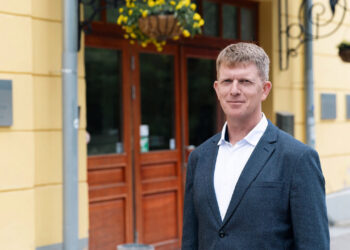
Lieutenant Colonel Timothy D. Otten, call sign “TO,” is the first U.S. Defense Innovation Unit Embedded Liaison to the UK Ministry of Defence, based in London. A native of Norfolk, Virginia, he graduated from the University of Arizona and was commissioned in the U.S. Marine Corps in 2005.

As an AV-8B Harrier pilot, he completed deployments to the Western Pacific and Afghanistan. He earned qualifications as a 4-ship division leader and weapons training officer, and managed aircraft operations. After transitioning to the Marine Corps Reserve in 2017, he supported U.S. Marine Corps Forces Europe and Africa in various roles until he joined U.S. Marine Corps Forces Pacific in 2022 as an Operations Officer. Later that year, he was selected to join the Defense Attaché System to support diplomatic missions throughout Europe until he assumed his current role in October 2024.

Tim is a graduate of the Marine Corps University’s Expeditionary Warfare School and Command and Staff College. He holds a Master of Arts in International Relations from the Fletcher School of Law and Diplomacy at Tufts University and is a designated European Regional Affairs Officer within the U.S. Marine Corps.
Tags: DIUTimothy D. Otten
Previous Post

Announcing a DIU & Resilience Media Event at Munich Security Conference Innovation Day

Next Post

Announcing ‘The Future of Defence Tech Manufacturing & Innovation’ event

Resilience Media

Resilience Media

Start Ups. Security. Defense.

Related News

Fibre-optic drones: flying in the face of reason

Fibre-optic drones: flying in the face of reason

byJohn Biggs
August 14, 2026

  The image is arresting: a once-pristine Ukrainian forest is now strung with plastic fibre-optic cable, gossamer lines spanning trees...

A helicopter flying next to a flag flying in the sky

Australia puts speed ahead of perfection in new defence technology strategy

byCarly Page
August 13, 2026

Australia has unveiled a 10-year plan to overhaul how it develops and buys military technology, with AI, autonomous systems and...

Image credit: Kraken

Chinese tech in Royal Navy drones exposes UK defence supply chain dilemma

byCarly Page
August 12, 2026

Britain’s push for cheaper, faster military technology comes with a catch: somewhere inside that shiny new British-built drone, there may...

grey concrete wall

Material issue: the sovereign supply chain Europe is trying to build

byPaul Sawers
August 11, 2026

Drones need carbon fibre, buildings need cement, and shells need TNT -- meet the startups helping Europe to make its...

UK-based OLIX raises $312 million Series B to build better AI infrastructure

UK-based OLIX raises $312 million Series B to build better AI infrastructure

byJohn Biggs
August 4, 2026

London-based OLIX has raised a $312 million Series B at a $3.3 billion valuation, one of the largest in the...

Ore Energy raises $43m to scale iron-air batteries for Europe’s AI boom

Ore Energy raises $43m to scale iron-air batteries for Europe’s AI boom

byCarly Page
August 4, 2026

Amsterdam-based Ore Energy has raised $43 million (£32 million) in Series A funding to commercialise its iron-air battery technology, betting...

Taiwan’s defence plans are up in the air

Taiwan’s defence plans are up in the air

byHarry Saunders
July 31, 2026

For an island nation with no regional ambitions and territory roughly the size of the Netherlands, Taiwan has an impressive...

Weekly Digest: Agon, Nuclear Turbines come out of stealth; Germany’s new growth stage fund; Amelia Gould joins Kraken; General Catalyst on stage at Resilience Conference

Weekly Digest: Agon, Nuclear Turbines come out of stealth; Germany’s new growth stage fund; Amelia Gould joins Kraken; General Catalyst on stage at Resilience Conference

byLeslie Hitchcock
July 30, 2026

Good afternoon from Resilience Media. Last week saw the devastating missile attack on a defence tech demo day in the Kyiv region...

Load More
Next Post
Announcing ‘The Future of Defence Tech Manufacturing & Innovation’ event

Announcing 'The Future of Defence Tech Manufacturing & Innovation' event

In conversation with Yaroslav Azhnyuk, founder of The Fourth Law

In conversation with Yaroslav Azhnyuk, founder of The Fourth Law

Top stories

Confirmed: Cambridge Aerospace raised $300M at a $3.4B valuation
Drones & UAS

Confirmed: Cambridge Aerospace raised $300M at a $3.4B valuation

August 10, 2026
Image credit: Kraken
News

Chinese tech in Royal Navy drones exposes UK defence supply chain dilemma

August 12, 2026
grey concrete wall
NATO

Material issue: the sovereign supply chain Europe is trying to build

August 11, 2026
A helicopter flying next to a flag flying in the sky
News

Australia puts speed ahead of perfection in new defence technology strategy

August 13, 2026

Resilience Media is an independent publication covering the future of defence, security, and resilience. Our reporting focuses on emerging technologies, strategic threats, and the growing role of startups and investors in the defence of democracy.

  • About
  • News
  • Resilence Conference
    • Resilience Conference Copenhagen 2026
    • Resilience Conference Warsaw 2026
    • Resilience Conference 2026
  • Guest Posts
  • Subscribe
  • Privacy Policy
  • Terms & Conditions
  • Mission Statement & Code of Practice
  • Press

© 2026 Resilience Media

No Result
View All Result
  • Home
  • About
  • Subscribe
  • Events
  • Guest Posts
  • Interview
  • News
  • Resilience Conference London 2026
  • Resilience Conference Copenhagen 2026
  • Resilience Conference Warsaw 2026

© 2026 Resilience Media

This website uses cookies. By continuing to use this website you are giving consent to cookies being used. Visit our Privacy and Cookie Policy.