Two surface vessel drone makers, Saronic and Castelion, have announced plans to build a hypersonic vehicle for maritime maneuvers. The product, a merging of Castelion’s Blackbeard with Saronic’s Medium Unmanned Surface Vessel (MUSV) Marauder, aims to create a low-cost, high-speed vessel that can move quickly in urgent naval warfare situations.
“Launching a Castelion hypersonic from a Marauder MUSV significantly changes the approach for any adversary calculating where and how the U.S. can strike,” said Dino Mavrookas, CEO of Saronic, in a release. “Deterrence is ultimately a function of capability, capacity, and credibility. Saronic and Castelion are working to increase all three by combining autonomous maritime and hypersonic strike capabilities that are more scalable, more affordable, and faster to field.”
Blackbeard is Castelion’s first missile system, designed for large-scale production and rapid deployment. The weapon uses vertically integrated propulsion and guidance technologies developed in-house, allowing the company to reduce both manufacturing complexity and cost. The company recently raised $49.9 million from the U.S. Navy to bring the product into production.
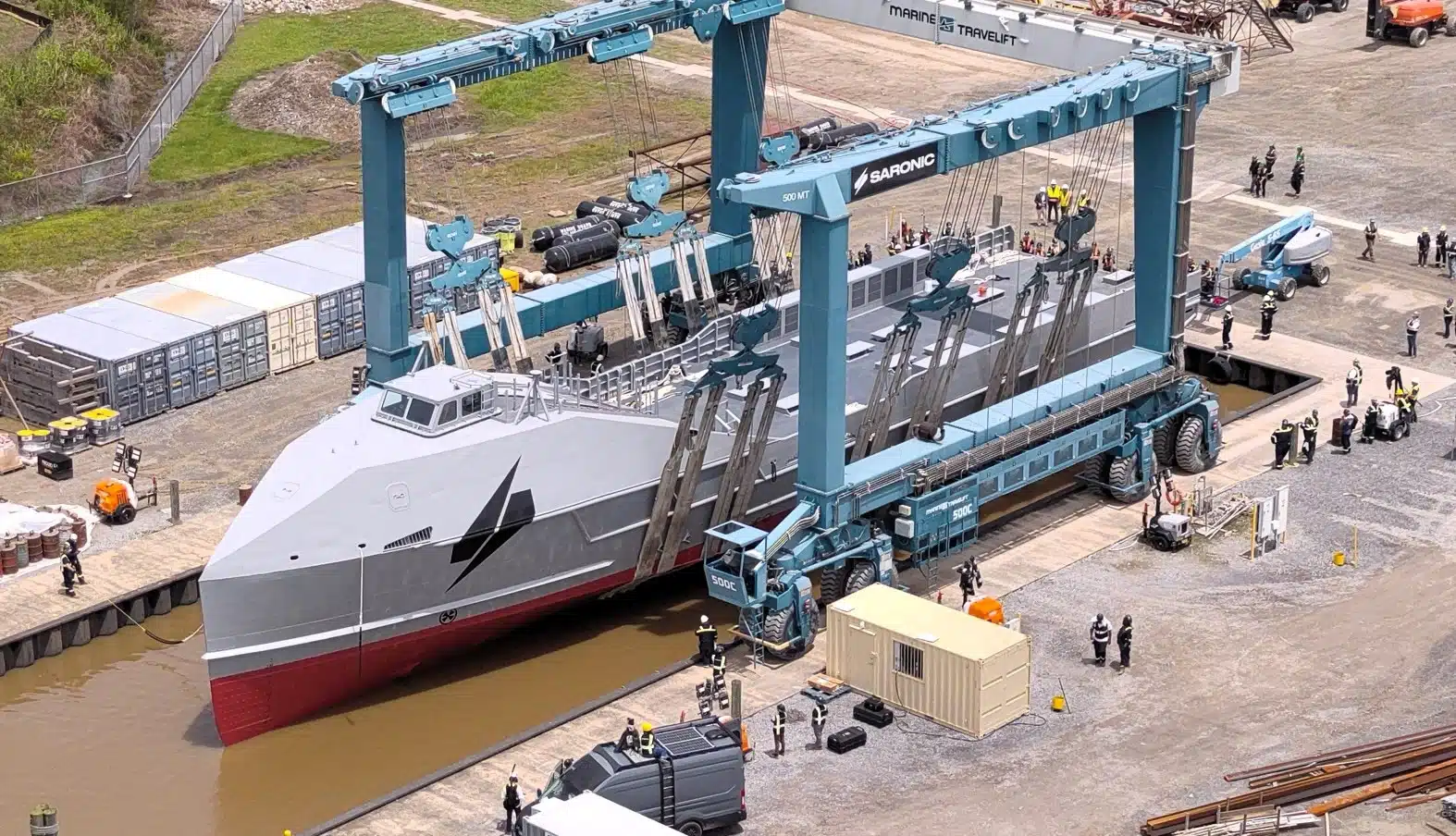
The Marauder is Saronic’s “medium” USV that is designed to carry electronics and payloads and to run uncrewed in harsh environments. The 180-foot ship recently entered on-water trials after progressing from initial design to launch in less than a year, an unusually rapid pace for a naval platform. Designed for long-range military and commercial missions, the Marauder can operate autonomously or under remote supervision, carry up to 150 metric tonnes of payload, travel up to 5,400 nautical miles, and reach speeds exceeding 25 knots. The vessel is also one of the contenders in the U.S. Navy’s emerging MUSV programme, which aims to field fleets of robotic ships capable of logistics, surveillance, electronic warfare, and other distributed maritime operations.
By connecting the two products — essentially a kinetic weapon with a delivery system — the company has the ability to “give commanders more ways to generate credible strike capacity without relying only on scarce, expensive crewed launch assets.”
The companies will launch their combined product in 2027.
Castelion reported that it was expanding production capacity to support the manufacture of several thousand Blackbeard missiles annually. Central to that effort is Project Ranger, a 1,000-acre hypersonic manufacturing campus in New Mexico supported by more than $250 million in private investment. The facility is intended to provide the scale required to produce hypersonic systems quickly enough to meet demand.
Saronic is pursuing a similar strategy at sea. The company is investing $300 million in an expansion of its Louisiana shipyard, adding 300,000 square feet of production space that is expected to be operational by the end of 2026. Once complete, the facility will be capable of producing up to 20 Marauder vessels each year. The expansion complements Saronic’s broader industrial strategy, which includes a 400,000-square-foot facility in Austin, Texas, designed to produce thousands of smaller autonomous surface vessels annually, as well as Port Alpha, a planned next-generation shipyard intended to support the revitalisation of the U.S. maritime industrial base.
Taken together, these investments illustrate a growing focus on production capacity as a strategic advantage. For the United States and its allies, the challenge is no longer simply developing advanced autonomous systems, but manufacturing them at the scale and speed required for modern conflict.