In 2016, PetCube founder Yaroslav Azhnyuk was sitting in Las Vegas, showing off what amounted to an amusement park for dogs.
Azhnyuk and his co-founder, Alex Neskin, built their company, PetCube, after Neskin’s black Chihuahua seemed bored and anxious when left home alone. Azhnyuk said that the best solution at the time was a collar that would zap the dog with electricity when it barked. They wanted to build something better.
In 2013, Petcube launched on Kickstarter with a $100,000 goal. The campaign reached that target in just six days and ultimately raised more than $250,000 from thousands of backers, making it the most successful pet product on Kickstarter at the time. After shipping its first products, Petcube raised a $1.1 million seed round in March 2015, co-led by AVentures Capital and Almaz Capital. The money helped the company move into retail stores across the US and Canada.
In early 2016, Petcube joined Y Combinator’s Winter batch and raised another $2.6 million. Its biggest round came in October 2017, when Petcube raised a $10 million Series A, again led by Almaz Capital and AVentures. By that point, the company had raised about $14 million in total, was selling in more than 5,000 retail locations across 18 countries, and had expanded beyond its original pet camera into the broader connected pet space. The company, born because of a chewy Chihuahua, was a global phenomenon.
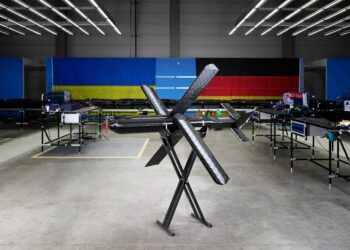
Fast forward to 2026, and Azhnyuk now runs The Fourth Law and Odd Systems, a pair of drone and camera companies that are building FPV systems for battle in Ukraine. The skills he amassed while wending his way through the global startup ecosystem, from Kickstarter to TechCrunch to Y Combinator, are now pointed directly at the biggest, hairiest, most audacious problem ever: how to face off against a marauding force attempting to destroy his homeland.
From launch plans to battle plans
Central Europe entered the 1990s with a plethora of problems. The Soviets had created a massive engineering class, a cadre of scientists and builders tasked with reverse engineering Western innovations while also building Russian tools and inventions. Out of this engineering culture came Zenit cameras, based on Leicas, Raketa watches, based on Swiss timepieces, and, lest we forget, Russia’s primary cultural export of the 1980s, Tetris.
The Soviets prized and rewarded citizens skilled in mathematics, physics, cryptography, and computer science almost as much as they rewarded loyalty to the Politburo.
In 1991, however, the Soviet Union fell and destroyed funding for science, more importantly, computer science. Personal computers had spread to Central Europe through the West, and clones abounded. Businesses booted up PCs like the ES PEVM, while students had access to the Agat (an Apple II clone) and Sinclair clones like the Hobbit and the Pentagon. Universities produced generations of highly trained programmers and engineers, many of whom worked in military research, aerospace, telecommunications, and scientific computing. Simultaneously, a hacker class rose out of the ashes of the Kombinat, with kids learning to crack games and early online resources simply because they couldn’t access the originals at home. It was during this time that East Germany, Ukraine, and Belarus became hacker hubs.
When the Soviet Union collapsed, that technical talent did not disappear. What disappeared was stable funding. Thousands of engineers suddenly found themselves with world-class skills but few legitimate jobs. Some built software companies, while others moved into security research, reverse engineering, and, in some cases, cybercrime. The same deep understanding of operating systems, networking, and encryption that made excellent engineers also made effective hackers. Of particular interest is the 1989 book The Cuckoo’s Egg by physicist Clifford Stoll. It encapsulated the collapse of the engineering class nicely by telling the story of Markus Hess, a German computer whiz who sold secrets to the KGB in the early days of the Internet simply because it was more lucrative than legitimate work.
By the late 1990s and early 2000s, Ukraine and Belarus had become recognised as major sources of software outsourcing talent. Companies around the world hired developers from Kyiv, Minsk, Lviv, and Kharkiv because they combined strong technical training with lower labour costs. At the same time, these countries also gained reputations as centres for malware development, exploit research, and sophisticated cyber operations, producing both respected security researchers and some of the world’s most capable cybercriminal groups.
The region has produced globally successful technology companies, including GitLab, Grammarly, Reface, MacPaw, PandaDoc, and EPAM Systems, alongside many of the engineers who now work at Google, Microsoft, Amazon, Meta, and OpenAI. It also remains one of the world’s richest sources of cybersecurity talent, with expertise shaped by decades of intense technical education and constant exposure to real-world cyber conflict. In short, Ukraine was the startup nation that swiftly pivoted to self-defence.
PetCube 2.0
As the Ukraine war rages on, we’re seeing some interesting moves by the country to capitalize on their deep bench of technical talent. The aforementioned startups are one thing. Tiberius Aerospace, for example, was co-founded by Andy Baynes, a former Apple, Google, and Nest exec who was building software and hardware in Ukraine when the war broke out, leading to a pivot to missile manufacturing. The same skills that served him selling iPods are now helping him sell kinetic weapons.
Further, President Zelenskyy brought startup founders into his cabinet, most notably Mykhailo Fedorov, the recently ousted Minister of Defence. A startup founder, Fedorov turned the Ukrainian military into an experiment-making machine, allowing the military to pivot quickly when tactics demanded it. The effect he had on the country can’t be overstated, as one local founder noted to Resilience.
“This is not really about Fedorov himself, but about what he came to symbolise: Ukraine’s ability to change the way the system works, even in the middle of a full-scale war.” said Roman Sulzhyk, founder of Resist.UA.
“Fedorov became the face of the hope that Ukraine could neutralise Russia on the battlefield, reform defence procurement, and drive many of the positive developments we’ve seen.”
Ukraine went from a bloodlands during World War II to a swathe of modernized farmland for the Soviets to a research facility that built technology first behind the Iron Curtain and then on top of it. The country is, quite simply, a startup nation, a place where technology could reach escape velocity into a global market and now reaches terminal velocity on the battlefield. Before the war, Ukraine had over 200,000 certified developers and led the region in outsourcing. Now, those some coders are fighting for their lives.
What’s most interesting about this fact is that this is the first time in recent memory that a country fought with its brains and less on its brawn. While the Ukrainian military is still strong, it is strengthened by the simple fact that no matter how many souls its enemy will throw at its borders, Ukraine, a startup nation at its core, will fight back with intelligence. If its neighbors, engineering powerhouses in their own right, can learn anything from this, it is that every startup needs to pivot, and Ukraine did so admirably and, we hope, successfully. And, most important, their mission is not to amuse a lonely dog but to save a country and a way of life — a “big, hairy, audacious goal” if there ever was one.