Going to film school might just get you running a drone software company. At least that’s what happened to Brian Streem, the founder of Vermeer.
The startup, which makes visual positioning systems that help drones and other uncrewed systems operate in GPS-denied environments, now has more than 40 customers, including agencies in the US government and major drone makers.
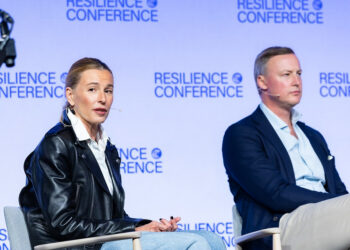
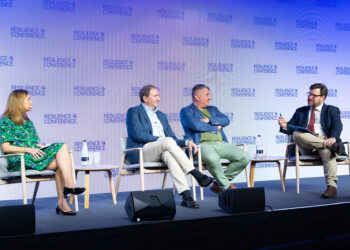
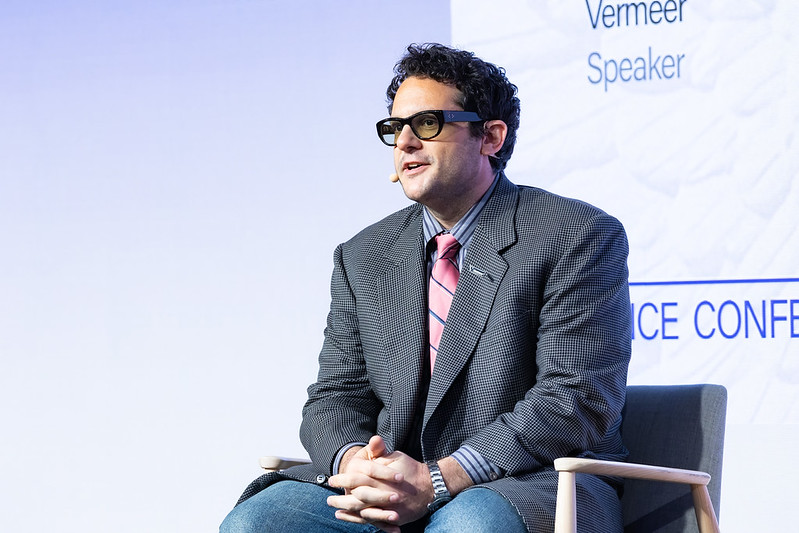
On stage at Resilience Conference earlier this month, Streem (pictured above) gave an at-times wry and funny, and ultimately very illuminating, recount of his unexpected move into defence tech.
Looking back at his company’s journey, Streem said it evolved from a project that had nothing to do with defence at the start.
The year was 2010, and Streem had graduated from New York University’s Tisch School of the Arts with a major in film production. At the same time that Streem was looking to make his way in the world of film, drones were also just starting to take off (so to speak).
Early efforts in drone technology were very much the domain of military research and development and DIY gadget hobbyists, yet 2010 was when that started to shift. It was in 2010 that Parrot in France launched the first ready-to-use model for the consumer market; and DJI (now the biggest drone maker in the world) came along a couple of years later with its first consumer model, the Phantom, in 2013. Alongside those hardware releases, commercial companies like Amazon were starting to play around with the idea of using drones for deliveries.
Amidst that push, Streem saw an opportunity to apply drones to cinematography. The idea was simple: take off-the-shelf drones and design camera technology that could be mounted on them for high-quality film shooting. Along with that, build some technology to improve how those drones could be navigated, using those cameras to bypass the inaccuracies of GPS.
Streem said that in 2014, he became one of the first certified drone operators in the US, and by 2015, he had founded Aerobo, a drone-as-a-service company. Aerobo had some momentum to it: it counted the Fast and Furious franchise and Steven Spielberg’s production company among its early customers, and Streem said it was, at the time, “the biggest drone cinematography service company in the world.”
That work started to give Streem some profile in the industry, and he testified before Congress on drone regulation. In 2018, he rebranded the company to Vermeer from Aerobo to nail home the visual technology aspect, and by 2019, Streem was pitching his company to investors for backing to grow the business.
It was a comment from one of those investors that changed the course of where Vermeer was heading.
“I think the US Air Force would be very interested in this,” the investor told him.
That might seem ironic now — drones were born in the military, after all — but as is the way with so much innovation, it’s often harder for large organisations to move it along than it is for smaller, fleet-of-foot startup.
Looking for more cutting-edge thinking, it just so happened that the US Air Force had set up an accelerator with Techstars in 2018, and so Streem applied and eventually got accepted to join its second cohort.
Drones may have had their origins in the military, but working with the military was very new territory for Streem, so he did what a lot of startup founders do when building products.
“I spoke to probably two thousand people at the Department of Defense” to understand their technological challenges, he recalled with his eyes widening.
He said he was surprised to learn that what his team had built as a side-feature to the image capture tech was exactly what the DoD lacked: “Everyone said: GPS-denied navigation.”
Things started to accelerate after that for Vermeer.
Within the first 18 months after the accelerator, Vermeer raised $11 million, largely from the US Air Force. Then, geopolitics and — significantly — the new tools of technological warfare overtook whatever business plans he may have sketched out for his startup.
“As it so happens, a big war breaks out in Europe, and one of the first things that disappears is GPS,” said Streem. Thus, an instant market demand materialised nearly overnight for Vermeer and the wider ecosystem of drones and drone technologies that are now being used and developed for the battlefield against Russia.
Vermeer’s core focus these days is continuing to build out its visual positioning systems (VPS), which is what is drawing in new business at the moment.
With navigation based on visual observation, VPS has become one of the key ways to orient devices like drones in GPS-denied environments, since VPS requires no signal transmission, making it immune to jamming and spoofing.
Vermeer says it now has more than forty customers that include tier-one drone companies and US government agencies, which integrate its technology into third-party hardware and software stacks. The company now employs 60 people, including 10 in Ukraine, which is possibly its biggest market outside of the US.
In October 2025, Vermeer announced that it had closed a €10 million Series A round, led by Draper Associates and joined by a Czech fund Rockaway Ventures. The company is raising money again now, Streem confirmed, but he declined to give any details on the timeline, the size of the round, or investors.
Drawing lessons for defence-tech companies, Streem said that combat-testing solutions is the biggest hurdle. These days, “the only place you could really test this stuff and really see if it works is Ukraine,” he said. This gives his company an inherent advantage as it’s already actively working there, but it makes it less easy to broker new relationships.
But it is not impossible: another really informative panel at the conference of active Ukrainian servicemen said that it welcomes more input from startups, but that it has to be a working relationship where startups listen to and incorporate feedback rather than expect units to use tech that may not be up to scratch.