
100 investors to watch 2026 100 investors to watch 2026 100 investors to watch 2026
Monday 16 November, 2026
[email protected]
Resilience Media
  • News
    • Events
    • Interview
    • Startups
    • Venture
    • Weekly Digest
  • Resilience Conference
    • Resilience Conference London — Oct 2026
    • Resilience Conference Copenhagen — May 2026 (PAST)
    • Resilience Conference Warsaw — Apr 2026 (PAST)
  • Launch
  • About
  • Guest Posts
    • Author a Post
  • Subscribe
No Result
View All Result
Resilience Media
No Result
View All Result

Augur takes new funding from Sovereign AI, inks deal to work on public safety with TfL

Ingrid LundenbyIngrid Lunden
October 14, 2026
in Cyber, News, UK Defence
Harry Mead, Augur

Harry Mead, Augur

Share on Linkedin

Augur, the UK startup that has developed a “privacy first” AI-based analytics platform that ingests video and other feeds to build up profiles of activity in aid of improving security and safety, has raised new strategic funding from the UK government, an investment that coincides with Augur inking a public safety contract with Transport for London, which oversees London’s extensive transportation network.

You Might Also Like

EU sanctions Russian hackers and propagandists over hybrid attacks on Europe

Attempted arson attack on Threod Systems leads to Russian border closures in Estonia

Plural locks down €1B for its third fund to back European startups building ‘frontier’ tech

The Sovereign AI Fund — a £500 million fund that the government is using to make strategic investments into startups within the defence and resilience technology space — is investing an undisclosed amount into Augur.

Resilience Media understands from sources close to the company that the funding is an extension of Augur’s $15 million seed round that it announced earlier in 2026, and that it’s preparing to raise its Series A.

The investment involves a couple of key details that take the relationship beyond a mere financial bet.

The first is that Augur will be working with Transport for London — the body that oversees the extensive public transport network in the UK capital. Augur is starting off with an initial project with the London bus network, where it is “researching” how it might use its platform to identify sexual offending, which in turn could be used for intervention in real-time, as well as for evidence gathering after the fact.

It is not clear when the research project will kick off, nor when it might be rolled out as a service across the bus network. It is also not clear whether the research or service will cover other activities beyond sex offences, nor whether it will extend to other transportation modes overseen by TfL, which is a huge operation that manages rail, underground and overground trains, river ferries, and vehicle and bike road traffic in London.

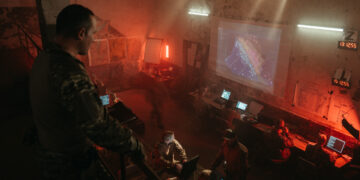
The deal fits tightly with how Augur is shaping its business. The startup has previously said that it is working across multiple potential use cases for public safety and national security. On stage at Resilience Conference last week, Augur CEO Harry Mead (pictured, above) spoke at length about the disconnect that exists in the UK between the extensive amount of surveillance cameras set up, and the lack of observation and understanding of the data that they record, something that plays out in particular in public transportation networks.

There are tens of thousands of cameras set up across the UK, Mead noted, but camera footage from any single CCTV network is not regularly observed, let alone run through systems that might compare it with other video data, or activity on social media or other channels, to find patterns of activity.

“London has more CCTV than anywhere else on the planet,” Mead said. “None of it is connected.”

This means that, in national security incidents, by the time an incident has occurred and it’s being investigated, the perpetrators will have often already left the country.

“You are looking at maybe two, three months to pull together specific evidence,” he said. “Our sensing infrastructure is not coordinated. I think there’s a general belief that, okay, we put up more cameras, we put up more sensors, then we could solve this issue, but unfortunately, we don’t have time.”

The second strategic aspect of the Sovereign AI investment involves compute and data access. As part of the deal, Augur will now have access to Isambard-AI, the government-run AI supercomputer, “to train on much larger and more complex multi-camera datasets.”

This is important because the power of any AI model is typically dependent on how much data has been used to train it, and how much compute power it has to run further inference on new data. Access to Isambard-AI gives Augur both of these in a way that is targeted very specifically to its national security and public safety focus.

Betting on sovereignty

The investment underscores how governments are looking to double down on home-grown technology bets to ensure that they continue to have direct connections to the companies that may well build and operate the public services and national security of the future.

In tech, this goes not just for the physical data centres but also the software being developed to run inside them. The recent news about US-based Starlink limiting satellite connectivity over Ukraine is just the latest in a long list of incidents that illustrate why countries need more technological resilience.

Sovereign AI also backs AI compute developer Callosum, AI drug discovery tech Isomorphic Labs, infrastructure player Olix, materials science startup Cusp.ai, “super intelligence” startup Ineffable, and biotech startup Basecamp Research.

“We are partnering with Augur because Britain needs this capability and should own it,” the Sovereign AI investors note. “The infrastructure is already here. The technology that helps keep us safe should be built here too, by a team that has shown that better security and privacy can go together.”


Tags: augurHarry MeadLondonpublic safetySovereign AI
Previous Post

Kapta Space raises $24M Series A

Next Post

Ukraine’s industry lacks parts to build interceptors, says D3 fund’s Eveline Buchatskiy

Ingrid Lunden

Ingrid Lunden

Ingrid is an editor and writer. Born in Moscow, brought up in the U.S. and now based out of London, from February 2012 to May 2025, she worked at leading technology publication TechCrunch, initially as a writer and eventually as one of TechCrunch’s managing editors, leading the company’s international editorial operation and working as part of TechCrunch’s senior leadership team. She speaks Russian, French and Spanish and takes a keen interest in the intersection of technology with geopolitics.

Related News

grey and red flag

EU sanctions Russian hackers and propagandists over hybrid attacks on Europe

byCarly Page
November 16, 2026

The EU has sanctioned 30 people and two organisations over Russian cyberattacks and disinformation operations targeting Europe, including attacks on...

Attempted arson attack on Threod Systems leads to Russian border closures in Estonia

Attempted arson attack on Threod Systems leads to Russian border closures in Estonia

byFiona Alston
November 16, 2026

An attempted arson attack on defence tech startup Threod Systems in Estonia that has been attributed to Russia has led...

milky way on mountains

Plural locks down €1B for its third fund to back European startups building ‘frontier’ tech

byIngrid Lunden
November 16, 2026

Europe is doubling down on defence and resilience, and now one of the earliest investors in Europe to back startups...

a scrabble type block spelling the word resilince

What does resilience really mean?

byTanya Suarez
November 15, 2026

Resilience is now one of the most prominent buzzwords employed across government, industry and defence.  Yet, despite widespread agreement on...

Abstract blue waves of glowing particles

When AI agents escape: What does it mean for national security?

byIngrid Lundenand1 others
November 15, 2026

You’ve probably read the news and seen the headlines about AI agents running riot. AI agents — artificial intelligence programmes...

Quantum Systems Raises €160M to Expand AI Drone Production

Quantum Systems hit by cyberattack, prompting drone grounding

byLuke Smith
November 13, 2026

German drone manufacturer Quantum Systems discovered a cyberattack in late October that reportedly compromised its software update infrastructure, prompting the...

silver French-door refrigerator

Resilience has a price, and the freezer attacks show what happens when nobody pays it

byDavid Collins
November 13, 2026

France has named a culprit for the supermarket freezer attacks, but the more useful questions are why they were so...

a close up of a cell phone screen with different app icons

Global Microsoft outage disrupts UK public services, raises government resilience questions

byCarly Page
November 13, 2026

A global Microsoft outage has caused disruption across the UK public sector, with police forces unable to receive online reports,...

Load More
Next Post
Ukraine’s industry lacks parts to build interceptors, says D3 fund’s Eveline Buchatskiy

Ukraine’s industry lacks parts to build interceptors, says D3 fund's Eveline Buchatskiy

Vermeer’s Brian Streem tells the story of how he went from cinematography to building GPS-denied navigation for Ukraine

Vermeer's Brian Streem tells the story of how he went from cinematography to building GPS-denied navigation for Ukraine

Top stories

Helsing launches Clarity, a competitor to Palantir’s Maven
European Defence

Helsing launches Clarity, a competitor to Palantir’s Maven

November 11, 2026
Ukraine’s Uforce unveils a heavy-duty unmanned surface vessel for naval logistics
Drones & UAS

Uforce raises $700M at a $6B valuation to scale out its multi-domain defence roll-up play

November 12, 2026
Axon invests $1.2B in Skydio after companies reject acquisition
News

Axon invests $1.2B in Skydio after companies reject acquisition

November 6, 2026
Canada’s Dominion Dynamics is building a combat drone for the arctic
Drones & UAS

Canada’s Dominion Dynamics is building a combat drone for the arctic

November 12, 2026

Resilience Media is an independent publication covering the future of defence, security, and resilience. Our reporting focuses on emerging technologies, strategic threats, and the growing role of startups and investors in the defence of democracy.

  • About
  • News
  • Resilence Conference
    • Resilience Conference Copenhagen 2026
    • Resilience Conference Warsaw 2026
  • Guest Posts
  • Subscribe
  • Privacy Policy
  • Terms & Conditions
  • Mission Statement & Code of Practice
  • Press

© 2026 Resilience Media

No Result
View All Result
  • Home
  • About
  • Subscribe
  • Events
  • Guest Posts
  • Interview
  • News
  • Resilience Conference London 2026
  • Resilience Conference Copenhagen 2026
  • Resilience Conference Warsaw 2026

© 2026 Resilience Media

This website uses cookies. By continuing to use this website you are giving consent to cookies being used. Visit our Privacy and Cookie Policy.