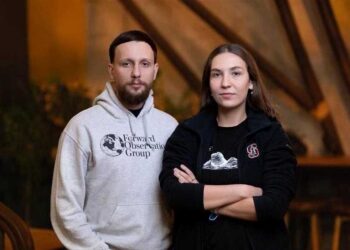


When Mykhailo Fedorov was ousted as the minister of defence in Ukraine in August 2026, it caused a national furore. Since the full-scale Russian invasion in 2022, he had become the face of how Ukraine was harnessing technology in its fight. Many wondered how his departure would impact that, and what he would do next.
Three months on, Ukraine is still deep in its war with Russia and still using tech to make inroads. And now, we are starting to see more details emerging of what the ex-defence minister’s next chapter is, too.
Fedorov has been setting up a new defence tech business – gathering investment and inking partnerships – and he appears to be hiring key talent to build out a wider team at a new venture called Mission Defense Partners, sometimes referred to as Mission Defense or MDP.
Understanding what Fedorov is building sheds light on how the country’s embrace of defence tech is evolving, and what its own next chapter might look like.
Some of Fedorov’s activities to date have been relatively public; some have been more under the radar. We understand that there may be more news on MDP in the coming weeks. Here is what we know so far:
Delaware
An entity named Mission Defense Partners was registered in Delaware in October 2026. That registration would have been made shortly after Fedorov visited the US and met with Alex Karp, the CEO and co-founder of Palantir, whom Fedorov described as an anchor investor in his (unnamed) new venture.
Fedorov has name-dropped two other investors in the US — Nate Fick, a director of equity investment strategy at Cerberus Capital Management; and Guy Filippelli, founder and managing partner of Squadra Ventures — but did not confirm whether they were involved, too.
Talent acquisition
Resilience Media also understands that Mission Defence Partners is recruiting.
According to four separate sources familiar with the appointment who spoke to Resilience Media on condition of anonymity, Artem Moroz has joined Mission Defense as its chief investment officer.
Moroz is one of the recent high-profile departures from Ukraine’s Brave1 defence-tech cluster. He spent nearly three years helping build Brave1’s investment department from scratch. During his tenure, the cluster launched Defense Tech Valley, held more than 30 investment days for hundreds of startups, established an investment portal, and organised roadshows in the United States and Europe. Brave1’s investor network grew to include more than 400 venture funds, family offices, and private investors. Moroz credited his team’s efforts with helping attract hundreds of millions of dollars into Ukrainian defence tech, according to an October report in Forbes Ukraine.
Moroz has publicly said he’s joining an organisation still in stealth. He and a current spokesperson for Fedorov declined to comment on Moroz’s involvement.
Enter Lazar
Another key part of the picture is who else is involved. We’d heard from sources months back that Lasar’s Group would be involved in Fedorov’s new venture. Then earlier in November, in an interview in Ukrainian publication DOU, Pavlo Yelizarov of Lasar’s Group confirmed that he was a co-founder of MDP, along with Fedorov and a third, unnamed partner.
“We want to combine our experience, human intellectual capital, and the latest technological developments that will influence the course of the war,” he said. “Mykhailo Fedorov’s managerial experience and his strategic vision are very important.”
Yelizarov noted that MDP would build its own technology, as well as invest in companies to put that tech within a wider ecosystem. Fedorov had hat-tipped Palantir’s Karp as an early backer; Yelizarov noted that Palantir would be involved as an investor.
Having Yelizarov involved is a key detail because it is not an understatement to describe Lasar’s Group (Yelizarov’s military call sign is “Lazar”) as emblematic of how tech has played into Ukraine’s war effort.
According to this lengthy profile of him and Lasar’s Group in Forbes Ukraine from a year ago, the group claims to be the first to figure out how to weaponise drones to target heavy artillery, how to use satellite receivers to direct them (note: these days it claims to be working on alternatives to that and that it is not being impacted by the Starlink throttling), and how to scale out that operation – including with pilots hundreds of kilometres from the frontlines.
Lasar’s Group also figured out how tech and an operation quickly built out of private enterprise could fit into the National Guard and the military’s mission to mobilise and fight, and that has worked: the group has regularly been at the top of Brave1’s “Army of Drones” bonus table, set up to gamify progress among brigades and to reward with procurement.
And another lesson to be learned: as with so many who have found themselves in the centre of Ukraine’s resistance, Yelizarov did not come from a strictly military background. At the time of the invasion, he was the lead producer of a popular political talk show and part-owner of the company that made it; and he’d also had periods in government and agribusiness. He joined Ukraine’s Air Force as a deputy commander as Lasar’s Group formed and took off (so to speak). He resigned from that role after Fedorov was dismissed.
Orbiteo.
The first signs of the Mission Defense ecosystem are emerging. On 17 November, a Polish investment company called JRH ASI published a market statement noting that it had signed an agreement to partner with the Fedorov-”created” Mission Defense to build “modern defence technologies,” including dual-use tech. Financial terms of the deal were not disclosed, and Fedorov appeared in Warsaw to sign the agreement.
The main focus of the deal will be collaboration with a JRH business called Orbiteo, the agreement said. January Ciszewski, the CEO and founder of JRH, said in an interview in October 2026 that Orbiteo has been operating since last year, initially as an investor and now as a builder itself. It aims to become the “Palantir of Poland,” with an emphasis on space technology in particular, he added.
Apart from the article in October 2026, there is no evidence of Orbiteo or its activities online.
One investor in Poland said they were surprised to hear of the deal, given the lack of track record, and he questioned the Palantir analogy. “The real Palantir is trying to get a contract in Poland and it is close to it,” he said.
He speculated that it could be more of a financial relationship for now. “January has some money [and that] may take this off the ground,” the investor said.
Fedorov’s spokesperson also declined to comment on the partnership in Poland.
Third co-founder?
Earlier this month, Ukrainian technology outlet dev.ua reported that Herman Smetanin, the former Minister of Strategic Industries, registered a defence tech company called Mission Defense on 23 October. Is he the third, unnamed partner at MDP?
Smetanin, interestingly, also registered a separate company in September 2026 called “Airmission Ukraine”.
Fedorov’s spokesperson declined to comment on Smetanin as well.
Why MDP?
We understand from sources that some of the rationale behind building a commercial entity like this has come out of the frustration of missed opportunities.
On one side, there is the issue of what Ukraine lacks in its quest for sovereignty. There is a huge surge of international development in defence tech. Hundreds of millions of dollars are being invested and many of the companies getting backing are coming to Ukraine to develop their products and sell to the forces there.
Like every country, especially nowadays, Ukraine also wants to develop its own sovereign technology. Yet Ukrainian startups have hit a roadblock when it comes to financing that next step.
“We as a state are missing this type of, let’s say, growing chain,” Oksana Ferchuk, Ukraine’s minister for digital transformation (coincidentally a job once held by Fedorov) told Resilience Media in an interview.
Asked about the rise of roll-up companies like these, she described the gap: “We have accelerators, but we do not have a next-stage fund from the state and from private capital to help them to invest… I am happy that international money is coming.”
Indeed, a source in Ukraine’s defence industry told Resilience Media that this was one of the reasons Yelizarov linked up with Fedorov: Lasar’s Group was one of the entities reaching the point of needing to figure out how it would scale and evolve.
Mission Defense, therefore, could be one potential financial roadblock-unblocker.
Mission Defense is not working in a bubble here. Others like Uforce — which recently raised $700 million from international investors — and Swarmer — which went public in the US last year — are examples of other Ukraine-focused businesses that are building up (literal) war chests of international funds to scoop up startups or take controlling stakes in them. And Onodrim is building a similar model out of Amsterdam.
The Ukraine ecosystem may lack capital, but there is also the issue of how Ukraine can best leverage what it does have. The country has worked to productise its data – working with countries like the UK and defence businesses to help train their AI systems using that data.
But on a more physical level, some contend that Ukraine’s defence industrial machine has, even now, manufacturing capacity and expertise to spare and the opportunity to do more in terms of exporting as another route to financing. That is the other area where Mission Defense may well be looking to play, too.
“For certain EU and NATO partner countries, it should be made much easier [to buy Ukrainian defence tech],” Yelizarov said in the DOU interview. “Ukraine would receive the currency, which we lack so much today. Now our production is loaded only by 30%. Why can’t we use the remaining 70% of our capacity, produce additional products and sell them abroad?”
We’ll update this story as we learn more.