Ukrainian-founded drone autonomy company Swarmer has agreed to acquire Ratel Robotics, one of Ukraine’s leading manufacturers of unmanned ground vehicles, in a cash-and-stock deal valued at up to $224 million in a combination of cash and stock. The deal signals an expansion into the ground domain for Swarmer, known mostly for its software for coordinating aerial drone swarms.
The deal, Swamer said, is expected to close in the fourth quarter of 2026, pending legal, regulatory and shareholder approvals.
Ratel Robotics, which is also known as JK Land Vehicles, appeared to have some outside shareholders. The official filing with the SEC lists CEO and founder Taras Ihorovych Ostapchuk, Mykola Oleksandrovych Paliienko, Taras Ivanovych Murashko and Denys Volodymyrovych Gorovyi as the direct sellers of the company. Gorovyi and Paliienko have backgrounds in e-commerce and as investors. Ostapchuk will remain CEO of Ratel Robotics and report directly to Fink.
This is a big deal for Swarmer in more ways than one.
For starters, Ratel claims to be one of Ukraine’s largest UGV manufacturers. Swarmer said that the company’s products accounted for around 37% of the UAH11 billion ($247 million) that Ukraine spent on UGV procurement by the Defense Procurement Agency between 1 January and 18 April. (It doesn’t break out further historical numbers.)
It claims to have secured $86 million in contracts so far this year and is in discussions with several NATO countries under Ukraine’s Build With Ukraine initiative.
Ratel will also be bringing a significant number of people into Swarmer, with 300 employees to Swarmer’s 200. All are expected to join with the acquisition.
But the deal comes amid some surprising moves and hiccups at Swarmer itself.
Swarmer went public in March 2026 by way of a SPAC on Nasdaq in the US. In the midst of defence tech getting a lot of attention and the wars in Ukraine and the Middle East showing no signs of winding up, the company saw its stock pop, rising some 520% in its first day of trading.
But since then its stock has been on a rollercoaster, and it reported widening net losses in its most recent quarterly earnings in August, missing analysts’ expectations in its first two quarters of trading.
Swarmer reported just $216,413 in revenue during the second quarter of 2026, although it said it has signed licensing and other agreements potentially worth millions more. Against that backdrop, an acquisition carrying a headline value of up to $224 million represents a transformative move for the young public company, although that figure includes stock and remains dependent on Ratel meeting earnout milestones.
The company remains Ukraine-focused but much of its corporate structure appears to have shifted to the US. Co-founder Serhii Kupriienko stepped down as global CEO at the end of July, just four months after that IPO, and he no longer has an executive role at the company. Co-founder Alex Fink is now described as the company’s US CEO and president, and the company no longer has a global executive leader. (Kupriienko is due to remain on the board until 2029.)
Ratel Robotics is not Swamer’s only investment. In August, the company announced that it would be taking a 20% stake in Vectus Air Defence Systems – a new company founded by non-executive chairman Erik Prince.
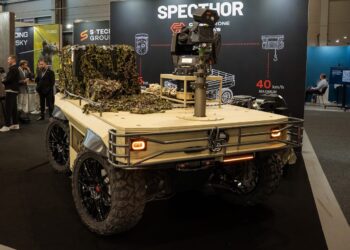
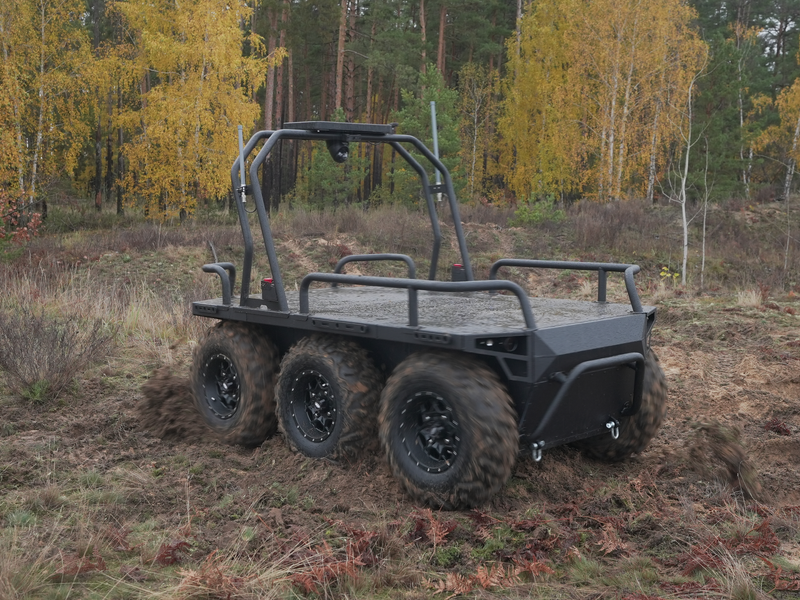
Ratel produces ground systems for logistics, casualty evacuation, engineering, demining, reconnaissance, strike, and drone launching. The vehicles range from smaller platforms intended to carry explosives or lay mines to larger vehicles capable of transporting supplies and evacuating wounded soldiers. The company says it is also expanding beyond ground robotics, developing two UAV variants as well as mobile workshops and solar-powered trailers.
Ground robotics have become an increasingly important part of Ukraine’s unmanned warfare ecosystem as the military seeks to remove soldiers from some of the battlefield’s most dangerous tasks. UGVs are now routinely used to carry ammunition and supplies across exposed terrain, evacuate casualties, lay mines and deliver explosives to Russian positions.
For Swarmer, Ratel offers more than entry into a rapidly expanding UGV market.
The company’s Swarmer Operating System provides collaborative autonomy for unmanned systems, allowing multiple drones to coordinate missions with reduced operator involvement. Swarmer says systems running its technology have completed more than 100,000 combat missions in Ukraine since its first operational deployment in April 2024.
Fink said Swarmer sees UGVs as potential “universal launch-platforms” for UAVs, interceptors and other autonomous systems. Integrating Ratel’s ground vehicles with Swarmer’s autonomy software could therefore allow the company to coordinate networks of aerial and ground systems operating together.
The acquisition also marks the execution of an acquisition strategy Prince laid out shortly after taking over as chairman.
In June, Prince said Swarmer’s opportunity extended beyond its existing software platform and outlined plans to identify, acquire or partner with companies whose technologies had already been proven under battlefield conditions.
Many Ukrainian defense companies face a difficult transition as they attempt to turn wartime demand into sustainable international businesses. Prince argued that Swarmer could provide those companies with capital, strategic support and access to foreign customers while reducing their dependence on the Ukrainian market.
“Our objective is straightforward: assemble the best systems that have been forged in combat into one decisive, integrated solution,” Prince said in announcing the Ratel deal.
It also makes Swarmer-Ratel one of the largest tie-ups yet in Ukraine’s young private defense technology industry.
Consolidation continues to accelerate
There will likely be more roll-up strategies play out in the market as larger companies scoop up smaller players for better economies of scale in the market.
Battlefield-tested Ukrainian companies that are struggling to scale – or simply do not have the appetite to pursue that path on their own – are being picked up by larger and better-capitalized corporate platforms capable of financing production, integrating different technologies and selling them internationally.
FPV manufacturer Vyriy Industries has acquired or invested in five other Ukrainian defense technology companies as it diversifies beyond its original drone business.
MITS Capital has pursued a similar strategy through MITS Industries, a Danish-Ukrainian defense group designed to bring several Ukrainian manufacturers under a larger platform with access to Western capital and markets.
Uforce follows a similar strategy, and it looks potentially like the recently ousted defence secretary Mykhailo Fedorov is planning to put together yet another consolidator.