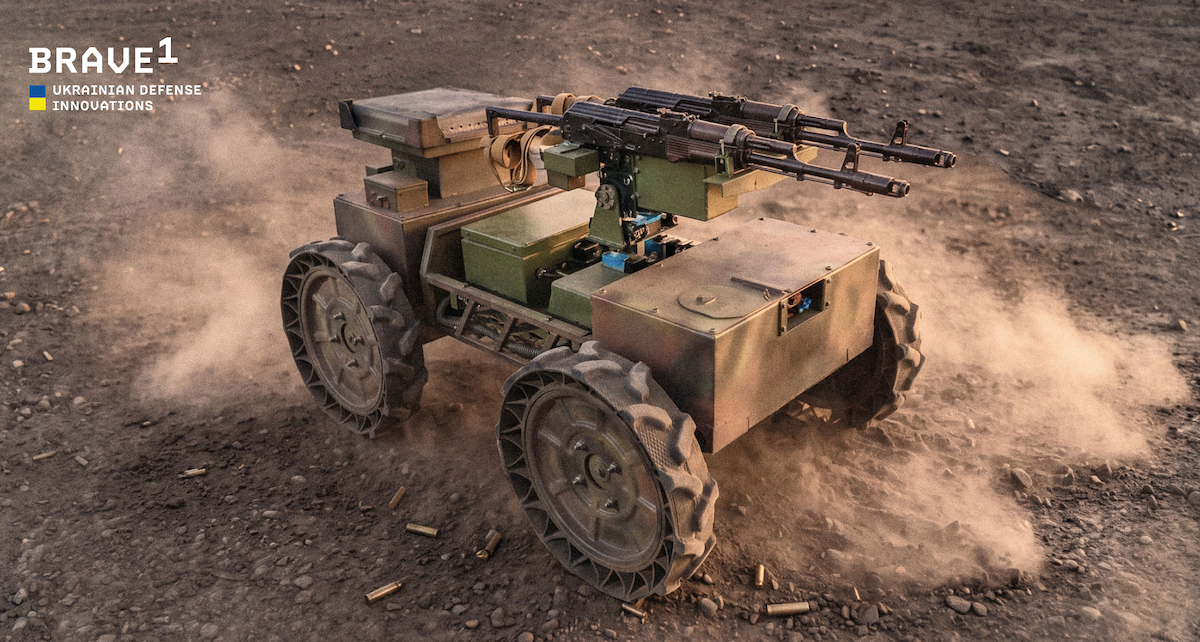
An unnamed company backed by Ukraine’s BRAVE1 defence technology program has developed a robotic turret designed around one of the most common weapons already in Ukrainian service, the Kalashnikov rifle. According to the program, the system moved from concept to prototype in less than six months.
The resulting system combines a four-wheeled unmanned ground vehicle with a protected hull, airless tires, and a remotely operated weapons module. Its most notable feature is a twin turret capable of carrying two Kalashnikov rifles at once.
In other words, Ukraine is adapting to the ever-changing nature of wartime procurement in an effort to build out a defence system that is cheap, agile, and replaceable.
“Why the Kalashnikov?” wrote Brave1 in an X post. “The reason is simple: it’s the most widely available small arm across our military units. Using the Kalashnikov makes it possible to rapidly scale these UGVs on the frontline and deploy them for both assault and defensive operations against enemy infantry.”
The allure of this odd uncrewed vehicle is clear. Ukrainian units already have the rifles, ammunition, and experience needed to maintain and operate them. Building a robotic turret around that existing supply makes the system easier to introduce without creating another weapon and ammunition chain. The turret isn’t tied to a single robot either. According to BRAVE1, the weapons module can be fitted to other wheeled and tracked UGVs.
That could make it possible to add armed variants to existing ground robot fleets without replacing the underlying vehicles.
More than five Ukrainian military units are now testing the systems in combat. According to BRAVE1, personnel from Special Operations Center “A” of the Security Service of Ukraine have already used the robotic system against enemy ambush drones.
The real question is which of Brave1’s portfolio companies is pushing for this decidedly effective if odd solution. Adding old munitions to new systems is nothing new — consider the rise of primitive explosive devices triggered by complex mobile systems — but something so rugged and arguably strange is entirely different.