For an island nation with no regional ambitions and territory roughly the size of the Netherlands, Taiwan has an impressive assortment of top-shelf weaponry, largely stocked with US-made equipment. Its army boasts more than a hundred M1A2T Abrams, a tank many consider the most powerful in the world. (Estimated tank order value: around $2 billion.) Its air force operates a fleet of 140 refurbished F-16V fighter jets, which, when combined with the 66 brand new fighters now on (very overdue) order, will make it the largest fleet in Asia. (Total cost per new unit: $120 million.)
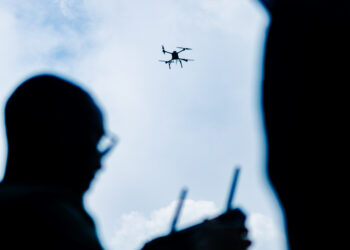
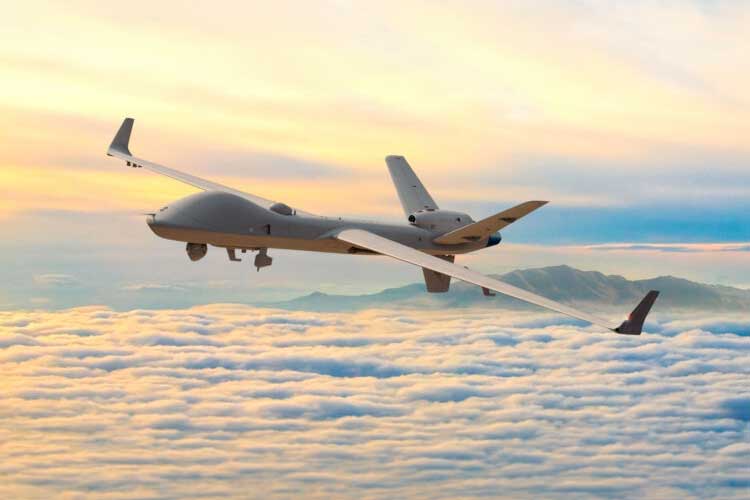
Now, Taiwan has begun testing its latest addition: a pair of MQ-9B SkyGuardian remotely piloted reconnaissance drones. The SkyGuardian drones are similar but not identical to the Reapers made infamous by the war on terror, and more recently, the war in Iran. They are a continuation of the spending habits that have saddled Taiwan with American weapons that are expensive to maintain — a second pair of the drones should arrive next year, bringing the total cost of the programme to about $700 million. But the SkyGuardians also promise to bring some relief on that front. As an unmanned system that can stay in the air much longer than an F-16, they offer Taiwan a more fuel-efficient means of tracking the Chinese harassment that has been wearing down Taiwan’s air force for years.
The new drones arrive at a moment of reckoning for Taiwan’s defense sector. For years, US officials have pushed Taiwan’s military to adopt a more asymmetric approach to defense, to embrace the posture of the “porcupine.” In practice, this would mean fewer legacy platforms — like SkyGuardian, which Taiwan first ordered back in 2020 — and more low-cost, unmanned systems akin to what Ukraine has been using against Russia.
Asymmetry has its champions in Taipei, particularly within the ruling Democratic Progressive Party, or DPP. When Taiwan’s president, Lai Ching-te, announced his $40 billion supplemental defence budget proposal last December, he promised that it would fund not only the big, flashy weapons that his country is used to buying, “but also vastly enhance Taiwan’s asymmetrical capabilities.” Lai reiterated that stance earlier this month, soon after Raymond Green, the de facto US Ambassador, called on Taiwan to develop a “hornet’s nest” of drones to deter China.
But the asymmetric push has met stiff resistance from Taiwan’s opposition Chinese Nationalist Party, or KMT, which spends half its time lambasting the DPP for corruption, and the other half warning that sharpening the island’s quills will only make a war with China more likely.
To some in the KMT’s old guard, the purchase of US weapons is a simple transaction: syphon a sliver of Taiwan’s semiconductor riches into the pockets of American defense contractors, and the US government will return the favor by helping to dissuade a Chinese attack.
“The defense budget is essentially a protection fee paid to the mafia,” said Jaw Shaw-kong, a local media personality and the KMT’s 2024 vice presidential candidate. “For us, buying things is equivalent to paying a protection fee to the United States. You just have to pay it.” It was April when Jaw said that, and Taiwan was at the zenith of its latest legislative staredown over defense spending. The KMT eventually passed a stripped-down version of the government’s proposal: $25 billion, the largest in history, but almost entirely devoid of funding for asymmetric systems and the domestic drone industry.
‘What are these for, anyway?’
Money isn’t the only problem with F-16 fighters and Abrams tanks. In fact, it’s not even clear whether these weapons would be useful in the event of an invasion. Many analysts think China would begin its assault with strikes on Taiwan’s air strips, potentially neutering a fleet of aircraft that need room to take off. But the air force’s approach to this problem has not been to abandon the pricey planes, but to covet a fleet of even pricier F-35s, a version of which can take off from much shorter runways.
Concerns about Abrams tanks follow a similar logic: if China lands enough forces on Taiwan to make tank warfare necessary, the fight might already be lost. As the American defense blogger David Axe described it in a recent post for the Australian Strategic Policy Institute, drone tactics in the Ukraine war have reduced tanks to the role of escorting smaller platforms through a drone-infested no-man’s-land. And that’s in a ground war.
“Does anyone expect that Taiwan’s outnumbered military will hold out long enough for a similar no-man’s-land to form on the island?” Axe writes. “If not, then what are Taiwan’s tanks for?”
The Iran war has raised similar concerns for the SkyGuardian, whose cousin aircraft, the MQ-9A Reaper, has had a mixed record. Reapers have been essential to the tactical success of US airstrikes. But roughly 30 of them have already been shot down in the war with Iran, losses that account for about a quarter of the United States’ total fleet.
“Those kinds of large drones, especially in the Taiwan Strait setting, they are not very survivable,” says Xu Tianran, an expert in Chinese missile systems at the Open Nuclear Network, a European non-profit. “They are just targets. Even [the] Iranians can shoot them down.”
And China’s defenses go far beyond the capabilities that exist in Iran. A SkyGuardian patrolling the Taiwan Strait, the Chinese mainland, or any other area within range of China’s missile defenses “would suffer a high attrition rate,” Xu says.
Shu Hsiao-Huang, a researcher at the Institute for National Defense and Security Research (INDSR), a government-owned think tank in Taipei, points out that a SkyGuardian’s capabilities and applications are more robust than a Reaper’s. Most importantly, the flight time exceeds 40 hours — about 13 hours longer than its counterpart. That should make it useful for tracking the escalation of China’s gray-zone activities, which crossed a new threshold in June with attempted coast guard inspections off the east coast of Taiwan. “It should be called the SeaGuardian,” Shu said.
In fact, General Atomics, the American contractor that makes SkyGuardian, does offer a model called the SeaGuardian, which is essentially a SkyGuardian with different sensors attached.
This has led to some confusion in the Taiwanese press, with some outlets referring to it as the SkyGuardian, and others as the SeaGuardian.
More than a semantic issue, the inconsistency speaks to Shu’s primary doubt about the MQ-9Bs: if the aircraft is so useful for maritime operations, then why was it acquired by the air force? “The 9B is equipped with synthetic aperture radar, electro-optical systems, and even sonobuoys,” he said. “Theoretically, that’s what the Navy should do.”
Hsieh Pei-shiue, Shu’s colleague at INDSR, was eager to point out that, with their ability to stay in the SkyGuardians can help to relieve some of the wear and tear on Taiwan’s air force fleet. Every year, Hsieh notes, Taiwan’s military spends a non-trivial portion of its budget just to refuel the jets that it scrambles every time China sends one of its own fighters on a harassment mission over the Taiwan Strait.
In 2020, those fuel costs alone accounted for nine percent of Taiwan’s military spending. China’s airborne gray zone harassment has only increased since then, Hsieh says.
The economics of responding to gray-zone harassment are bad enough for Taiwan when China sends fighter jets over the strait. When China sends a balloon, or some other aerial drone, the math gets even worse. Taiwan has to spend fuel and time that could be spent on pilot training just to track an object that costs China little to make and even less to use.
Ben Lewis, an independent defense analyst who runs the open-source intelligence website PLATracker, estimates that prior to January 2024, when Taiwan’s military stopped releasing detailed Chinese aircraft information, drones made up roughly 10% of China’s sorties around Taiwan.
“From what we can glean from the data, I think that number has remained roughly unchanged (perhaps with a slight increase depending on which timeframe you look at),” Lewis told Resilience Media in a Signal message. The modes of airborne harassment have continued to evolve. On July 20, China for the first time sent a helicopter across the median line of the Taiwan strait, prompting speculation that it was planning to conduct joint operations training along with other drones on Taiwan’s side of the strait.
The SkyGuardian drones could go a long way toward relieving the burden that this harassment places on Taiwan’s air force.
Hsieh says that once the second pair arrives next year, Taiwan can establish an optimal rotation: two in the air, one in the shop, and one reserved for training. He also points out that the SkyGuardian’s intelligence transmission system runs on Link 16, a tactical data network used across NATO countries and other American allies.
“Once you have those data links, you can share the data to each other and to create so-called COP, common operating pictures, so whatever we are seeing the Japanese or maybe the United States military, they also can see those kinds of data,” Hsieh said.
Whether the SkyGuardian drones are a much-needed upgrade for Taiwan’s surveillance capabilities, or an expressive reminder of its outdated approach to procurement, depends ultimately on one’s underlying theory of Taiwanese security.
If the point of buying weapons is to maintain US political and military ties (and potential support), then a costly, American-made drone equipped with a NATO-standard data sharing system looks like the perfect item. And if an actual amphibious assault is highly unlikely, as many in Taiwan’s government — not to mention the general population — believe, and therefore the greater Chinese threat is a naval blockade, a quarantine, or the slow decay in the public’s faith in its own government, then a high-endurance drone that takes some of the burden off Taiwan’s fighter pilots while giving the military a better handle on its coastal environment makes perfect sense.
But if the goal is to acquire weapons that could repel a Chinese invasion, then a $700 million programme to acquire a weapon that will be shot down the moment the fighting begins starts to look like a costly mistake.