
Taiwan is deeply divided when it comes to facing up to China. It has turned the island’s defence strategy into a tug-of-war


Taiwan is deeply divided when it comes to facing up to China. It has turned the island’s defence strategy into a tug-of-war
Thousands of marchers snaked their way through the heart of downtown Taipei under a scorching afternoon sun on a Saturday in May, rallying in support of Taiwan’s domestic defense industry.
Demonstrators young and old chanted slogans in Mandarin such as “True peace requires national defense!” while carrying signs bearing messages including “Reject annexation under ‘One China’ – support domestic weapon manufacturing!” One group of marchers brought a banner in support of investing in Taiwan’s drone sector.
The rally was in response to Taiwan’s recently passed special defense budget, a watered-down version of President Lai Ching-te’s original proposal, which he announced in a Washington Post opinion piece in November 2025. Instead of the US$40 billion of spending over eight years that Lai had laid out, the majority coalition in Taiwan’s parliament passed its own version of the budget. It came in at just under $25 billion – with the majority allocated for weapon procurement from the US.
At the heart of the issue is the conflicting aims of the executive and legislative branches. President Lai and his Democratic Progressive Party favor greater investment in national defense, while the Chinese Nationalist Party, or Kuomintang, which leads the majority coalition in parliament, is increasingly meeting and coordinating with its fellow ethnonationalists across the Taiwan Strait: the Chinese Communist Party.
``Long-term domestic procurement by Taiwan’s government addresses both challenges through two channels, she said. It creates sufficient demand to build out a non-red vertically integrated supply chain from tier-one platforms to tier-three components – a prerequisite for sustaining attrition-rate drone operations under blockade conditions.``
Since taking control of parliament in early 2024, the KMT-led coalition’s agenda has been highly aligned with Beijing’s interests.
In terms of the recent special defense budget, the KMT and its junior partner, the Taiwan People’s Party, did not merely cut $15 billion from Lai’s proposal. The coalition effectively eliminated what many say would have been a transformative long-term government investment in Taiwan’s domestic defense industry.
The aim of that investment would have been to harness the country’s formidable manufacturing and tech prowess to build up a defense industry capable of meeting Taiwan’s needs, while reducing reliance on the US. At the centre of the investment would be drones and air defence.
Taiwan’s vulnerability via its dependence on procurement from the US – the only country willing to sell weapons to the diplomatically isolated democracy – has recently been on full display. Following US President Donald Trump’s mid-May meeting with Xi Jinping, it appears that a $14 billion US weapons package that had been approved for Taiwan may now be delayed.
Following Trump’s visit to Beijing, the American president referred to US weapon sales to Taiwan as “a very good negotiating chip.”
In the eyes of many in Taiwan’s government and think tanks, a strong domestic defence sector would be a very good way to reduce exposure to US-China relations – and the whims of the American president.
A fully approved special defense budget would have been large enough to procure around 200,000 drones and 1,320 unmanned surface vessels between now and 2032, Cathy Fang, a policy analyst at the government-funded Research Institute for Democracy, Society and Emerging Technology (DSET), told Resilience Media.
Government orders of such magnitude “would have sent a strong, long-term demand signal to Taiwan’s domestic defense industry, enabling firms to commit to R&D, capital investment, and capacity expansion with greater confidence,” Fang said.
The Ministry of National Defense, Fang notes, has characterized the special budget as a mechanism to accelerate procurement and reduce reliance on annual budget cycles, which are structurally constrained. In fiscal year 2025, of the $5.14 billion military investment budget, $4.88 billion was consumed by ongoing programs, leaving only $270 million for new procurement, a rigidity worsened by legislative review requirements, debt ceiling limits, and approval uncertainty.
A strong domestic drone industry would significantly improve Taiwan’s military in terms of both procurement and deterrence, a military officer involved in procurement told Resilience Media on condition of anonymity.
On the procurement side, Taiwan would become less dependent on foreign suppliers, which would also help prevent long delivery times during conflicts.
“Instead of buying small numbers of expensive systems from abroad during wartime, the military could rapidly produce large quantities of drones as the front required,” the officer said. Taking a page from Ukraine’s strategy, domestic companies in rear areas could also update software, sensors, and anti-jamming technology much faster based on battlefield lessons. This would create a more flexible and sustainable defense system, especially in a wartime situation where drones may be heavily consumed.
In terms of deterrence, a robust drone sector would support Taiwan’s asymmetric defense strategy, the officer added. Large numbers of low-cost drones could monitor coastlines, track enemy movements, attack landing forces, and overwhelm more expensive PLA equipment, creating a hellscape for the enemy.
“Even if some drones are destroyed, Taiwan could quickly replace them,” said the officer. “That would increase the cost and uncertainty of any invasion attempt by China.”
For its part, the KMT has framed the smaller defense budget that it passed in terms of oversight and accountability, often publicly hinting at or straight-up accusing Lai and the DPP of corruption.
KMT chair Cheng Li-wun has opposed increasing military spending, effectively saying it cannot guarantee Taiwan’s security. Cheng, who has no position in Taiwan’s government, met with Chinese leader Xi Jinping in Beijing in April, where she echoed his claim that Taiwan is part of China and that “Taiwan independence” cannot be tolerated.
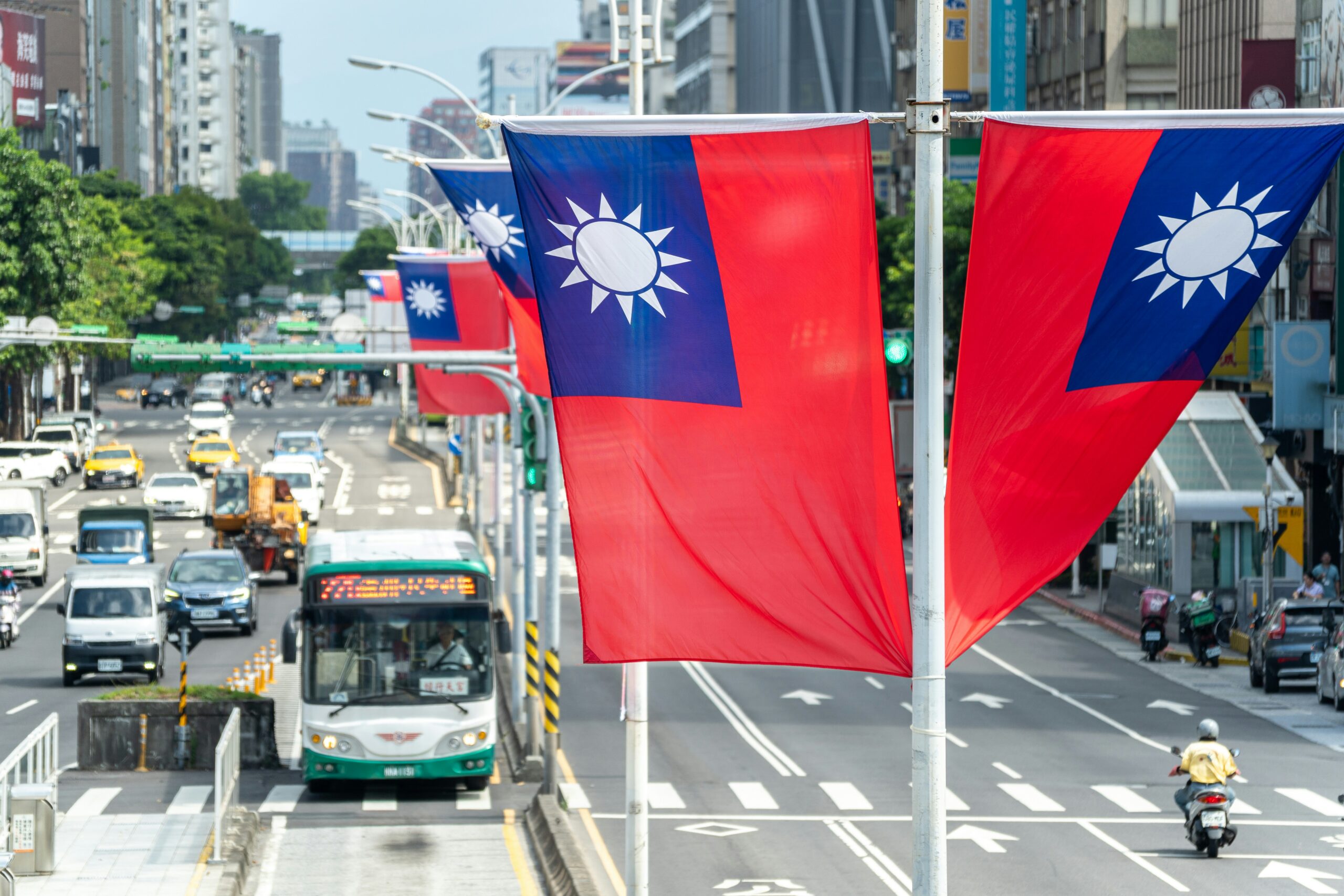
It is worth noting that strictly speaking, the Taiwanese military is a Chinese military that has long been resistant to localization.
Taiwan’s government is the Republic of China (ROC), the former government of China that first arrived in Taiwan in 1945 on American warships following Japan’s surrender. Japan had colonized Taiwan for 50 years, during which it industrialized and modernized the island.
When it arrived in Taiwan, the Republic of China was a party-state controlled by Chiang Kai-shek’s KMT. When Chiang and the KMT lost control of China to Mao’s Chinese Communist Party in 1949, Chiang relocated the ROC government “temporarily” to Taiwan, where it has remained ever since.
This exodus from China brought between one and two million Mandarin-speaking Chinese to Taiwan, where six million Taiwanese who spoke only Japanese plus Taiwanese, Hakka, and/or indigenous languages had been living for centuries or longer.
While one’s heritage does not dictate one’s political views in Taiwan, supporters of the KMT today are often descended from the Chinese who crossed the strait with the party eight decades ago. Taiwanese whose families were in Taiwan before the KMT’s arrival tend to lean towards the DPP. Intermarriage between the different groups over decades, and the subsequent political untethering that facilitated, have made when one’s family arrived in Taiwan less relevant in recent years.
Chiang not only sought to retake China, but he imposed brutal martial law and a Chinese identity upon Taiwan – often referred to as “Free China” in the anti-communist world – a state of affairs that would last until 1987. At 38 years, it was the longest-ever period of martial law until its ignominious record was broken by Syria in 2011.
The ROC military was the instrument through which martial law was exercised. This is significant because many of the top officers in the ROC military today got their start during martial law and were highly indoctrinated to view Taiwan as a part of China — not the communist People’s Republic of China (PRC), but a more nebulous historical and cultural China.
Decades of bottom-up pressure by the Taiwanese people paved the way for a bloodless revolution in the early 1990s, which ushered in the democratization of the ROC in Taiwan. This facilitated the re-emergence of Taiwanese identity, and the pursuit of a Taiwanese state. It was at this time that many legal scholars here argue Taiwan became an independent, sovereign democracy, rather than an island occupied by a Chinese rump state.
After democratization, the KMT remained the dominant party for legacy and patronage reasons until the DPP took power for the first time in 2000 with Chen Shui-bian’s stunning election victory.
The shared Chinese identity of the KMT and Chinese Communist Party proved stronger than ideology in the face of a resurgent Taiwanese identity. In 2005, the KMT and CCP normalised party-to-party relations, which have improved steadily in the following two decades. The DPP has won four of the six presidential elections since 2000, and is now the establishment party, with the KMT the largest opposition party.
Taiwan’s ROC military is now headed by a civilian, essentially for the first time (there have been others before but they only served for very short periods). Defence Minister Wellington Koo has done much to modernise the military and transform it into a stronger deterrent against Chinese aggression, but he is fighting an uphill battle.
In the past two years, more than a dozen KMT legislators and the party’s vice-chair have had private meetings in Beijing with the powerful Politburo Standing Committee member Wang Huning, whom Xi Jinping has en trusted with the Taiwan portfolio.
The partisan nature of Taiwan’s security debate is made clear by recent survey data published by the Brookings Institution.
According to findings by Taipei-based political scientists Lev Nachman and Wei-Ting Yen – respectively a political scientist of National Taiwan University and an assistant research fellow at Academia Sinica – 54% of respondents said they supported President Lai’s special defence budget. When broken down by party, however, a stark gap emerges. About 87% of DPP voters approve of the budget, while that number drops below 28% for KMT voters.
Responding to a Resilience Media question at a Taiwan Foreign Correspondents’ Club briefing on 13 May, senior KMT official Jaw Shaw-kong pushed back against the notion that his party was anti-drone. Lai’s special defence budget lacked the necessary legislative oversight, Jaw said.
“This special budget is like a blank check,” Jaw said, voicing a major talking point by both the KMT and TPP on the issue. Rather than fund the drone industry via a special budget, he said, drone industry investment should instead be included in the annual budget.
But passing the annual budget has not been a priority for the KMT-led coalition. It is now early June, and the KMT-led coalition has still not passed the annual general budget for fiscal 2026, which has negatively impacted Taiwan’s domestic operations and diplomacy. The coalition also obstructed last year’s general budget.
For Taiwan’s domestic defence industry, having to wait and see if the KMT will approve drone procurement is unlikely to inspire the confidence needed for larger investment outlays. For Taiwan’s drone sector, government procurement is foundational for both industrial scaling and “non-red” (excluding China-made components) supply chain development, DSET’s Fang noted.
Taiwan’s defence-industrial base, spanning ICT supply chains, precision motors, batteries, and advanced materials, supports a comparatively complete UAV ecosystem, but structural vulnerabilities remain, she said. Unit costs run two to three times higher than Chinese systems, and critical components including motors and batteries retain partial dependency on Chinese-origin materials.
Long-term domestic procurement by Taiwan’s government addresses both challenges through two channels, she said. It creates sufficient demand to build out a non-red vertically integrated supply chain from tier-one platforms to tier-three components – a prerequisite for sustaining attrition-rate drone operations under blockade conditions.
It also generates the production volume necessary to drive down per-unit costs, positioning Taiwan as a price-competitive, non-red supplier in government procurement and commercial export markets.
Modern drone warfare has shifted toward attrition, Fang said, where production capacity and resupply rate are as strategically significant as platform capability – a scenario for which Taiwan is not well-prepared.
At present, Taiwan’s domestically produced platforms operate well below 50 kilometres, while the average width of the Taiwan Strait is 180 kilometres. The Center for a New American Security, a Washington think-tank, assesses that credible layered defense requires platforms operating 40 to 80 kilometres offshore, with strike assets beyond 100 kilometres.
President Lai’s original special defence budget had included 4,040 medium-range loitering munitions and 32 Albatross II units to begin closing that gap. Neither survived the legislative process.
“A robust domestic industry would not eliminate this asymmetry but would arrest its trajectory,” Fang said. “Industrial capacity underwrites resupply, resupply underwrites attrition tolerance, and attrition tolerance is the operational foundation of deterrence under blockade conditions.”
Meanwhile, the government deadlock appears likely to continue until at least early 2028, when Taiwan holds its next presidential and legislative elections. With a massive top-level purge ongoing in China’s military, this would be an opportune time for Taiwan to build up its defence industry, but that would require a functioning government.
The KMT’s Jaw, speaking of the party faction that supports Cheng, the current chair whose status was boosted by her meeting with Xi, summarized the main political obstacle to the parties working together.
“They hate Taiwan independence, they hate the DPP,” Jaw said of Cheng’s supporters, known as “deep blues”.
“Some deep blues,” he continued, “would prefer that the communists conquer Taiwan.”
