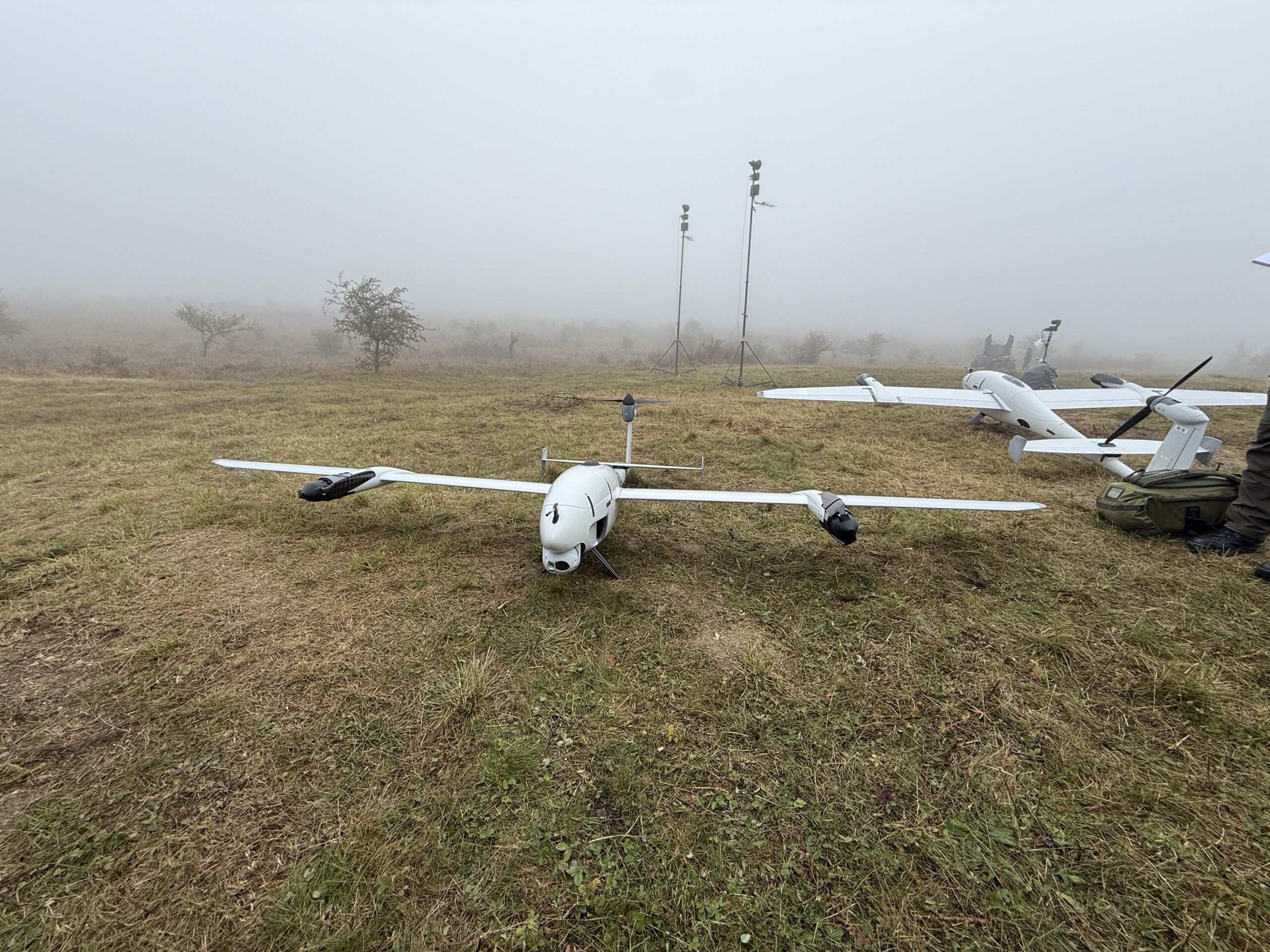
A cold, foggy, and windy military training field in the centre of Germany was not where I expected to be on an early morning in the middle of October, but it’s where I found myself, with Quantum Systems, as the drone giant assembled customers and would-be users from ministries of defence for “Forward Edge,” a series of exercises featuring its latest technology as it transitions into being a full-fledged defence tech.
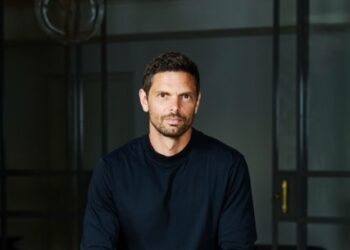
The German startup is best known for its intelligence, surveillance, and reconnaissance drones and getting an early move on operating in Ukraine after its founder, Florian Seibel, saw what was unfolding with Russia’s invasion and wanted to do something, ultimately reorienting his commercial drone business to military uses.
Earlier this year it made a big bet on transforming itself into a full-fledged defence tech company, raising $1.2 billion on a valuation of $8 billion.
Those efforts are what brought a small group of journalists and hundreds of military and government officials here, to a wide plane in the middle of the country, for the company to show off what it is building for the next stage of its business: more autonomy in the sky, on the ground and in the sea; systems that are designed to intercept lethality; and more systems that will carry the means of doing damage themselves.
The company had set up several simulated scenarios to show how Quantum Systems’ devices fared in action:
- One involved surveillance systems identifying a threat to a ground defensive position and triggering counter-UAS systems to take it out.
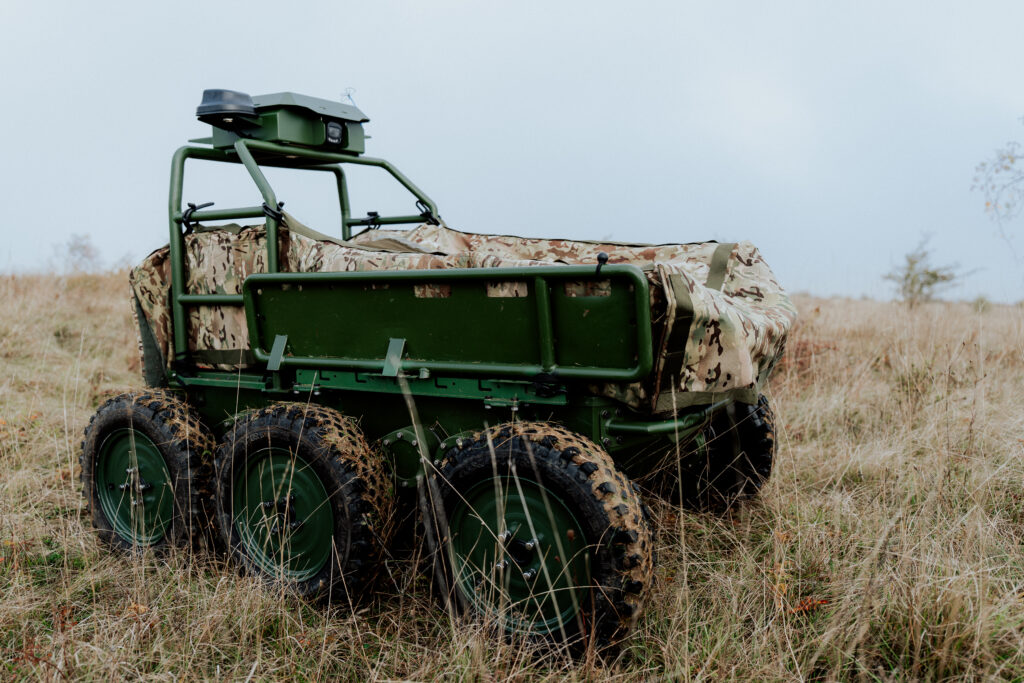
- Another showed a convoy of Quantum Systems’ unmanned ground vehicles travelling through a field and ISR devices monitoring its position.
- A third demonstrated route clearance operations, and a fourth (over a video feed from Germany’s coastline) used the company’s aerial and maritime systems in a coordinated formation to protect assets in the water.
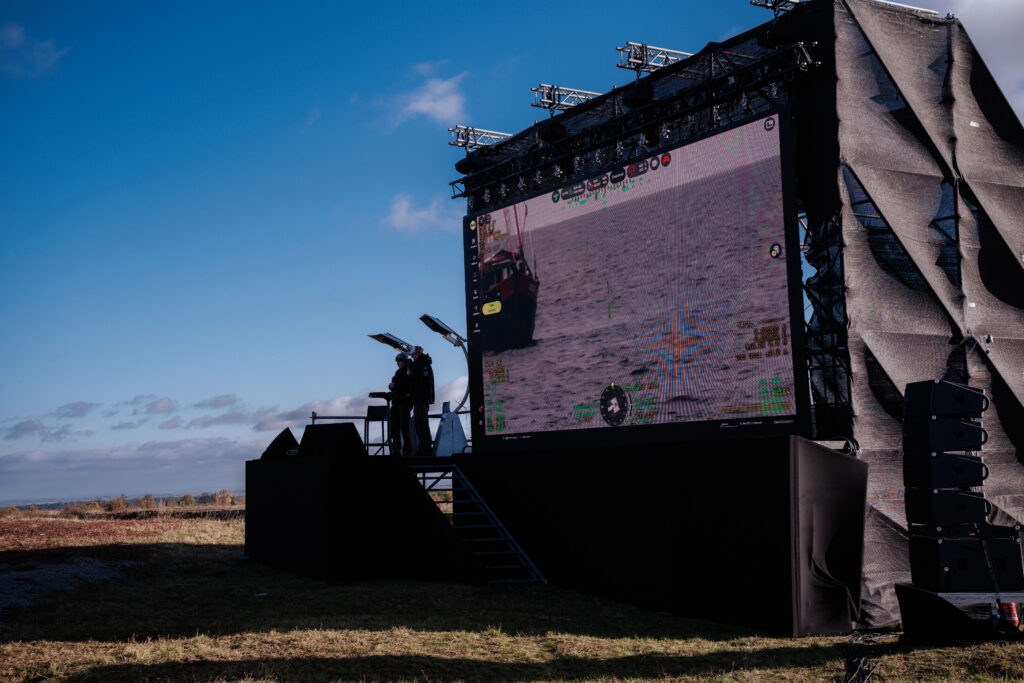 Much of what we saw were more work-in-progress, what-to-expect rather than what is already possible: some of the upgraded equipment is still in the testing phase, self-driving vehicles were were set up to follow human-driven vehicles, and the video feeds of what we couldn’t see with our own eyes were accompanied by low, dramatic music effects.
There was no live ammunition involved in any of the displays.
“Our goal is to make sure it works by the end of the year,” said one person at the company, “and to make sure it does work in real life.”
The first couple of days were for Quantum Systems’ teams to prep, letting journalists chat casually with the teams on the ground.
Employees — wearing rugged walking shoes and trousers, hoodies and military-style jackets with velcro patches on their arms — scrambled between pre-fab cabins set up as control centres, systems set up around the field, a stage set up for presentations, and some massive lorries full of more equipment. Journalists, some with years of experience covering the military industry, and some from tech and business (guess which ones were woefully underdressed) perched on the sidelines and chatted with execs, engineers, and product managers.
The company requested that the exact location of the event this week not be disclosed, citing military security protocols and a general grey zone threat warning: nation-state adversaries are keeping tabs on what defence tech companies are testing and where. The same went for the employees on the ground: no names, no faces.
But the mood of the location was palpable. On top of the cold, grey weather, and the spectre of current world events, this part of the country is full of heavy recent history.
On the spectrum from manicured marketing show to military-grade hardware tested in restricted locations, there were definitely moments that the two extremes ran up against each other.
Co-CEO Florian Seibel dramatically helicoptered in during the first day of the event; other attendees were bussed in from the nearby town. Press photos show off people gathering and speaking in a slick indoor location; journalists assembled in a tent to eat mess-style lunches with employees — thick pea soups, pickled beets, boiled eggs with potatoes. Off to the side of the action, two men dressed in full combat gear posed for a photoshoot with some of the equipment.
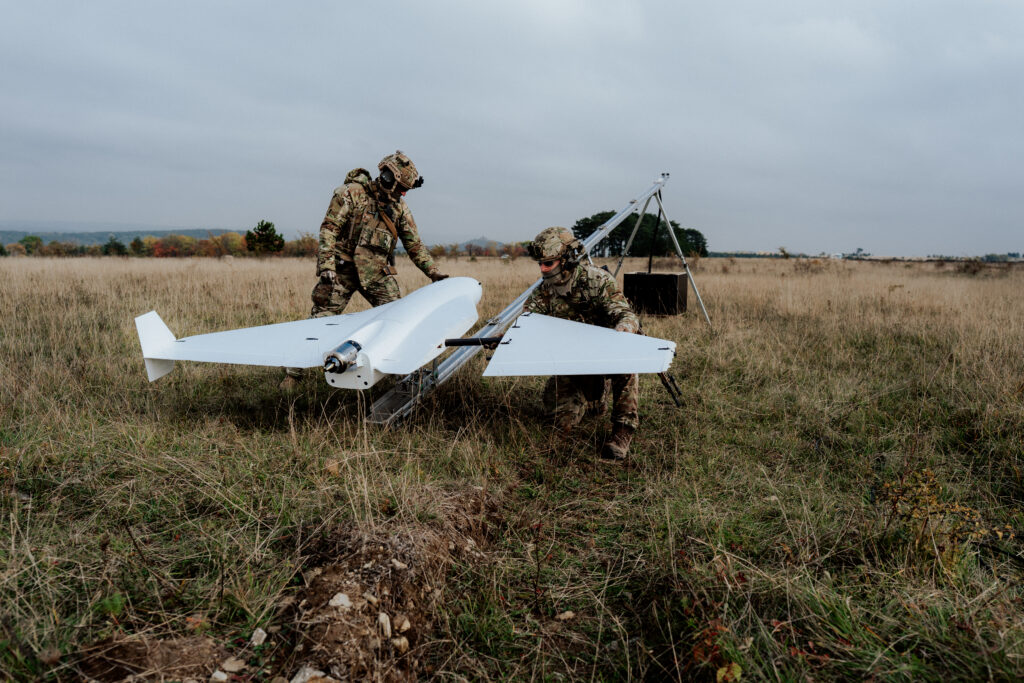 Seibel’s arrival on the first day was to witness what the company hoped would be a new speed record for its drones.
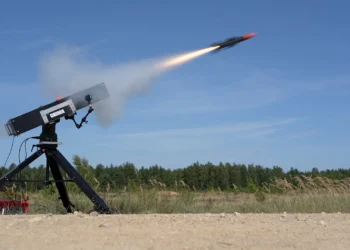
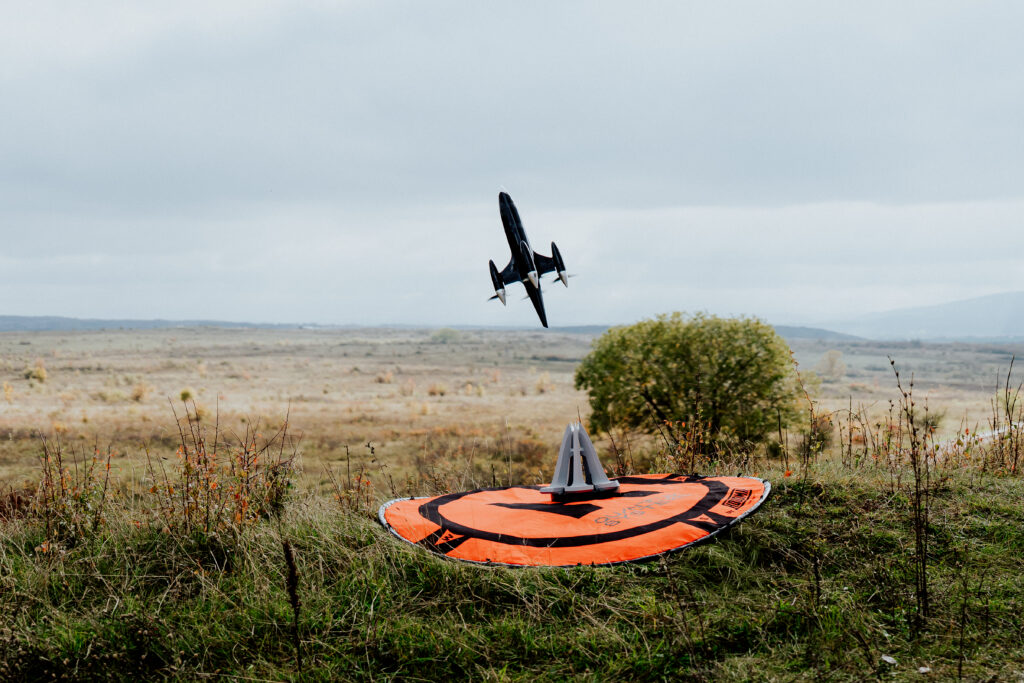
The device the company was using was not one of its listed products but a testing-focused battery-powered device its R&D team aptly calls the Apex Recordhunter.
The first attempt sputtered on its first try, petering out to the side like a deflating balloon. When it got going and did what the company expected it to, the Apex clocked an unofficial time of 777 km/h. (An official time would have required two launches in opposite directions to account for the wind.)
“We dedicate [this world record] to Ukraine and the defence of a great nation that is helping Europe to survive,” Seibel announced proudly in English, speaking to a group of journalists (just about most of what he said after was in German; quotes are translated into English below).
Quantum Systems may have built both its reputation and business out of the work it has done in Ukraine and in its home country, but now, it wants to export that to more places, with expansions to the US, Australia, Spain, the UK, and the Baltics — and, as of this week, Japan. At the event in Germany last week, Seibel described the company’s move into the last of these an opening also to get involved in “the Taiwan question.”
The test it ran with the Apex Recordhunter points to the growing need for speed everywhere, and also what might be coming around the corner for Quantum Systems.
Forward Edge event aside, Seibel and his company have some challenges ahead of it as it progresses forward to the edge.
 Not a Jet all the way
Notably, what Quantum Systems used for its speed test was not jet-based. Russia has been attacking Ukraine with Geran-4 and Geran-5 jet-powered drones, so the question now is whether Ukraine and its allies can defend effectively with the interceptors they are able to source.
The 777km/h speed would imply that what Quantum Systems is building can — potentially. The likely commercial speed of the engine used in the test would be 600-650km/h, said Seibel, and Geran drones of these two generations travel between 450 and 600km/h. Seibel noted that Porsche, Liebherr, and EOS collaborated to produce the electric power, and the batteries contributed by Porsche will also be the same that it expects to be using in boosters for its GT3 booster in 2027, “but we have it here, in our drone, today,” he said.
There are different ways of looking at the situation here. On one side, the Western drone industry, not just Quantum Systems, has been too slow over the past years to grasp the role that jets would be playing at this moment. In response to that, Seibel noted that no one could guess that this war would be close to entering its fifth year.
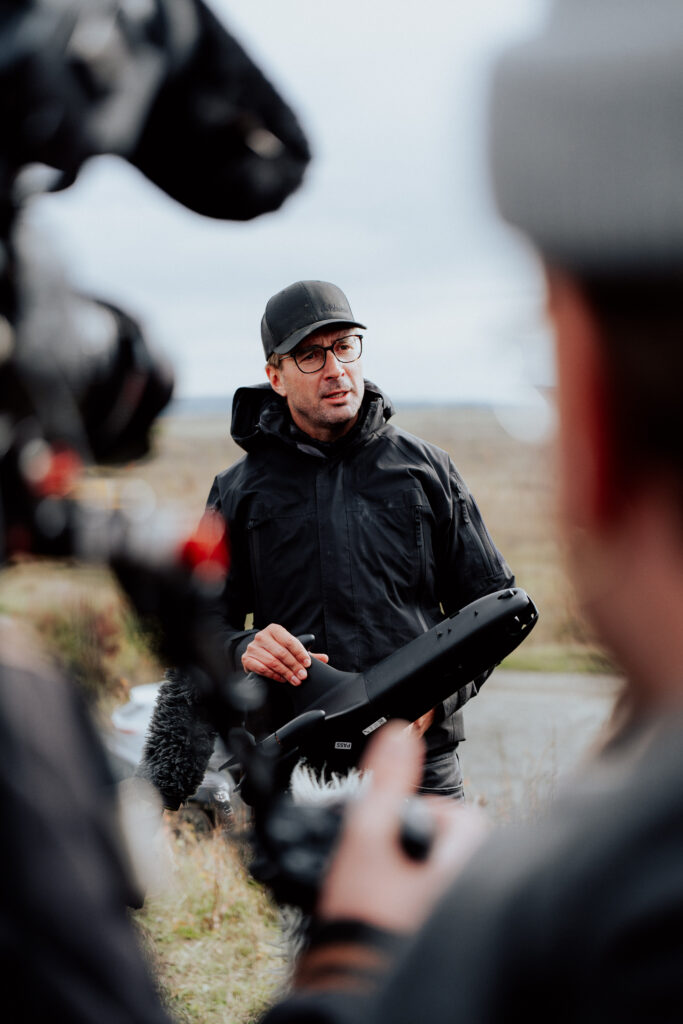 “In the last four years there has been a constant evolution of technology. Russia develops something, Ukraine counters it, and then the cat and mouse game starts again,” he said. “For now it’s very promising what we have here, but the future will tell if this is good enough, for sure we will not stop, we are already working on the next generation of counter-UAS elements, but for now this is the best we can do.”
And if there was intelligence about adversaries developing jets, he added, it’s not clear what of that information would have been shared with drone developers. (Added to this, Quantum Systems, which only started to focus formally on military uses beyond ISR after its big fundraise this year, arguably wouldn’t have prioritised that kind of R&D for that reason, too.) He also didn’t rule out that Quantum Systems would potentially work on other propulsion methods, including jets.
Some at the event who have been exposed to more traditional military work wondered if showing works in progress was self-defeating, showing what you cannot do more than what you can.
Seibel believes it is the opposite: Quantum Systems’ approach is exactly what is needed right now.
“Fail fast and iterate fast. We learned that from Ukraine,” he said. “In Germany we have optimised for split measurements for years, for decades, and now we realise we are no longer able to.”
And there is a market for that. The company is developing a C-UAS system in partnership with Ukraine’s Frontline Robotics, and earlier this month the JV landed a big order from Ukraine for these, on the order of “several tens of thousands” of units, Seibel said. The devices are not fully functioning yet — but they are showing “very positive signals and results,” he added.
Rapid prototyping also reflects what Quantum Systems’ customers need (the “cat and mouse” referred to before): first one advances, then the other, and then the first again, and so on.
Software at the moment, he said, refreshes at a rate of six weeks and hardware at a rate of 12 weeks. If an optical infrared sensor was standard in earlier UAV models, they are now being replaced with synthetic aperture radar-based cameras: there are some 2,000 systems of these kind already deployed there, and there will be more, until something else replaces that.
This leads us back to what drives UAVs. Even as other companies, and maybe Quantum Systems itself, think about how to develop jet-powered systems, there is room for more development on the non-jet trajectory, too.
The Pulse P19, the company’s first armoured drone that it first announced in June 2026, is well on its way. This device — which when fully loaded for military use can weigh up to 4.5 tonnes, Seibel said — is continuing to go through regulatory and other approvals because “the potential for danger is much greater due to the mass and speed.” It is on target for its first flight to be in mid-2027, he said.
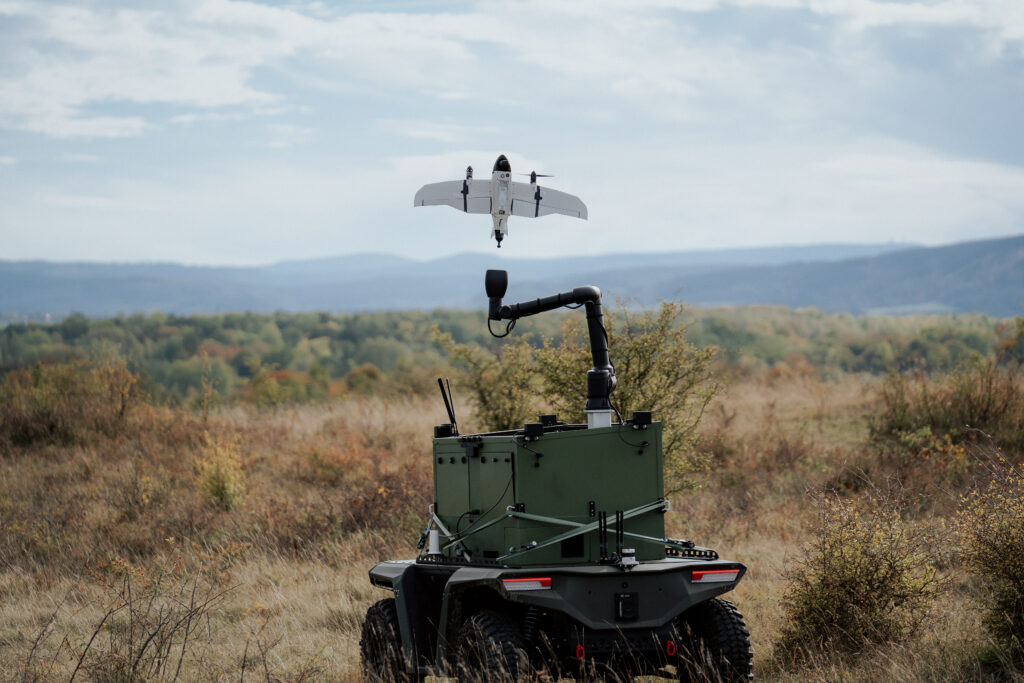
The Reliant, the long-range ISR drone that it showed off, has been optimised for maximum airtime (10 hours in the most perfect conditions and not at its highest-achieving altitude) and a variety of payloads, but also minimum detectable footprint: the noise level it emitted was genuinely lost in the wind.
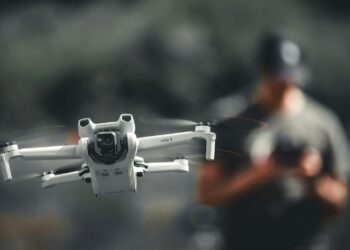
It complements two other systems. First, the smaller and louder Vector, Quantum Systems’ mid-range drone that is hyper compact and mobile — able to fit into a giant suitcase-style rucksack to be launched on the fly. The older models have been used extensively in combat; what Quantum Systems used last week was the newer AI edition that has yet to ship. Second, the Twister for short-range missions with self-docking capability.
 AI and other future technology
Artificial intelligence figured strongly throughout the event in Germany. UAVs and UGVs were not only autonomous but getting increasingly independent, and everything is pulled together with Mosaic, Quantum Systems’ AI-based mission software.
More generally, AI is seen as something of a panacea for helping with the task of fighting — analytics, managing the ‘cognitive overload’ of taking in too much data (often generated thanks to the increasing use of these new autonomous systems), visibility, and forward strategy — but also specifically to effectively supersize smaller teams of humans.
“Ukraine is working with five times less people than the enemy,” one executive on the Ukraine team said. “That means one Ukrainian soldier should be doing what five Russians are doing, just to be in the war. Ideally, one Ukrainian should be doing the work of 10 Russians.”
Quantum Systems is as all-in on the idea as its peers. Its firm bet on AI has been transformed into a company motto — “The future is unmanned” — incorporated into sizzle reels that it ran on the large video screen throughout the week. Worries about AI power backfiring and using regulation to rein in what AI can do were not factored in.
“Our systems are developed in such a way that humans will always have the opportunity to break away,” Seibel said. “Of course , AI has to be regulated… But don’t first regulate, or over-regulate, to prevent technological progress.” The battlefield of the future, he continued, will likely have more autonomy, but also weapons in space.
Indeed, progress may well be a little terrifying regardless of how AI factors into it.
The spectre of who builds the next generation of tech hovered over Quantum Systems’ event, much as it does over Europe in general.
Top of mind was Starlink, which was going into its second week of being throttled over Ukraine as the event was taking place. The executive from Ukraine said that aside from more and better interceptors, this was the main topic of discussion amongst the squads in the field. Ukraine and others in Europe are exploring alternative satellite infrastructure, but they are also doing more with mesh, he said.
The clear takeaway is that even for companies that are not specifically set up to build communications networks, any player working with systems that rely on them now need to consider infrastructure, as well as who controls it.
“Do we really want to depend on two relatively crazy people who are now pushing each other into each other’s shoes?” Seibel asked. “I’m sure it was very clear who switched it off, and something like that should never happen again, and that’s what we should work on as Germany, as Europe.”
“Do we really want to depend on two relatively crazy people who are now pushing each other into each other’s shoes?” Seibel asked. “I’m sure it was very clear who switched it off, and something like that should never happen again, and that’s what we should work on as Germany, as Europe.” He believes that the efforts will need to be audacious, on the “moonshot” variety.
Longer term, the company’s tech and product strategies will be shaped by what it needs to be verticially-integrated, in keeping with its ambition to become a neo-prime.
“It’s all about strengthening in-house capabilities,” one person the company said. No Hensoldt, no third-party integrations unless that is what the customer wants, he added. “In-house is more efficient, and it’s easier to replicate.” Some of that will come through JV’s such as its partnership with Frontline. Others will be via consolidation. The company has made acquisitions such as Estonian defence AI specialist SensusQ, autonomous logistics company Fernride, and computer vision firm Spleenlab.
More vertical integration also reflects what the company believes should be a wider push for sovereignty in Europe.
“My vision for us, for Europe and Germany, is that we [take] our security and defence capability into our own hands again, and not be dependent on other countries that might turn off satellites, or deactivate F-35 systems,” said Seibel. The latter is a reference to the rumours that surfaced in 2025 that the US and Lockheed Martin, the maker of the F-35 fighter jets, could lock them at will should they choose to (the US and Lockheed both deny this is possible). “We are a country of engineers and we are able to do all this ourselves with the right mindset.”
Finance
Quantum Systems has a lot of money in the bank right now but also, it is currently profitable, said Sven Kruk, Seibel’s co-CEO, in a separate conversation with journalists at the event.
The company now employs around 2,000 and has “found a purpose in helping Ukraine, building products that really matter, saving and defending Europe,” Seibel said.
If the early problem was, in Seibel’s words, the money the company didn’t get from investors, it no longer is — and neither, it seems, is getting connections to people in high places.
The company now has “the best connections” to the political sphere, Seibel said, pointing out that he was attending the exercises accompanied by Oleksandr Kamyshin, formerly strategic adviser to Ukraine’s president Volodymyr Zelenskyy, and now an advisor to Lieutenant General Christian Freuding, the chief of the German army.
The challenge remains the same for Quantum Systems as others: pulling connections together along with what you have to sell, and turning them into actual procurement deals without too much delay.
“I would say a very tight circle of trust is what you need to be able to implement the right things as quickly as possible,” he said.
The push for sovereignty in Europe will potentially lead to other questions for privately-held startups in Europe. “We are financed by foreign capital,” Seibel said plainly last week. (Its Series D this summer was actually from a mix of European and non-European investors, co-led by Blackstone, Noteus, Airbus, and Advent, with backing from institutional investors including Fidelity Management & Research Company, Wellington Management, A.P. Moller Holding, and BOND, as well as existing investors Balderton, HV Capital and Omnes Capital, among others.)
That financial structure may take away from the idea of German “ownership” but it also has defrayed the cost for potential customers. “The federal government does not carry the costs for the development,” Seibel said. “We have a high incentive for speed and are then of course dependent on the federal government to come to us as an anchor customer at some point.”
*Big thanks to Stefan Tesch at Militaer Aktuell for sharing the recording of Florian Seibel.