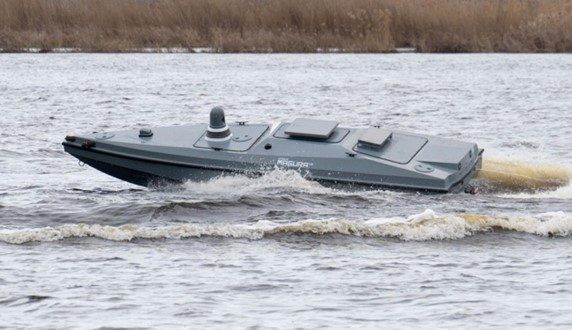
Ukraine has made effective use of sea drones, surface vessels and other new technology to take on Russia’s traditional naval fleet in the maritime arena. Despite initially entering the war with a very depleted resources, Ukraine has leaned into the scrappy side of asymmetric warfare to do a lot of damage against a much bigger enemy.
Yet sea access and domination remain very high priorities for Russia, so it will continue to rebuild and fight to secure them. “The blunt reality is that the presence of a strong Russian fleet will perpetually threaten shipping, ports, and infrastructure,” write Alina Frolova and Stepan Yakymiak for the Carnegie Endowment’s Russia Eurasia Center. “It will always provide Moscow with a lever for the coercion of Ukraine and Europe.”
Now, as it aims for longer-term security at sea, Ukraine is looking at how to upgrade its approach beyond single-use attritable weapons into larger systems that can be tailored for specific scenarios, with equipment that can be reused. That includes taking vessels like the Magura V5 (pictured above), best known for being used in kamikaze missions, and improving their modular and re-usable capabilities.
That shift was the focus of the inaugural DIH Naval Forge, held in Kyiv on June 8–9. More than 300 military representatives, Nordic defense officials, investors and maritime technology companies from over 20 countries gathered for the two-day forum, which combined panels, pitching and matchmaking with live demonstrations of unmanned maritime systems near Kyiv.
Speakers and panelists instead described a shift from kamikaze USVs toward modular, multi-role systems able to support different missions, including strike, reconnaissance, air defense and the launch or transport of other unmanned platforms.
For Ukraine’s partners, the forum offered a direct view into that transition.
Nordic officials and companies framed cooperation with Ukrainian units and manufacturers as a way to connect European industrial capacity with battlefield-tested requirements emerging from the Black Sea.
Speakers repeatedly returned to the same basic point: the decisive advantage is not any single platform, but the speed with which units, engineers and manufacturers can adapt systems to changing Russian defenses.
“Ukraine…has reshaped what we understand to be possible in maritime defence. Unmanned systems, asymmetric tactics, technology built fast and tested faster — this is the frontier of naval warfare, and it is happening here” said Esben Gadsbøll, co-founder of the Defense Innovation Highway.
During a keynote speech, Yuriy Kochevenko, commander of the Unmanned Surface Vehicle Division of the 412th Nemesis Brigade, pointed to the first downing of a Shahed drone by an interceptor drone launched from a surface platform as a sign that unmanned maritime systems are beginning to blur the line between naval warfare, air defense and drone operations.
“We will never reach a final, static technical solution. A commander’s primary mission is to build a team that is agile, swift, and highly adaptable to emerging challenges. Ultimately, it is not the technology that secures victory – it is the people,” Kochevenko said.
Kochevenko also discussed how unmanned maritime platforms can extend the operational reach of aerial systems, including heavy bomber drones, allowing Ukrainian forces to threaten targets that would otherwise be difficult to reach from land-based launch points.
Panelists described future maritime drone operations less as the work of individual one-way attack boats and more as coordinated groups of unmanned systems, with different platforms configured for different roles. In such a formation, one USV might support air defense, another could launch FPVs or other aerial drones, while a third could carry a strike payload.
According to participants, one of the most critical operational challenges in the Black Sea is denying Russia freedom of action in the airspace above maritime operating areas.
“The enemy has built a layered defense in which it has involved absolutely every force and asset one can imagine. For example, during an operation, one unmanned boat can be targeted by three Lancets, two Sukhois, and one helicopter,” said Andriy Maksymenko, commander of the Ukrainian Navy’s Unmanned Systems Department.
‘Every formation of unmanned boats is unique’
That threat environment forces Ukrainian units to treat each maritime drone mission as a bespoke operation rather than a repeatable template. Formations can change shortly before launch based on weather, sea state, enemy aircraft activity, deception measures or updated intelligence.
“Every task is unique. Every formation of unmanned boats is unique,” Maksymenko said. “When you build or arrange a tactic or formation, you are guided by the information you have on the day of the operation. Therefore, the formation can be changed within an hour. Everything can be reconfigured and replanned because the situation has changed.”
During the second day of the forum, live tech demonstrations were conducted at a testing ground near Kyiv, where Ukrainian maritime drone developers showed systems to foreign delegations, investors and military representatives. The demonstrations underlined the central premise of the event: Ukraine’s maritime drone sector is no longer only seeking donations or finished foreign systems, but deeper integration with partners able to support production, payload development, testing and procurement.
Norwegian company Maritime Robotics demonstrated their Sentry Target USV before donating to a Ukrainian frontline operational unit, according to organizers. The company said the system’s payload capacity, upgradeability and experience in Arctic conditions made it suitable for operational use.
The Nordic presence at the event also pointed to a wider defense-industrial strategy. Organizers and speakers cited the so-called Danish model of defense procurement, under which international funding is directed to Ukrainian manufacturers, as a possible template for scaling maritime unmanned capabilities. In the naval domain, that approach could help reduce delivery timelines while allowing foreign partners to support Ukrainian systems already shaped by operational feedback.
The challenge now is whether Ukraine and its partners can scale that process without slowing it down. The Black Sea campaign has relied heavily on rapid iteration between operators and engineers, but larger production runs, foreign financing and multinational cooperation bring their own challenges.