Defence tech investing continues to heat up in Europe amid strong calls for re-armament across NATO and the ongoing war in Ukraine against Russia. Cambridge Aerospace, the startup out of the UK building counter-drone defence systems, is very close to announcing a big new funding round. Sources close to the company tell Resilience Media that it’s raised $300 million at a post-money valuation of $3.4 billion.
US investor DFJ is likely to be leading the round, with previous backers including Never Lift (the company’s first investor, as Resilience Media reported last year) among them.
Some but not all of this lines up with previous reporting about this funding round while it was in the works. Bloomberg in June noted the same amount being raised with the same lead investor, but at a higher $3.5 billion value. Just two months earlier, those figures were somewhat lower: $200 million at a $1 billion valuation, an increase that speaks to the heat in the market right now.
The figures we have seen may change. Resilience Media understands the round is closing now and likely to be made official within days. We have reached out to representatives for Cambridge Aerospace who declined to comment at this time.
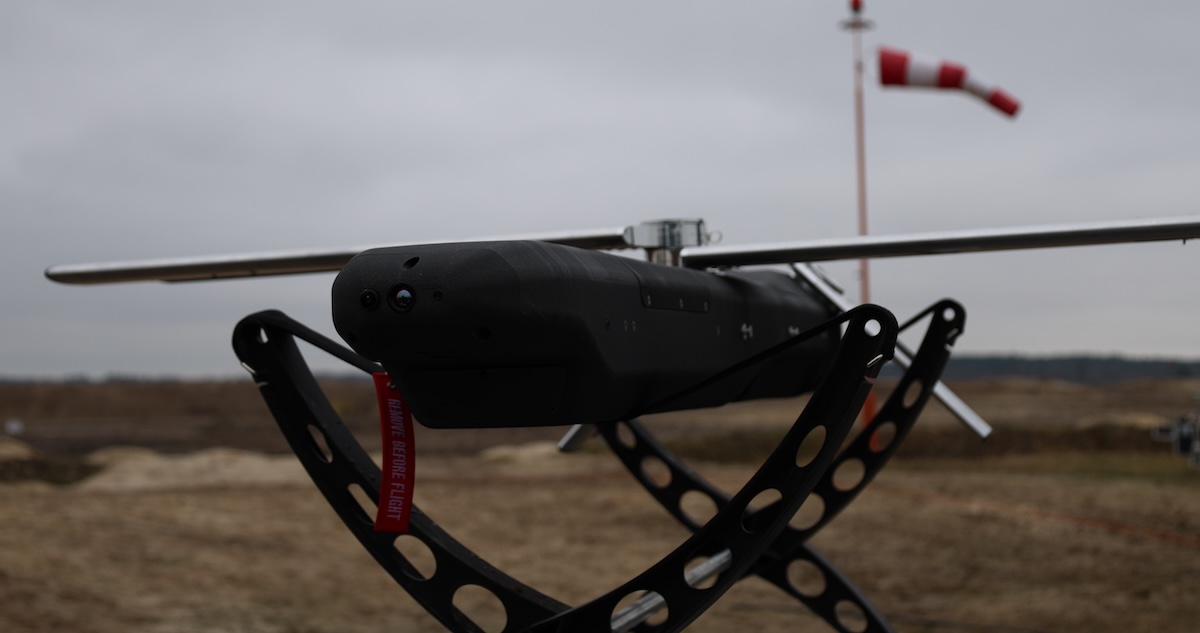
If all goes to plan, this is a big valuation leap for Cambridge Aerospace, which is less than two years old and last raised funding at a $400 million valuation. Prior to this newest investment – before launching a single product – the startup had picked up $136 million across three previous funding rounds. More recently, it has unveiled its flagship Skyhammer drone interceptor, with plans for more systems for air and other domains.
Other backers have included Accel, Lakestar, Lux, Spark Capital, and individual investor Elad Gil.
The jump in valuation is like due to a number of factors: the wider climate for defence tech startups, the company’s own pace of activity, and its background.
Cambridge Aerospace is co-founded and led by Professor Steven Barrett, a former MIT researcher who is now based at Cambridge University. His co-founders include a former Anduril executive, Chris Sylvan, who left the neo-prime to build Cambridge Aerospace; Junaid Hussain; and – a little controversially – former UK defence secretary Grant Shapps. Shapps had been the startup’s chair, providing “strategic guidance,” Barrett told Resilience Media last year. In May, he stepped down from that role after a watchdog probe.
The startup’s pace of activity, meanwhile, has accelerated as the UK and other countries across NATO stock up on systems that match, and hopefully exceed, technology used by adversaries.
The startup now has more than $140 million in signed contracts, along with apparently another $5 billion in the pipeline, according to correspondence leaked to Resilience Media.
It’s not clear how many Skyhammer systems Cambridge Aerospace is currently producing, but Barrett last year said the goal was to make “hundreds per month” – a rate that this new funding could help achieve.
The UK earlier this year said it would be purchasing “a significant number” of the company’s Skyhammer flagship interceptor drones, although it did not attach a value to the announcement. Earlier this week, Cambridge Aerospace separately won a deal – worth a modest £3.16 million – alongside Frankenburg and Greenjets to supply anti-drone systems to the five-nation consortium that includes the UK, Italy, France, Poland and Germany.
It is also hiring and expanding in the UK and beyond. It seems to have recently recruited a new person to lead on guidance, navigation and control out of Munich, for example.
Add to this the hive of funding activity that has been buzzing – Helsing raising $1.8 billion at an $18 billion valuation; Kraken raising $175 million in funding at a $1 billion valuation; Dominion Dynamics raising $100 million at a $400 million valuation; Quantum Systems raising $1.2 billion valuing it at $8 billion; and Stark raising $570 million (€500 million) valuing it around $3 billion, among many others – and you have the context for this funding round.
Barrett’s expertise is in aerospace engineering, and he has proven to be prescient when it comes both to his own company and the factors that would contribute to its growth.
He told Resilience Media last year in an interview that he registered the name for the company when he was still at MIT, before he moved to another world-leading university for engineering.
“I actually registered Cambridge Aerospace while I was still at MIT, not knowing whether it would end up in Cambridge, Massachusetts, or Cambridge, England,” Barrett said.
Barrett is one of the industry leaders who has regularly talked about the need for more cost-effective defence solutions. As the plea goes, western countries need to move away from a sole reliance on “exquisite” missile systems that can cost in the millions per unit to defend against swarms of low-cost drones, such as the ones used in Ukraine (both by Ukrainians and Russians) and in the Middle East, where the Shahed drones from Iran have proven to be effective against a US missile onslaught. The cost of Skyhammers is not known, but one report in The Aviationist suggests sources at the company have estimated that pricing for systems is equivalent to that of Shaheds (around $20,000-$50,000).
“Using a million-pound missile against a Shahed isn’t sustainable,” Barrett said in September 2025, many months before US warring kicked off in Iran and the wider Middle East. “We’re focused on building interceptors that are reliable and affordable, capable of protecting critical infrastructure with very high assurance.”