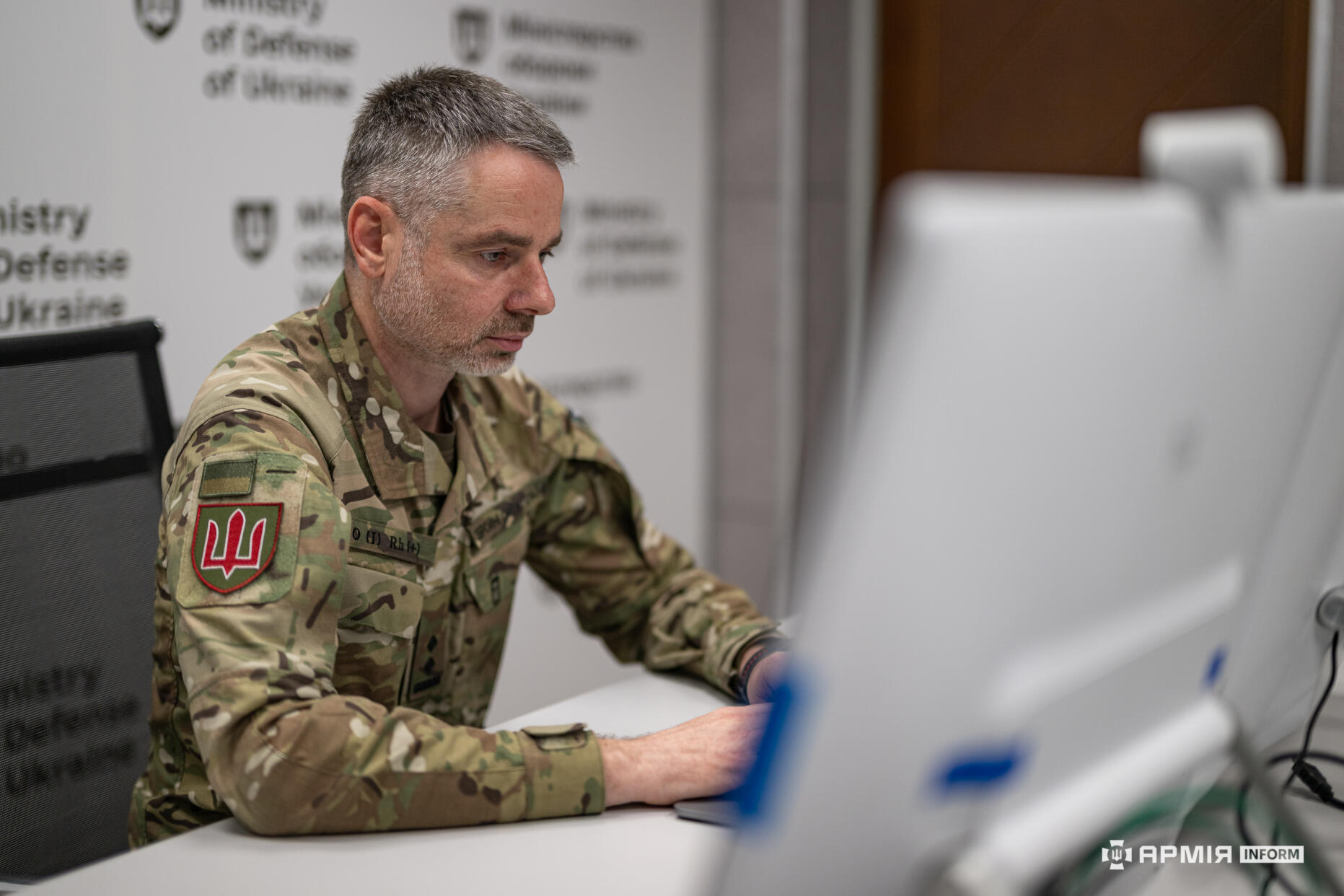
Ukraine has a new inspector general in its Ministry of Defence: Yurii Myronenko, appointed on Wednesday evening to evaluate the effectiveness of MoD decisions on the battlefield and identify corrections when they fail. “A real picture from the front and rapid feedback for management decisions,” in the words of the defence minister, Mykhailo Fedorov.
The appointment is one of a flurry of recent executive changes in the MoD as it continues to recalibrate in its war against Russia, which invaded Ukraine just over four years ago.
Fedorov himself only ascended to minister of defence in January. Shortly after, he announced a new set of deputy ministers. Then Wednesday, at the same time as naming Myronenko the new Inspector General, Fedorov also announced Mstislav Banik as another deputy minister overseeing procurement. Yet one more deputy minister, focused on finance, is likely to be announced this week, we understand.
And until yesterday, Myronenko was also among the deputy minister ranks. We happened to be the last outlet to speak to him in that role, days before his new appointment.
In that exclusive interview, Myronenko spoke at length about his plans to turn Ukraine into a global supplier of battlefield data.
A key centrepiece of that, he said, is its new AI development environment. Launched on March 12, the platform provides international partners with real combat data for training autonomous systems.
Myronenko shared extensive details on Ukraine’s data strategy — a clear signal of where the opportunities may lie for defence tech companies both inside and outside the country. But getting things to work more efficiently is also part of the country’s wider challenge at the moment.
In one of Fedorov’s first speeches as minister of defence, he noted that the country has a list of 2 million people who are expected to be reporting for duty — meaning, they are not — and another 200,000 soldiers who have gone AWOL. The MoD has room to improve how it operates, and that is, essentially, what Myronenko will be working on.
Before entering the ranks of ministry executives, Myronenko was a soldier himself, giving him first-hand experience for his new role of improving the alignment between ministry ideals and frontline reality.
From UAS operator to UAS data enabler
In the age of AI, where extensive data is essential for building good systems, Myronenko highlighted the repository’s unmatched scale as what makes it valuable.
“It’s important to understand the uniqueness of this dataset we have,” he said. “We’re talking about millions of marked objects collected from both daytime cameras and infrared cameras. These objects include tanks, artillery systems, air defence systems, cars, Shaheds, and infantry. And this dataset is constantly updated.”
According to the Ministry, Ukraine is the first country in the world to grant its partners access to real battlefield data for AI model training. Myronenko believes the platform will particularly appeal to UAV developers.
“This constantly updated dataset lets drones perform their functions on a new level, even when there are problems with communication. And obviously, in battlefield conditions, there’s always problems with communications,” he said.
Myronenko has dealt with these problems in the field. Before he was appointed deputy defence minister last July, he commanded a drone unit on the strategically vital front lines of Zaporizhzhia. He also defended Kyiv at the start of Russia’s full-scale invasion as a member of the Territorial Defence Brigade. These accomplishments earned him the Silver Cross and Steel Cross.
After entering government, he chaired the SSSCIP, a national security and cyber defence agency, where he launched a procurement system that supplied over 1 million drones to the military. He later led the MoD’s Centre for Innovation and Development of Defence Technologies, where the new platform was set up.
DELTA force
Inside Ukraine, the system’s datasets already train neural networks to identify aerial targets in DELTA, the situational awareness system that Myronenko helped implement. The March launch expands access to the global market.
“This data access has been key to success for our companies, and we believe that it will also be very important for success for international companies,” Myronenko said.
Pushed on the benefits to Ukraine, Myronenko downplayed the allure of financial incentives and sidestepped the question of a commercial fee. Instead, he highlighted the platform’s potential to advance Kyiv’s own autonomous systems and other frontline technologies.
‘We try to create intermediaries between the military and the market, because the military doesn’t naturally speak the language of business and vice versa.’
“Our highest priorities are companies from our nearest partner countries, which allow us to solve specific military objectives… Maybe a country can help us with other data, maybe with resources, maybe with ammunition,” he said.
One key attraction for those countries is the platform’s data curation. Myronenko says the MoD handpicks the best samples, ensuring they cover diverse conditions — from weather to time of day — and keep the system up-to-speed with events on the battlefield.
“Because the nature of the war is constantly changing — the technology, but also the application of the cameras, the distances, the angles, etcetera — the fact that this data is constantly updated allows different companies to keep developing,” he said.
That rate of change is integral to the plans to build a global hub for defence data.
The data-driven military
Military command, Myronenko explains, has shifted to a real-time, data-driven operating system for the entire country.
With around 900,000 troops on active duty and plans to make 7 million military drones in 2026, Ukraine’s defences have grown too vast for individuals to review. Instead, the country relies on technology to analyse millions of data points simultaneously.
“We study everything that happens: how reconnaissance works — including from space — how drones work,” he said, “what EW systems are working and what they’re doing, which asset, whether artillery or drones, has hit more targets on any particular day.”
The data flows up from the frontline and then returns as insights. Military leaders, meanwhile, can monitor the impacts online in near real-time. Instead of waiting months to see whether a drone is accurate or a missile is cost-effective, they can address the issue within hours. They can also assess where and when to place troops and resources. “We can predict a lot of things because we have a lot of data,” he said.
This shift reaches the very top of the command chain. “Every day, top management — including the President — sees a data report, not a paper report. We see all information online, and we don’t spend one year to analyse what happened.”
The new data platform is not the only new initiative benefiting from this data. The MoD also recently launched Mission Control, which centralises all UAV operations into a single digital environment.
Each drone crew enters operational data into the system, including drone type, launch location, flight route, and mission task. Mission Control then automatically generates battlefield insights, quantifying the success of individual units.
Another system, Avengers AI, scans video footage to confirm the damage done to a target. This data is then fed into a “cost-per-kill” metric, which guides the funding allocated to individual drone manufacturers and units.
All these data-driven schemes turn a fragmented army into what Myronenko calls “one big team” sharing findings to maximise efficiencies.
He argues that Ukraine’s allies in the Middle East have much to learn from the insights. The veteran commander points to his country’s unparalleled intelligence on Shahed drones, which are now raining down on Israel, US military bases, and Gulf state partners. Russia has launched over 57,000 such UAVs on Ukraine since the full-scale invasion began, giving the country unique insights into intercepting them.
Fighting them requires a blend of data from real-time drone tracking, signal intelligence, battlefield telemetry, satellite imagery, and intercepted communications. Ukraine has built “software specially made for intercepting Shaheds,” Myronenko said, which provides an extra level of coordination. He also notes that Ukraine frequently downs these UAVs with far cheaper systems than the multi-billion-dollar Patriot PAC-3 missiles being launched by the US.
Information security
As a global supplier of battlefield data, Ukraine will have to prevent sensitive information from falling into the wrong hands. How will the country prevent the new platform from revealing troop movements, for instance, or new military technologies?
“On our part, we believe we have solved this problem,” Myronenko said.
He said that the platform is built on frameworks set by the American National Institute of Standards and Technology (NIST). Leading consulting firms have also been involved in how it has been set up, although he did not disclose which specifically. “In testing the security of the system, we don’t even trust ourselves,” he said. “We use the annual Big Four’s audits.”
Further monitoring was provided by the Ukrainian state special communications company. For what it’s worth, it “gave us very high marks,” he said.
“We’ve obviously put a lot of time into separating our data so that platforms don’t have access, basically installing another platform between the dataset and the client, such that third-party software has no access to our data on its own,” he said. “It’s a very complicated technical solution.”
Security, however, must be balanced with speed. Myronenko argues Ukraine’s survival depends on being “faster and smarter” than its resource-heavy adversary, Russia. He emphasises that the army has shifted from a slow, rigid bureaucratic model to rapid rollouts of effective innovations and swift termination of failed ones.
A key part of this shift is forging links between the public and private sectors — a bond the new AI training platform seeks to strengthen.
“We try to create intermediaries between the military and the market, because the military doesn’t naturally speak the language of business and vice versa,” Myronenko said. “So we try to make it such that they can talk to each other, and we use data to see what works and what doesn’t.”
Yet there is no perfect data, he admits. Quoting the boxer Mike Tyson, he notes that even the greatest AI can’t predict everything.
“We try to have a plan,” he said. “But there’s the famous dictum: everyone has a plan until they get punched in the face.”