Tuesday 24 March, 2026
[email protected]
Resilience Media
  • About
  • News
  • Resilience Conference
    • Resilience Conference Warsaw 2026
    • Resilience Conference Copenhagen 2026
    • Resilience Conference London 2026
  • Guest Posts
    • Author a Post
  • Subscribe
No Result
View All Result
  • About
  • News
  • Resilience Conference
    • Resilience Conference Warsaw 2026
    • Resilience Conference Copenhagen 2026
    • Resilience Conference London 2026
  • Guest Posts
    • Author a Post
  • Subscribe
No Result
View All Result
Resilience Media
No Result
View All Result

The UK Needs to ‘Raise its Gaze’ when it comes to subsea cable defence

There have been growing shenanigans on the high seas with subsea cables a key target among malicious actors. A new report sets out what the UK needs to do be prepared to protect this critical asset

Tom PashbybyTom Pashby
September 19, 2025
in News
Share on Linkedin

Subsea cables — and the communications and technology that they enable — are an unsung but very essential part of the infrastructure that keeps a country up and running. So in times of geopolitical turmoil, keeping them secure becomes a growing priority. But it’s not so everywhere, it seems.

You Might Also Like

Meet the company preparing for a world without GPS

How the Element CEO secured communications in thirty-four countries

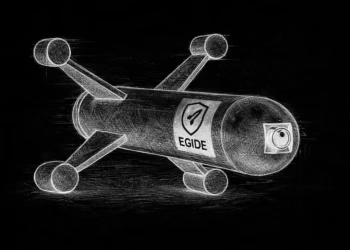
Egide lands €8M to build low-cost interceptors as Europe races to counter drone swarms

A report published today by a government body in the UK concludes that the country is not doing enough to protect that infrastructure for itself. It needs to “raise its gaze” when it comes to cables laid down deep under water.

The report, authored by MPs and Peers on the UK’s Joint Committee on the National Security Strategy after gathering evidence from academics, military and security personnel, financial services experts, telecoms experts and more, found that the UK has been “too timid” when it comes to protecting its subsea cable infrastructure. As such, it has become a strategic vulnerability.

“For many years the UK’s internet connection has been based on assumptions about international stability and commercial efficiency,” the report notes. “As the geopolitical outlook worsens, now is a good time to take stock of our security and resilience arrangements.”

The report calls for the country to adopt a series of new measures to improve how it responds to subsea cable issues and attacks in the future; and to deter and penalise those who might cause damage.

Responses include building skilled teams to repair cables; acquiring a cable repair ship by 2030; and building out contingency plans for the hundreds of critical services across a range of sectors — including financial, military, technology and telecommunications — that rely on subsea cables working.

Deterrents include improving monitoring schemes; more data sharing between law enforcement agencies nationally and internationally; legal sanctions; and what it terms “direct physical interdiction and prosecution of suspicious vessels and crew.” (The last of these judiciously, given this too could lead to escalating engagement.)

Today, there are about 570 subsea cables globally, most of them run by private companies that provide services to classic telecoms carriers through to major tech companies like Google and Meta. Collectively, they carry between 95% and 99% of the world’s long-haul telecoms data.

The UK, being an island, is especially reliant on functioning subsea cables for its communications infrastructure. So why is the defence of these assets not getting more attention?

The answer, it seems, lies in the fact that most of the threat up to now has been in the abstract.

“Severe disruption risks are low, and hype is unhelpful,” the authors of the report note. “Extensive damage is not likely outside a period of heightened tension.”

That has been shifting, however. In January 2025, the Royal Navy reported tracking a Russian spy ship, the Yantar, in UK waters, including loitering over critical undersea infrastructure (pictured above).

“My message to President Putin is clear. We know what you are doing, and we will not shy away from robust action to protect Britain,” Defence Secretary John Healy said in January. The UK worked closely with NATO on tracking the ship, and that appears to be a template that the UK would continue to pursue.

As with a lot of reports issued by government committees, this one is focused more on learnings and recommendations and less on execution and mandates. But across more than 70 pages, it provides a wide survey of the current issues facing the defence profile for subsea cables. For example, monitoring, even at its best, has a lot of flaws to it due to inconsistency in how boats are tracked (and how easily they can hide).

It also does not touch the topic of how to improve defence. That is something that a lot of defence tech companies are pursuing with the development of nautical drones and other AI-based hardware.

It’s still a strong start for an area that has been undervalued, despite the billions of dollars in value that these subsea cables represent.

“Undersea cables are the invisible backbone of the internet. Everything from everyday WhatsApp messages to financial transactions worth billions of dollars are carried through this network,” Matt Western, Chair of the Joint Committee on the National Security Strategy, said in a statement on the report. “The scale of the UK’s strategic reliance needs to be taken more seriously.”


Tags: John HealyMatt WesternNational Security StrategyUK
Previous Post

OpenAI Launches Stargate UK With the Promise of Sovereign AI Infrastructure

Next Post

More money is coming to defence tech VC, but is the market ready?

Tom Pashby

Tom Pashby

Tom Pashby (they/them) is a senior reporter at New Civil Engineer in the UK, and is a freelance contributing reporter at Resilience Media. At Resilience Media, they cover nuclear, hypersonic and ballistic missile defence, and critical national infrastructure, as well as wider defence tech news.

Related News

Meet the company preparing for a world without GPS

Meet the company preparing for a world without GPS

byJohn Biggs
March 23, 2026

The modern world runs on signals most people never see. GPS, the world's position system, now guides trucks, times financial...

How the Element CEO secured communications in thirty-four countries

How the Element CEO secured communications in thirty-four countries

byJohn Biggs
March 23, 2026

https://youtu.be/G9c3SAGx3HU Matthew Hodgson has spent more than a decade working on a question most people never think to ask: what...

Egide lands €8M to build low-cost interceptors as Europe races to counter drone swarms

Egide lands €8M to build low-cost interceptors as Europe races to counter drone swarms

byCarly Page
March 23, 2026

French defence startup Egide has raised €8 million in seed funding to develop a new class of low-cost interceptors aimed...

Defence Tech Valley 2025: Kicking Around Military Innovation at a Football Pitch

Brave1 packs rooms in the US with its Ukraine defence tech roadshow

byLuke Smith
March 23, 2026

Three years into the most drone-intensive conflict in history, Ukraine has built a defense tech industry that the world has...

a large flock of birds flying over a field

The Perfect Swarm: How Swarmer got its timing just right – by accident – and saw its US IPO pop

byIngrid Lunden
March 20, 2026

Timing accounts for a lot in business. Such was the case for Swarmer, a startup out of Ukraine that develops...

Announcing the Resilience Conference Warsaw Agenda

byLeslie Hitchcockand1 others
March 19, 2026

We are excited to announce the agenda for Resilience Conference Warsaw, 15 April 2026. This is the first conference of...

HyImpulse eyes first European launch from SaxaVord as UK space ambitions gather pace

HyImpulse eyes first European launch from SaxaVord as UK space ambitions gather pace

byCarly Page
March 19, 2026

German aerospace startup HyImpulse has signed a launch agreement with SaxaVord Spaceport in Scotland to carry out the next flight...

a view of a city from the top of a building

The UK is setting up meetings between Gulf states and defence tech startups

byIngrid Lunden
March 18, 2026

The last few weeks have seen the UK stepping up its direct military engagement in the Middle East to defend...

Load More
Next Post
More money is coming to defence tech VC, but is the market ready?

More money is coming to defence tech VC, but is the market ready?

MITS Capital Launches Danish-Ukrainian Defence Company

MITS Capital Launches Danish-Ukrainian Defence Company

Most viewed

InVeris announces fats Drone, an integrated, multi-party drone flight simulator

Uforce raises $50M at a $1B+ valuation to build defence tech for Ukraine

Auterion, the drone software startup, eyes raising $200M at a $1.2B+ valuation

Twentyfour Industries emerges from stealth with $11.8M for mass-produced drones

Senai exits stealth to help governments harness online video intelligence

Palantir and Ukraine’s Brave1 have built a new AI “Dataroom”

Resilience Media is an independent publication covering the future of defence, security, and resilience. Our reporting focuses on emerging technologies, strategic threats, and the growing role of startups and investors in the defence of democracy.

  • About
  • News
  • Resilence Conference
    • Resilience Conference Copenhagen 2026
    • Resilience Conference Warsaw 2026
    • Resilience Conference 2026
  • Guest Posts
  • Subscribe
  • Privacy Policy
  • Terms & Conditions

© 2026 Resilience Media

No Result
View All Result
  • About
  • News
  • Resilence Conference
    • Resilience Conference Copenhagen 2026
    • Resilience Conference Warsaw 2026
    • Resilience Conference 2026
  • Guest Posts
  • Subscribe
  • Privacy Policy
  • Terms & Conditions

© 2026 Resilience Media

This website uses cookies. By continuing to use this website you are giving consent to cookies being used. Visit our Privacy and Cookie Policy.