The ballistic missile defence capabilities of the US, UK and other allies have been put to the test as the Iranian armed forces fire missiles and drones at targets in its neighbouring countries across the Persian Gulf, in response to the ongoing US and Israeli attacks against Iran that started on 28 February 2026.
“Major combat operations” by the US military – codenamed Operation Epic Fury – were triggered seemingly out of the blue, with mixed messages around the wider rationale for attacking Iran. The US Secretary of State said it was to prepare against retaillations after Israel warned the US it was about to attack Iran; the US President said it acted on its own intelligence of an imminent threat around nuclear capabilities and Iranian aggression.
Be that as it may, the operation has been somewhat clearer on its bigger objectives: preventing Iran from obtaining a nuclear weapon (and the means to make one); regime change; and destroying its ballistic missiles.
Two of these have seen mixed outcomes. Iran’s supreme leader Ayotollah Khamenei was killed, but he was soon replaced by his hardline son. Nuclear capabilities, meanwhile, posed a complicated picture even before the operation kicked off and some have cast doubt on what Iran’s nuclear capabilities look like today.
Yet the third of these – the ballistic missiles – has been one of the more persistent threats, and is the one that has enmeshed further countries in the conflict. It was a ballistic missile headed for Turkey that NATO intercepted earlier this month. It was ballistic missiles threatening UK citizens abroad in the Gulf that compelled the UK to open its own bases to the US Air Force to launch “defensive” strikes against targets inside Iran aimed at sites associated with Iran’s ballistic programme. And it’s ballistic missiles that continue to make headlines daily in reports of Iranian strikes.
To be clear, some Iranian missiles are being intercepted; and the country is pursuing a second track of attack weapons, also launching a large number of uncrewed aerial systems (UAS) – seemingly Shahed drones and variants – across a number of its campaigns.
But there are indications that its ballistic artillery may not yet be exhausted. One report released earlier this month from Alma, a research group in Israel, cited IDF (Israel Defence Force) figures that estimated Iran had some 2,500 missiles as of February 2026, along with facilities to develop more. These, author and Alma head of research Tal Beeri notes, are primarily short-range and medium-range ballistic missiles (respectively up to 1,000km and 1,000-3,000km), but it adds that there are multiple reports that say Iran’s long-range missile programme (over 3,000km) is “currently in advanced stages of development.”
Videos published on social media and on news websites appear to show other ballistic weapons successfully penetrating integrated air and missile defence (IAMD) systems in areas linked or allied to the US.
Iran’s ‘powerful weapons’ killed American service personnel – US secretary of war
At a press briefing at the Pentagon on 2 March, Chairman of the Joint Chiefs of Staff Gen. Dan Caine and Secretary of War Pete Hegseth updated reporters on the “major combat operations” the US military launched against Iran on 28 February.
The briefing started with a broad breakdown of the offensive actions the US military had taken against Iran, but also moved into explaining some of the defensive moves the US has had to make in response to Iranian drones and missiles targeting US assets and bases.
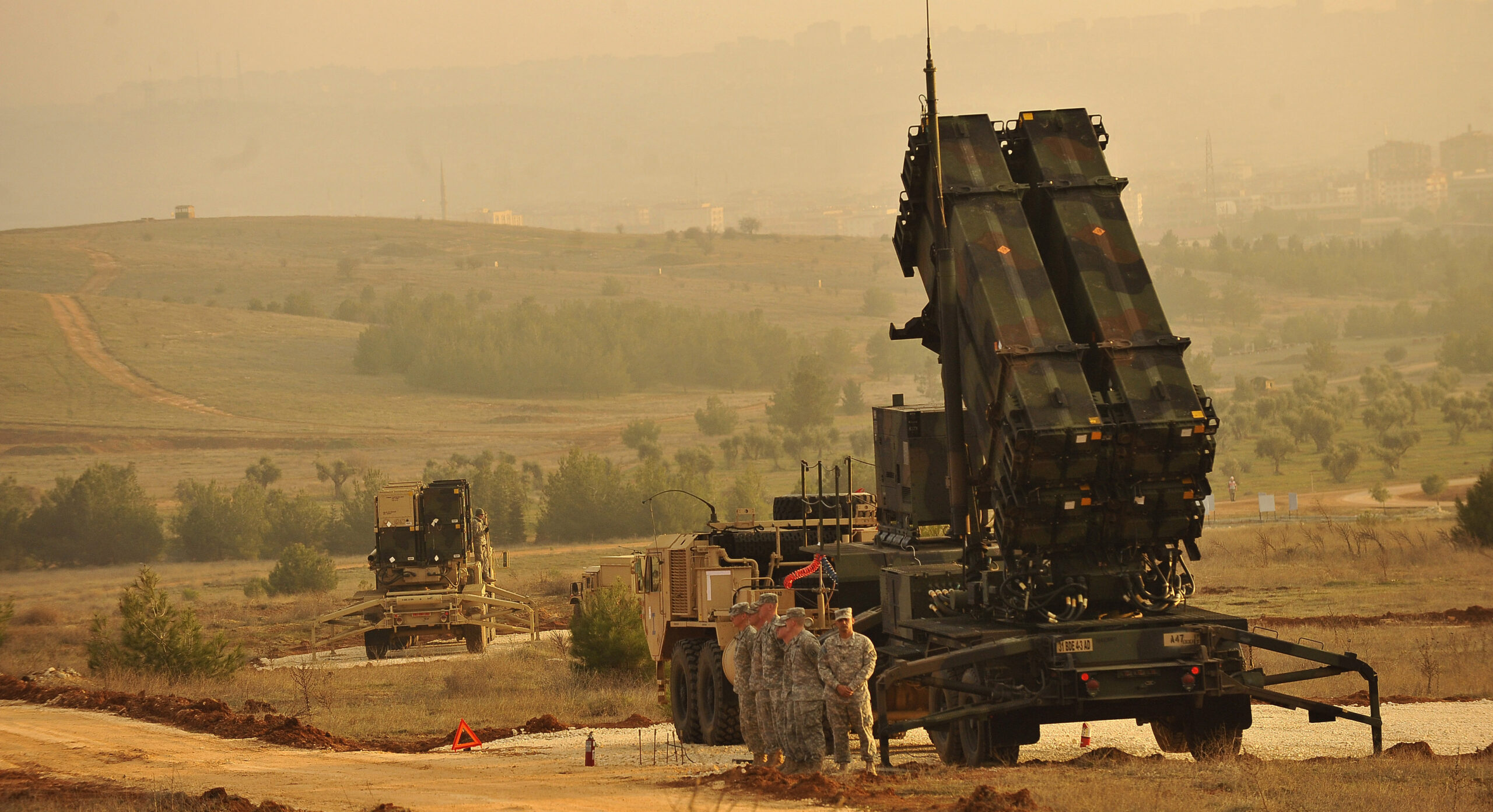
“While we’ve prosecuted a relentless offensive campaign, our defense has been equally important. Across the theater, operations have remained steady and disciplined,” Caine said. “Once again, our integrated air and missile defense network is performing exactly as it’s intended. US Patriot and THAAD batteries along with ballistic missile defense-capable Navy destroyers continue to coordinate and execute intercepts with precision and consistency.”
Raytheon is the overall contractor for Patriot air and missile defence system, including the batteries, while Lockheed Martin makes the missiles. Lockheed Martin is also the lead on THAAD systems and the PAC-3 family of missiles within the Patriot system.
A fact sheet from Lockheed Martin dated 2024 notes that “Seventeen nations have chosen PAC-3 for missile defense.” The website further clarifies that these are US Partner nations.
“The PAC-3 family of missiles are combat-proven Hit-to-Kill interceptors that defend against incoming threats – including tactical ballistic missiles, cruise missiles, advanced threats and aircraft – using direct body-to-body contact that delivers exponentially more kinetic energy on the target than can be achieved with blast fragmentation mechanisms.”
THAAD batteries are also produced by Lockheed Martin, with Raytheon as the lead contractor.
Lockheed Martin’s website marketing the THAAD system says: “The Terminal High Altitude Area Defense (THAAD) is a highly effective, combat-proven defense against short, medium and intermediate-range ballistic missile threats. THAAD is the only U.S. system designed to intercept targets outside and inside the atmosphere.” THAAD also uses PAC-3 missiles.
The product page on the company’s website says there are 10 active THAAD batteries – 7 in the USA, 2 in the UAE and one in Saudi Arabia.
Caine continued: “I wish that every American could hear the voice communications like I have as these joint operations centers remain calm, focused, and cool while executing under fire over and over again. Collectively, these systems have intercepted hundreds of ballistic missiles targeting US forces, our partners, and regional stability.”
He later added: “The defense of the region is not ours alone. As the threat grew, our partners surged in beside us. Air defense batteries in Qatar, the UAE, Kuwait, Jordan, and Saudi Arabia joined the fight, proof positive that years of training, trust, and hard-earned integration pay off.”
Secretary of War Pete Hegseth added: “We are aggressively pushing into that airspace over that southern flank [of Iran] to ensure that we control it and we destroy anything that moves that would attempt to shoot us. Think of it as shooting the archer instead of the arrows. That’s where we want to be.”
Asked by a reporter for more information on how Iran killed the US service personnel who lost their lives in the initial hours of the war, Hegseth said: “You have air defenses and the lot’s coming in and you hit most of it. And we absolutely do. We have incredible air defenders.
“Every once in a while you might have one. Unfortunately, we call it a squirter that makes its way through. And in that particular case it happened to hit a – a tactical operation center. That was — that was fortified. But these are powerful weapons.”
Prime Minister informed MPs UK military intercepting Iranian missiles
A Ministry of Defence spokesperson told Resilience Media that the government wouldn’t be answering any additional questions on the ballistic missile defence capabilities it is deploying against Iran, beyond what the Prime Minister had already said in his update to the House of Commons on Monday 2 March 2025.
In his speech to MPs, Prime Minister Keir Starmer indicated that UK armed forces were intercepting Iranian missiles in the region. The word ‘missile’ is a broad term that may include ballistic missiles and missiles which are not ballistic, such as cruise missiles.
“We put British jets in the air—Typhoons and F-35s—as part of co-ordinated defensive operations. They have already successfully intercepted Iranian strikes, including taking out one drone that was heading towards a coalition base in Iraq that is housing UK service personnel,” Starmer said.
He added: “It is simply not possible to shoot down every Iranian missile and every drone after they have been launched. The only way to stop the threat is to destroy the missiles at source—in their storage depots, or at the launchers.”
House of Commons Defence Select Committee chair Tanmanjeet Singh Dhesi MP asked: “I am extremely concerned about the safety of the millions of people in the region, including the thousands of Brits who live there or are currently stranded there.
“Will the Prime Minister please confirm what steps are being taken to ensure their safety, especially from the one-way attack drones?”
In response, Starmer said: “In relation to the protection of our citizens, we will obviously continue operating defensively in the air in the region, taking out the missiles, drones and strikes.”
UK air-defence warship and counter-drone helicopters deployed to region
The next day on Tuesday 3 March 2026, the UK Ministry of Defence (MOD) announced it was sending a warship and helicopters to the region.
“The UK is deploying its cutting-edge warship, HMS Dragon, and drone-busting Wildcat helicopters to the Eastern Mediterranean to boost British defences in the region,” the MOD said in a statement.
“The Type 45 destroyer is one of the most capable air defence warships in the world, and will strengthen the UK’s ability to detect, track and destroy aerial threats, including drones.
“The ship is fitted with the world-leading Sea Viper missile system, which can launch eight missiles in under ten seconds and guide up to 16 missiles simultaneously. Type 45 Destroyers have already been proven on operations, including when one successfully intercepted a Houthi missile in 2024.”
A Royal Navy article from 25 April 2024 that discussed the Houthi missile interception in 2024 did not specify whether it was ballistic.
An official further confirmed to Resilience Media the Sea Viper air defence systems on board the Type 45 Destroyers are capable of intercepting ballistic missiles.
A 2022 article describing the upgrade to ballistic interception capabilities noted, “All six Type 45s – HM Ships Daring, Dauntless, Diamond, Dragon, Defender and Duncan – will be fitted with the Sea Ceptor missile system on top of crucial upgrades to the destroyers’ principal weapon, the Sea Viper.
“Each destroyer carries up to 48 Sea Viper missiles, each held in a vertical-launch silo on the forecastle, each capable of taking out aerial threats at ranges up to 75 miles away, accelerating out of its launcher to reach speeds in excess of four times the speed of sound, manoeuvring for the kill at G forces no human can withstand.
“It relies on two distinctive radar systems – the Sampson (spinning spiked egg) and Long Range (large black slab) – which are able to track hundreds of targets as far as 250 miles away.”
Destruction of key US radar claimed by Iranian state media
Inception systems on not perfect. On 3 March 2026, Iranian state media organisation PressTV reported that Iranian armed forces had destroyed a key US radar asset.
“The largest US radar in the Persian Gulf that was capable of monitoring the entire Middle East, used for early warning with a range of 5,000 km and a price of 1.1 billion dollars, was targeted by Iranian Missiles,” PressTV claimed.
It also shared an image of what looked like a radar similar to the AN/FPS-132 Upgraded Early Warning Radar (UEWR) on fire and with blast damage. The image could not be verified as authentic, however.
AN/FPS-132 Upgraded Early Warning Radar (UEWR) is used to detect ballistic missiles.
Resilience Media approached the Pentagon to confirm or deny whether the image was accurate, and a spokesperson said: “We have nothing to provide.”