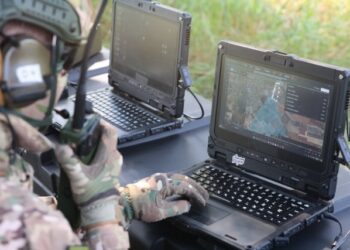

Ukraine is moving to reduce one of its most critical battlefield vulnerabilities: dependence on a single commercial satellite provider for front-line connectivity. After nearly four years of heavy reliance on Starlink, officials are advancing plans for a dedicated military mobile operator, a secure 4G and 5G network designed to function where normal coverage is unreliable.
Recent regulatory steps, including proposed changes to Ukraine’s radio frequency distribution plan and the allocation of 30 MHz in the 700+ MHz band, would allow the Armed Forces to deploy protected private networks using encryption and specialized security protocols. The stated goal is not to replace satellite internet, but to ensure that if access is disrupted, command and control do not collapse.
Allowing and formalizing official network(s) would be a major step forward, not just for redundancy beyond Starlink, but as a foundation for real spectrum governance,” wrote Daniel Connery, a Ukrainian Army Technical Specialist. “With proper oversight, you can coordinate communications and EW across units, reduce interference, prevent unnecessary losses, and protect the pilots doing the fighting.”
The Ukrainian military is exploring two models. One would mirror a virtual operator structure, allowing the military to use civilian infrastructure with dedicated SIM cards, traffic priority, and hardened security settings. The other envisions a fully isolated system with its own frequency resources, network core, and base stations under direct military control. The latter is more complex and expensive, but it would reduce reliance on commercial providers and allow tighter oversight of infrastructure, power, and physical security.
Connery noted that a national carrier would prevent friendly fire in electronic warfare.
“Without centralized spectrum oversight, electronic warfare (EW) and communications efforts aren’t always coordinated across units. The result? EW friendly fire is still a real problem,” he wrote. “It happened to a friend of mine just last week. His drone was taken down by friendly EW interference… and he now has to pay $400 out of his $500 monthly salary to cover the loss.”
At the tactical level, LTE has already become a fallback option. Some units maintain layered connectivity, combining fiber, Starlink, and civilian 4G. If satellite links fail, they switch to mobile internet, provided base stations remain powered. Unfortunately, according to a ePravda report, civilian towers often shut down within hours of power loss, and terrestrial infrastructure is fixed and vulnerable to missile or drone strikes.
Ultimately, this move is about redundancy in the field, something that has become increasingly important with the difficulty and problems of Starlink access in the country.