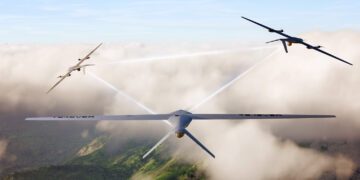
Innovative, low-cost uncrewed aerial system (UAS) technology is at the centre of Iran’s response in the Middle East to the strikes from the US and Israel, with the country estimated to have launched thousands of drones against targets affiliated with US support, and (allegedly) a robust production pipeline for more.
Yet it is unlikely that counter-UAS (C-UAS) systems will get deployed at scale to defend against these.
So claim defence startups talking to Resilience Media. The reasons for this, they say, vary from slow procurement procedures, through to the time it takes to train teams to use the systems, as well as how these challenges align with the timeline that the US has provisionally set for the conflict.
From the opening hours of the US and Israeli attacks against Iran at the end of February 2026, President Trump predicted that the conflict would last four to five weeks.
As of today, there is no definitive indication of what the timeline is, but if it follows that original plan, it could wind up by the first week of April. Defence tech experts believe this would only give enough time for limited roll out of new C-UAS tech, due to supply and integration issues.
“I expect interceptor drones to appear. The key question is whether they can be deployed with available operator teams,” said Origin Robotics’ marketing head Raitis Kipurs. “In cases where the interceptor lacks [full] autonomy” – which is typically the case – “the main bottleneck becomes the need for highly skilled pilots.”
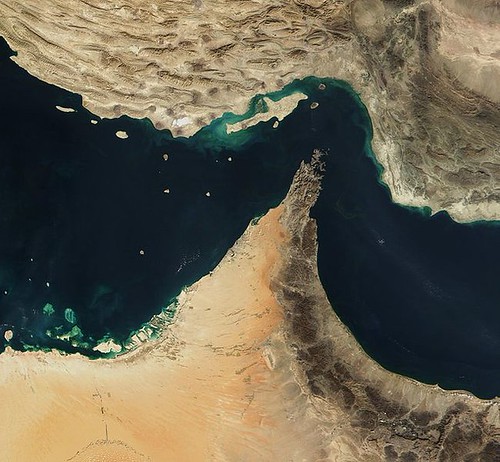
This also points to another outstanding issue, observers say: how contested airspace is managed even between different systems on the same side of the conflict across a multi-domain conflict that is in the air, on land and in the water, extending from the Strait of Hormuz and beyond. The hurdles underscore the bigger challenges of coordination overall in what is, ultimately, a defence and offence that is not one-size fits all.
“The complexity of airspace defence is that there is no one effector that will provide a solution for all types of threats that are out there,” Agris Kipurs, the CEO and co-founder of Origin, told Resilience Media (he and Raitis are brothers).
“It’s a complex problem that requires more than one factor, more than one sensor for protection and effectors for interception. So you have, in order to have a sufficient response, in order to have a truly effective air defence capability, you will have to rely on a multitude of systems.”
Iran’s use of drones is not going completely unanswered. Some companies and militaries are already working to provide limited C-UAS equipment to US allies, and there is evidence that it is precipitating a shift in how the US and its allies are fighting and coordinating defence overall.
Asymmetry is the name of the game
Drones are a pivotal part of how Iran has responded to the US and Israel.
Trump, in a statement at the start of the war, cited the “imminent threats” of Iran’s nuclear capabilities and ballistic missiles as part of the rationale for its Iran attacks.
And Iran has indeed used scores of ballistic assets on the US and its allies in the Gulf region. But is it the country’s drone capabilities that are forcing a rethink of effective integrated air and missile defence (IAMD) in 2026.
Just weeks into the conflict, Iran was already estimated to have fired off at least 2,000 drones against US and allied targets. Units of Iran’s iconic Shahed drone type are estimated to cost between $20,000 and $50,000 and Israeli intelligence sources have estimated that it is producing as many as 400 more each day, with a stockpile of 80,000 at the start of this year.
But Iran’s use of drones for the moment is spurring an asymmetric response. Most commonly, they are being countered with US-made PAC-3 air defence missiles costing millions of dollars apiece, launched from Patriot and THAAD missile defence batteries. The latter cost upwards of $1 billion.
Jan-Hendrik Boelens, CEO and co-founder of C-UAS startup Alpine Eagle, told Resilience Media that IAMD systems in Gulf states are designed to intercept missiles and aircraft – not drones.
In addition to Patriot and THAAD systems for higher-end threats, Alpine Eagle co-founder and CEO Jan-Hendrik Boelens told Resilience Media he and his team are also seeing shorter-range missile systems, electronic warfare tools, and some gun-based air defence as well as other high-cost systems.
“We’re also seeing the increasing use of airborne assets — for example, F-16 fighter jets and Apache helicopters being deployed to intercept drones,” he said. “However, these systems were not designed to deal with large volumes of small, inexpensive drones. They can work tactically, but when used at scale, they create significant economic pressure and strain on limited resources. This underlines the need for mobile, airborne counter-UAS capability.”
Boelens added that traditional IAMD platforms like aircraft and missile batteries “are increasingly being stretched by mass drone attacks, pushing militaries to explore cheaper interceptors, electronic warfare and new sensing approaches.”
The Iranian military’s successful use of asymmetric warfare to exploit the significant economic mismatch of low-cost drones versus the US, Israel and Gulf states’ billion dollar missile-based air defence systems is drawing fresh attention to lower-cost C-UAS systems.
Ukraine lessons, learned slowly
Drone makers have been waiting to see if the US and its allies are willing to take a page from the new book being authored in Ukraine, where forces have been compelled to take a very scrappy approach.
With tight budgets and a need to respond quickly to immediate attacks of Shahed and Shahed-style drones from Russian soldiers, Ukrainian brigades have not only sped up how they procure and learn to use equipment, but they have in some cases taken a part in the development of systems.
And maybe most importantly, they are willing to use kit at the “bleeding edge”: systems are being tested out in live battlefield environments, where repairs and improvements take on a new sense of urgency, too.
“Your shit doesn’t work. Fix it,” is how one tech CEO, Serhii Kuprienko of Swarmer, described the interactions he has had with those on the frontline buying and using his systems.
“Conflicts like these tend to accelerate experimentation with technologies that are already close to operational readiness,” Boelens at Alpine Eagle said, citing lower-cost interceptor drones, electronic warfare systems designed specifically for small UAVs, and distributed sensor networks that can detect drones earlier and track them more reliably.
“Ukraine has already demonstrated that these kinds of systems can be deployed relatively quickly compared to traditional air defence programmes,” he added. “So I would expect incremental deployments rather than completely new systems appearing overnight.”
To some extent, there are efforts being made to help bring more modern systems into the mix.
Last week, the UK government launched a new programme to bring together government and military representatives from Gulf countries directly with a handpicked group of UK defence tech companies to speed up procurement of modern equipment to defend against Iran’s attacks. This is very new, though: we are still waiting to see what fruits the project produces, specifically whether it can move fast enough.
Some signals indicate it may not be picking up critical lessons from Ukraine on that front.
“C‑UAS systems are evolving quickly in response to emerging threats, but any new technologies must be thoroughly tested and validated before deployment,” said a spokesperson from the ADS Group, a UK trade association working to advance the interests of companies in the aerospace, defence, security and space sectors. ADS worked on the new effort with the Ministry of Defence.
The talent gap
While inking deals to source drones remains a significant hurdle, so too is the talent to operate them.
“You need time to train personnel, integrate the system with existing sensors and current air defence solutions, and understand how it fits into the wider operational picture,” said Raitis Kipurs at Origin. “The military also needs enough time with the system to fully understand the use cases, its limitations, and the situations in which one solution can be relied on over another… I do not believe we will see anything significant within two weeks.”
Origin and Alpine Eagle are among the startups building progressively more autonomy into interceptors to help reduce that gap.
Origin’s first product, the Beak, is a “precision-guided weapon system” that relies on human controllers navigating a large quadcopter drone capable of carrying up to a 4kg payload. These have been deployed in Ukraine against Russian forces.
Raitis Kipurs told Resilience Media that its Blaze C-UAS system is designed to be integrated into existing IAMD radar systems already deployed and described it as “radar agnostic.”
Alpine Eagle’s offering, Sentinel, similarly can be deployed as a one-stop shop full system or as a networked controller, or as a modular solution to work with other radar, command-and-control, or short-range air defence systems.