
100 investors to watch 2026 100 investors to watch 2026 100 investors to watch 2026
Monday 23 November, 2026
[email protected]
Resilience Media
  • News
    • Events
    • Interview
    • Startups
    • Venture
    • Weekly Digest
  • Resilience Conference
    • Resilience Conference London — Oct 2026
    • Resilience Conference Copenhagen — May 2026 (PAST)
    • Resilience Conference Warsaw — Apr 2026 (PAST)
  • Launch
  • About
  • Guest Posts
    • Author a Post
  • Subscribe
No Result
View All Result
Resilience Media
No Result
View All Result

UK government backs Cambridge Aerospace in Skyhammer anti-drone defence deal

Ministry of Defence is backing UK defence startup as cheap drones expose gaps in traditional air defence systems.

Paul SawersbyPaul Sawers
April 10, 2026
in News, Startups, UK Defence
Steven Barrett, Cambridge Aeorspace and Charlie March, Never Lift on stage at Resilience Conference with Resilience Media Managing Editor, Ingrid Lunden

Steven Barrett, Cambridge Aeorspace and Charlie March, Never Lift on stage at Resilience Conference with Resilience Media Managing Editor, Ingrid Lunden

Share on Linkedin

The UK Government has announced that it’s buying a “significant number” of Skyhammer air defence systems from UK startup Cambridge Aerospace, with deliveries set to begin in May.

You Might Also Like

Simera Sense and S&T partner to build sovereign space surveillance system

The power of space

Agon raises $70M at a $450M valuation to build gamified, synthetic training for defence AI

The announcement was made Friday in a speech by Secretary of State for Defence John Healey, who said the move forms part of a broader push to accelerate contracts with British defence startups while expanding support to Gulf allies and strengthening the UK’s own capabilities.

“We are applying the approach for UK support to Ukraine and accelerating contracts with the most innovative British businesses to rapidly expand support to Gulf partners and equip our own forces with anti-drone tech,” Healey said in a statement.

Low-cost aerial threats

The deal lands as low-cost aerial threats, particularly Iranian-designed Shahed-style drones, reshape how countries think about air defence. These systems have been used extensively in conflicts across Ukraine and the Middle East, where relatively inexpensive drones can overwhelm traditional, high-cost interception systems.

That mismatch — cheap incoming threats versus expensive defensive missiles — has pushed governments to look for alternatives that can be produced quickly and deployed in larger numbers. The UK has been leaning more heavily on domestic startups to close that gap, opening up procurement to newer entrants able to move from design to testing on compressed timelines.

Cambridge Aerospace, founded in late 2024, is one of a new group of defence companies positioning itself around that problem. Its Skyhammer interceptor is designed to target drones and low-speed missiles, with a stated range of more than 30 kilometres and a top speed of 700 km/h.

The founding team brings together figures from academia, government, technology, and defence. Alongside CEO Steven Barrett, a former MIT professor now at the University of Cambridge, the company’s co-founders include Chris Sylvan (ex-Anduril), Junaid Hussain (Auctor), and former UK defence secretary Grant Shapps, who serves as chair.

Speaking at Resilience Conference in London in 2025, Barrett confirmed the company had raised $136 million across three rounds of funding, including backing from US-based venture firm Never Lift.

Cambridge Aerospace began developing Skyhammer in January 2025 and moved into initial flight testing within six weeks, according to the company. Since then, it says it has carried out weekly test cycles aimed at refining the system’s ability to identify, track and intercept aerial targets, while integrating with different sensor platforms.
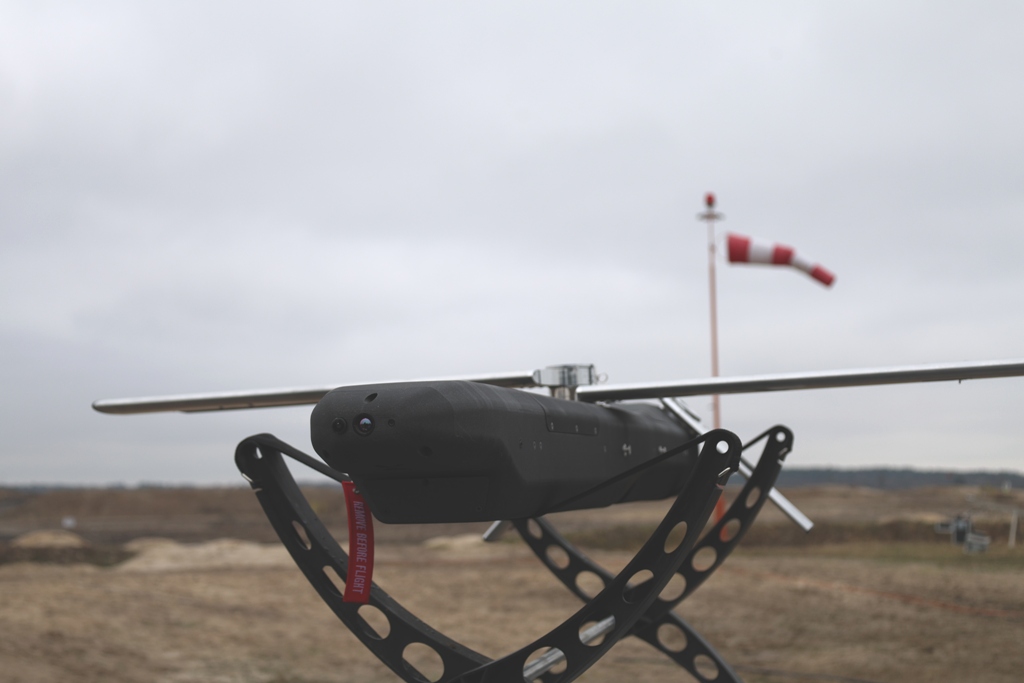
Skyhammer
Skyhammer (Credit: Cambridge Aerospace)

That pace of development sits at the centre of the government’s interest. Rather than relying solely on established defence primes, the Ministry of Defence has been widening its supplier base to include newer entrants that can iterate quickly, while also placing greater emphasis on sovereign defence technologies developed in the UK.

Healey pointed to Cambridge Aerospace as an example of that approach, tying rapid development to domestic security and industrial policy.

“Our government backing for Cambridge Aerospace is a prime case of a veteran-founded UK defence startup scaling at pace to deliver new interceptor missiles within weeks for our Armed Forces and Gulf partners, and good jobs and security here in the UK,” Healey said.

Cambridge Aerospace has also been scaling its operations in parallel. The company now employs more than 125 people across the UK and Europe, and is preparing a second production facility to increase output over the coming months.

Export ambitions

The Cambridge Aerospace contract reflects a shift in how the UK is approaching defence procurement and industrial policy. Alongside equipping its own forces, the government has been working to position domestic defence startups as suppliers to allied countries, particularly in the Gulf. Such efforts have included facilitating introductions between UK defence technology firms and Gulf states, as demand grows for counter-drone systems and layered air defence. Cambridge Aerospace was among the companies included in those recent discussions.

“With aerial threats to the UK and our allies increasing by the day, it is critical that we can defend ourselves effectively,” Barrett said in a statement. “Skyhammer was designed to do exactly that – bringing affordable mass to protect our skies.”

In addition to Skyhammer, Cambridge Aerospace is building out a broader portfolio that includes higher-speed interceptors such as Starhammer, alongside radar systems.

For the government, however, the bet is that younger companies can deliver systems quickly enough to keep pace with evolving threats, while also keeping production and supply chains within the UK.

This article was edited to include the full founding team.

Tags: Cambridge AerospaceSteven Barrett
Previous Post

LetsData catches the disinformation campaign boomerang

Next Post

Tiberius to link Ukraine-validated defence tech with UK manufacturing through GRAIL platform

Paul Sawers

Paul Sawers

A seasoned technology journalist, most recently Senior Writer at TechCrunch where his work centered on European startups with a distinctly enterprise flavour. At Resilience Media, Paul focuses substantively on the worlds of open source and infrastructure, looking at technology that helps people and society live outside the sticky ecosystems of Big Tech.

Related News

Simera Sense and S&T partner to build sovereign space surveillance system

Simera Sense and S&T partner to build sovereign space surveillance system

byJohn Biggs
November 23, 2026

Belgian satellite imaging company Simera Sense will partner with European space technology specialist S&T to develop a so-called sovereign Space Situational...

a satellite in orbit with the earth in the background

The power of space

byPaddy Stephens
November 23, 2026

A reliable energy system underpins Europe’s efforts to deter further Russian aggression, develop defence tech and build up advanced industrial...

Agon emerges from stealth with $30M to build AI training models for defence

Agon raises $70M at a $450M valuation to build gamified, synthetic training for defence AI

byIngrid Lunden
November 23, 2026

Agon, the London-based startup that emerged from stealth only four months ago with $30 million and a plan to build...

red and white flag on top of the mountain

Canada is joining the NATO Innovation Fund

byIngrid Lunden
November 21, 2026

When the NATO Innovation Fund was founded in 2022 to back startups building defence and resilience tech for the countries...

USIL Therapeutics passes initial NATO procurement assessment as it develops radiation exposure treatments

USIL Therapeutics passes initial NATO procurement assessment as it develops radiation exposure treatments

byJohn Biggs
November 20, 2026

Luxembourg-based USIL Therapeutics has passed the initial vendor registration assessment of the NATO Support and Procurement Agency (NSPA), giving the...

Auterion, the drone software startup, eyes raising $200M at a $1.2B+ valuation

Auterion and SkyFall plan German drone factory to boost Ukrainian production

byCarly Page
November 20, 2026

Auterion and Ukrainian drone manufacturer SkyFall are planning to establish a joint venture in Germany to increase production of first-person...

Michigan wants to turn its automotive manufacturing power into a defence industry advantage

Michigan wants to turn its automotive manufacturing power into a defence industry advantage

byJohn Biggs
November 20, 2026

  Michigan has spent decades building cars, trucks and industrial equipment. Now the state wants to use that manufacturing capacity...

Atmos space cargo visual

Atmos and MBDA link up to give Europe deep strike capability from space

byPaul Sawers
November 18, 2026

The ability to transport payloads into orbit and return them to precise locations on Earth could give European armed forces...

Load More
Next Post
Tiberius to link Ukraine-validated defence tech with UK manufacturing through GRAIL platform

Tiberius to link Ukraine-validated defence tech with UK manufacturing through GRAIL platform

Refute report finds coordinated election interference targeting European voters and diaspora

Refute report finds coordinated election interference targeting European voters and diaspora

Top stories

Tiberius says it’s successfully tested Sceptre munitions that behave like more costly missiles
European Defence

Tiberius, the munitions startup, becomes the latest defence tech unicorn, raising $85M at a $1B valuation

November 16, 2026
Atmos space cargo visual
European Defence

Atmos and MBDA link up to give Europe deep strike capability from space

November 18, 2026
OpenAI, facing a cybersecurity lawsuit in the US, is working with NATO… on cybersecurity
Cyber

OpenAI, facing a cybersecurity lawsuit in the US, is working with NATO… on cybersecurity

November 17, 2026
Satellites become a growing target for grey-zone warfare
News

ICEYE lights a rocket under its satellite business, offers €2.05B for launcher company Avio

November 17, 2026

Resilience Media is an independent publication covering the future of defence, security, and resilience. Our reporting focuses on emerging technologies, strategic threats, and the growing role of startups and investors in the defence of democracy.

  • About
  • News
  • Resilence Conference
    • Resilience Conference Copenhagen 2026
    • Resilience Conference Warsaw 2026
  • Guest Posts
  • Subscribe
  • Privacy Policy
  • Terms & Conditions
  • Mission Statement & Code of Practice
  • Press

© 2026 Resilience Media

No Result
View All Result
  • Home
  • About
  • Subscribe
  • Events
  • Guest Posts
  • Interview
  • News
  • Resilience Conference London 2026
  • Resilience Conference Copenhagen 2026
  • Resilience Conference Warsaw 2026

© 2026 Resilience Media

This website uses cookies. By continuing to use this website you are giving consent to cookies being used. Visit our Privacy and Cookie Policy.