Resilience Media’s contributor in Kyiv, Oleksandr Ihnatenko, attended the Tech Force in UA event last week. Tech Force in UA is a coalition of almost fifty private arms manufacturers. It describes its members as “strengthening the Ukrainian army with unmanned robotic systems and software products,” and its mission statement is “to develop entirely Ukrainian responses to military threats to preserve people’s lives and the sovereignty of the state.”
A defence trade coalition established in a country at war is a unique thing. Here is Oleksandr’s write up from the event.
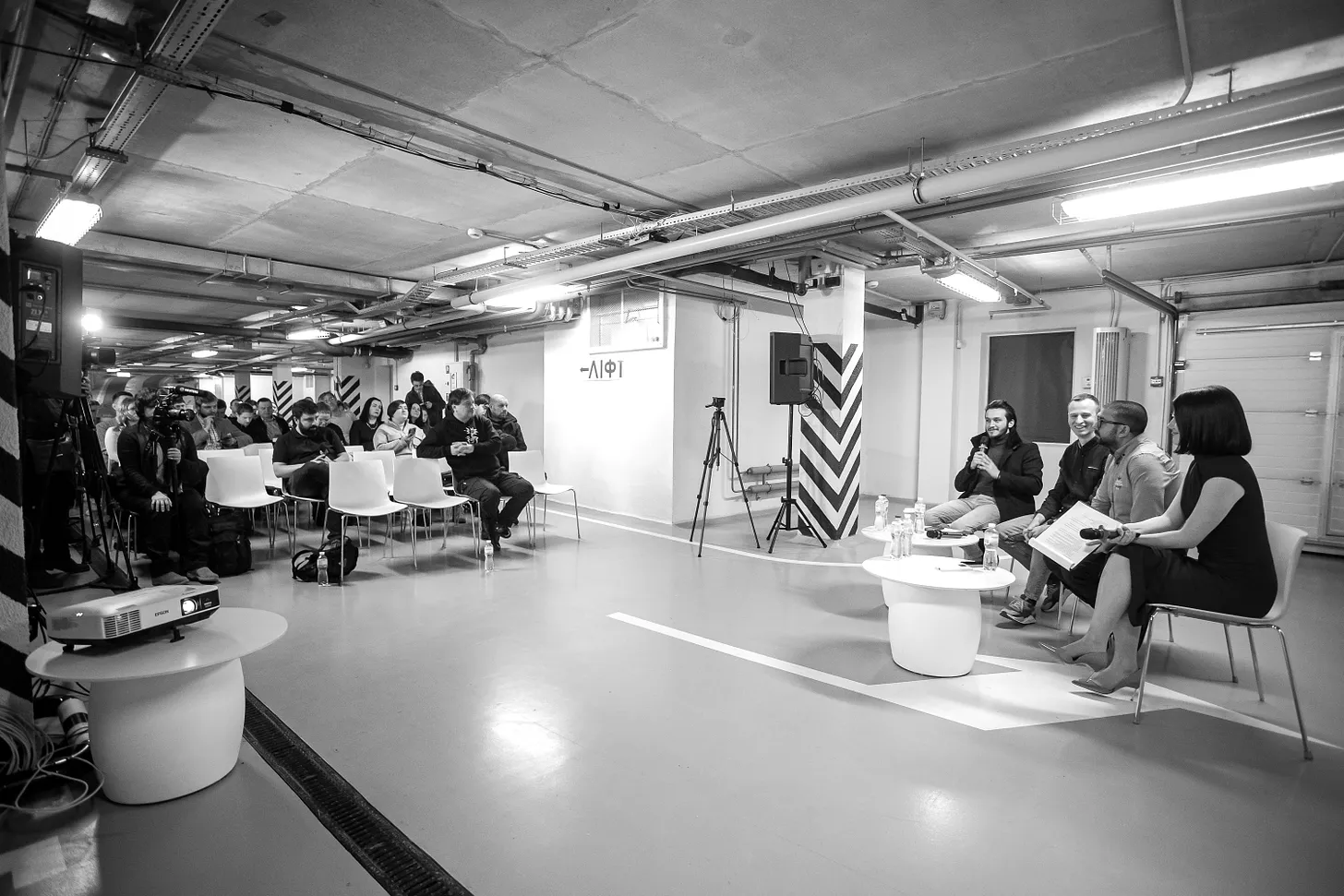
As I enter a long grey rectangular room five meters underground, the chairs are already aligned in neat rows facing what today serves as the backdrop for a panel discussion by the Tech Force in UA, an association of leading manufactures of innovative weapons for Ukraine’s defenders. This industry came into being as a response of civil society to the Russian invasion back in 2014 – one the first crowdsourced UAVs was called the “People’s Drone-1.” But now the word “ambition” looms large in an otherwise unassuming hall. This atmosphere stands in a striking contrast to the doom and gloom of the Ukrainian news cycle.
The meeting kicks off with a phrase I have heard too often since February 2022: “I never wanted this”, says Kateryna Mykhalko, the director-general of TFUA. Indeed, I do not remember being told by anyone in school that they aspired to build drones, let alone report on them. But here we are.
At the centre of today’s discussion lies perhaps the most important and somewhat bizarre problem: insufficient state funds to procure more weapons. In NATO, industrial capacity is not keeping up with demand. In Ukraine, the opposite is the case. The state signalled its willingness to procure more, thus the private sector expanded their plants, but the orders did not match the pace. Thus, the members of TFUA reported that a good two thirds of their machines stood idle through 2024. “1.6 million more FPVs could have been built,” notes Mykhalko.
It is no wonder that state funding is scarce. Most of the financial aid Ukraine receives is earmarked to be used exclusively for civil purposes. There are, of course, exceptions to the rule – Denmark gave out 0.5 billion Euros to fund weapons production in Ukraine, with another billion fundraised from eight other countries. An alternative approach to solve this problem would be to end the current restrictions on the export of Ukrainian defense products, hence enabling the firms to utilize the extra capacity for external markets. The government is still uneasy with this idea, being afraid that such a move would be unpopular with the public, result in the Ukrainian orders being backlogged, or even dissuade foreign countries from supplying arms to Ukraine.
However comprehensive and voluminous foreign arms transfers to Ukraine are, says Oleksyi Babenko, they no longer account for most of the kills made by the Ukrainian forces. Seated next to Mykhalko, he represents Vyryi Drones, a company which pioneers the localisation of FPV components. As he speaks, the Ukrainian Commander-in-Chief, Oleksandr Syrskyi, goes public with a number that partially confirms Babenko’s estimates: 66 per cent of the Russians vehicles hit in January were destroyed by UAVs. Some of these drones have been built by Vyryi Drone and consist entirely of local components. Babenko is quick to brush off concerns regarding the economy of such localisation. “The fully localised FPV is 10 per cent more expensive, compared to one built of Chinese components,” he says, explaining that his company is willing to absorb the difference by cutting their profits. But are such solutions scalable? Babenko says that currently Ukrainian industry already churns out hundreds of thousands printed circuit boards monthly and there is room to grow.
Babenko recalls that Vyryi Drones received multiple requests from abroad regarding localisation, reflecting a common concern for Western industry. Konstantin Minakov of Omnitech, also present on the improvised stage, tells a story that happened to a Ukrainian FPV developer. When the company was tasked to build a drone out of components produced exclusively in the US, the resulting product cost four times more than its Chinese alternative.
If this is the case, the Ukrainian industry is well-positioned to become a friendshore for its Western allies who are willing to procure FPVs cheaply and at scale. But will this ambition be fulfilled? As the event nears the end, one of the producers quickly leaves the hall, followed by an imposing security detail. A stark reminder that it is not only foreign funding that the Ukrainian industry needs – but also to survive the Russian onslaught.