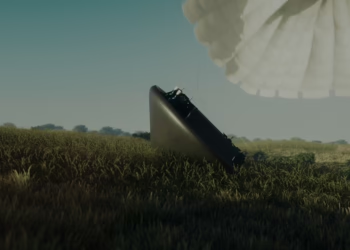
Munich- and Virginia-based Auterion says it has completed what it describes as a first for the small drone space in the United States, a live-fire swarm strike where multiple drones were coordinated on targets through its swarm software. The company framed the event as a step toward “one-operator” control of multiple weapons in a single engagement.
In an interview, Auterion founder and CEO Lorenz Meier said the company is focused on swarms that can work across different drone makers, with a common software layer and bolt-on avionics. “We’re really focused on swarms across different manufacturers. We’re enabling that by common software. We’re making the common software easy to install by providing avionics that you can just bolt onto your drone,” Meier said.
Auterion markets its swarm stack under the name Nemyx, describing it as software that links drones into a coordinated group and supports multi-target engagement. The company has also pushed the idea that the hard part is not only getting one swarm to fly together, but managing many groups at once and tying that into command systems used by units in the field. In the interview, Meier described that goal directly, “We are building the overarching command and control system where a commander can then use those prepositioned launchers to really mass fire.”
“That coordination piece right now does not exist,” he said.
Meier also pointed to Ukraine as the proving ground for Auterion’s baseline systems.
“We’ve shipped over 30,000 units last year,” he said and described the company as “the largest player outside of Ukraine in the Western world,” by unit volume.
On why swarming matters now, Meier argued that Western forces have a manpower constraint that Ukraine does not.
“Ukraine has a unique situation with a massive pool of trained FPV pilots,” he said. He said that the US, UK, and Germany cannot realistically generate that kind of pilot base quickly.
“You can’t have 10,000 FPV pilots. That doesn’t work,” he said. His view is that autonomy and coordination reduce the number of humans needed per effect, while increasing the number of systems a unit can employ at once.
What comes next, Meier said, is scaling the number of drones in a coordinated strike and changing how units think about employment. “We expect to do way higher numbers,” he said. “We are starting to think and talk about drone magazines rather than drones.”
He also said Auterion has already shown larger swarms in testing contexts,
“We have shown swarms of 22 systems in the US with the Marine Corps,” he said.
Auterion is trying to turn “swarm” into a repeatable capability that plugs into existing tactical tools, works across manufacturers, and scales without needing a huge pool of specialist pilots. This is the first live fire test of their product and they expect 2026 to help them expand their reach, sales, and capabilities.