Debate concerning the medium to long-term efficacy of Unmanned Aerial Vehicles (UAVs) in western countries predominantly revolves around the weapons platform itself. In our recent Research Report for the London School of Economics’ foreign policy think tank IDEAS, we engage an underdeveloped area of this debate: the people producing and operating these systems.
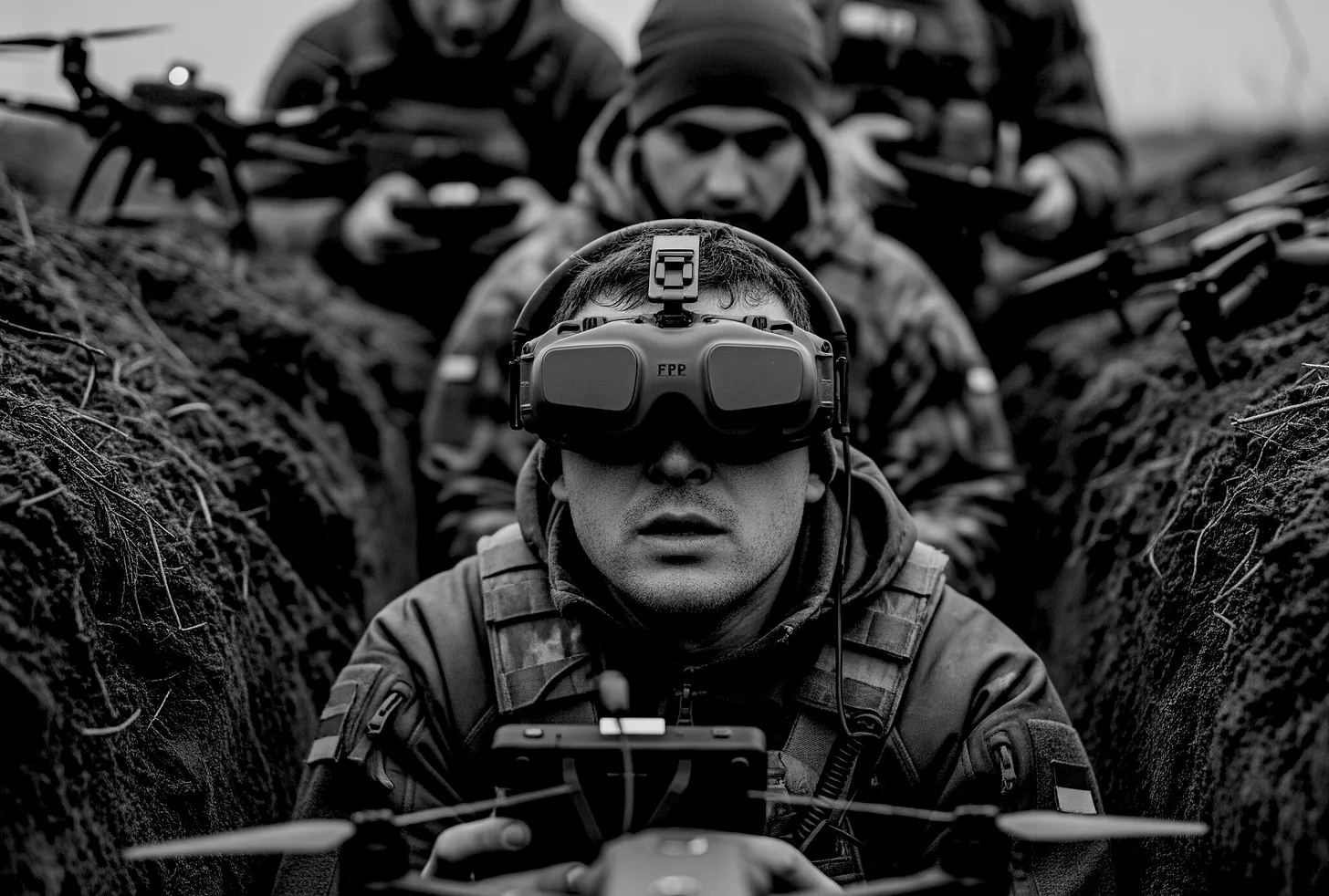
UAVs – focusing on FPV and reconnaissance drones – are anything but ‘unmanned’. The ‘crews’ operating these highly modular platforms merit dedicated attention. Akin to drones themselves, the multifaceted ecosystem crewing Ukraine’s battlefield UAVs comprises a range of diverse actors. Centralised military command and control in the AFU’s Unmanned Systems Forces, NGOs, civilian volunteers, and drone schools are the main – but by no means only – stakeholders that supply expertise and experience to Ukraine’s drone warfare ecosystem.
Alongside established scholarship and literature, this research report relies primarily on expert interviews conducted on-site in Ukraine in Q3 2024. Names and identities are fully anonymised. This data set includes senior AFU commanders, senior political advisors, and MoD officials, while also incorporating perspectives from FPV and recon drone pilots, frontline soldiers, and drone school instructors.
Our argument is straight-forward – drones as weapon systems do not inherently manifest a drone ecosystem (comprised of expert practitioners). Rather, the opposite is true – as products of swift feedback loops between producer and warrior, the highly iterative nature of drones owes its versatility to a skilled value chain of people. The ecosystem is attritting every day. Nonengagement concedes this amassed expertise to Europe’s geostrategic adversaries.
In order to maintain deterrence, in the best case, and to prepare for war in the worst, NATO countries must consider learning the lessons of Ukraine’s drone ecosystem as such, and not focus only on the weapon itself. In this spirit, we structure our argument along three themes of this drone ecosystem that NATO countries inadequately understand: speed, scale, and urgency.
Three aspects stand out from our interviews.
First, much of Ukraine’s drone expertise is significantly decentralised. Drone schools opened and operated by civilians, civilians undertaking combat missions in volunteer units, makeshift workshops crop out in every conceivable basement, office, and garage; discovering mad-scientist drone experts is only a matter of networking. This serves not to undercut the AFU, but instead functions as a result of Ukrainian culture.
Second, these actors wear multiple hats. Most drone school instructors are themselves former soldiers. As such, they still circulate their knowledge with frontline units, with some even occasionally taking part in ‘the hunt’ itself to validate concepts. This knowledge is subsequently recycled into drone schools. Civilian volunteers, in turn, sharpen their skills within these drone schools. Ultimately, this system multiplies buy-in from civilian stakeholders that otherwise might be less inclined to engage with the military.
Third, they work fast. Significantly faster than NATO countries. Owing to organisation concepts from software development, what we call War DevOps, individuals with private industry expertise find their role in various parts of the ecosystem. After all, drones’ dual-use nature democratises military innovation into civilian hands. Hundreds of drone types undergo service cycles that last only months, sometimes weeks, before Russian countermeasures catalyse new innovation. By focusing on the ecosystem of people, we undercover how these various groups interact to meet lightning fast iteration and ideation cycles to keep pace with battlefield needs.
Overall, we argue for integrating rather than replicating this drone ecosystem into European security architectures. Whether or not drones win the wars of the future is uncertain. Either way, we cannot afford to ignore them considering their widespread and still developing utility, not to mention their uptake by our adversaries. We urge NATO countries to incorporate lessons learned from Ukraine’s innovation-enabling WarDevops structures into its own defence and security infrastructure, while supporting Ukraine’s own ecosystem materially. While drones are not a Wunderwaffe, techno-optimism in Western military innovation isn’t either. Partnering with, rather than watching erode, Ukraine’s drone ecosystem benefits all parties. Except Russia.
Policy Recommendations
To meet the future challenges of the European security space, we submit three policy recommendations.
1. Surging support of bilateral joint ventures between NATO member states and Ukrainian defence tech companies and start-ups.
2. Negotiating bilateral civil-military liaisons to interface with the full spectrum of Ukraine’s drone ecosystem
3. Committing to binding defence tech orders to vest capital and political trust into NATO-Ukrainian joint ventures.
Read this Research Report here.
Jon-Wyatt Matlack is a PhD candidate at the University of Regensburg and former
Anthony Smith Fellow at LSE IDEAS, completing a dissertation on corps-level
training exercises of the German and U.S. armies in the Cold War. Jack is also
an associate researcher at the Leibniz Science Campus Regensburg and affiliate
of the Leibniz Institute for East and Southeast European Studies. He publishes
essays and policy papers concerning strategic communication of the U.S. Navy,
Russian training exercises, and Ukraine’s drone warfare ecosystem. His latest
book is Sovereignty through Practice (Routledge: 2025).
Sebastian Schwartz is an independent researcher specialising in the role of
technology in peace and conflict studies. His previous publications investigate dualuse aspects in the development of autonomous systems and the role of unmanned
systems in maritime security. Working in the private sector as an AI expert, his
research interests lie in autonomous systems, unmanned systems, human-machine
teaming, the automation of war, and the social impact of autonomous systems.
Oliver Gill is Programmes Manager and Researcher at LSE IDEAS where he delivers
a portfolio of capacity building programmes for partner institutions and government
in international relations, foreign policy, and diplomacy. After completing a master’s
in international relations at King’s College London with a focus on information
warfare and AI, his research now focuses on Black Sea maritime security, Ukrainian
defence innovation, information and influence operations, and emerging and
disruptive technologies’ impact on security.