“All warfare is based on deception. Hence, when we are able to attack, we must seem unable; when using our forces, we must appear inactive; when we are near, we must make the enemy believe we are far away; when far away, we must make him believe we are near.”
– Sun Tzu, The Art of War
For most of military history, camouflage was a relatively straightforward contest between the human eye and the ingenuity of soldiers and engineers. Paint, scrim netting, foliage, terrain – the task was to break up outlines, reduce contrast, and limit movement. If you could fool a person looking through unsophisticated optics, you could generally survive.
That world is gone.
Modern conflict unfolds under conditions of near-continuous observation. Sensing is no longer episodic or platform-bound; it is persistent, layered, and increasingly mediated by automation rather than human judgment. Visibility is not an event but a default state.
The modern force has to assume that someone is always looking – from orbit, from the stratosphere, from unmanned systems, from ground sensors, and from machine-learning models combing through data feeds in real time.
In that environment, traditional camouflage is not obsolete, but it is often insufficient. Concealment now means managing signatures in multiple domains simultaneously, dynamically, under constant observation. The side that fails to adapt will discover what “nowhere to hide” really means.
The Sensor-Driven Battlefield
Three structural shifts have made concealment dramatically harder:
- Sensor Proliferation
- Commercial and military satellites with high revisit rates
- HALE/MALE UAVs with multi-spectral payloads
- Proliferation of small UAS at tactical echelons
- Cheap, networked ground sensors (acoustic, seismic, RF, EO/IR)
- Multi-Spectral Coverage
- Visible, near-infrared, SWIR, MWIR, LWIR, radar, passive RF
- Weather and darkness no longer provide reliable cover
- Cross-cueing: a detection in one band rapidly triggers tasking in others
- Algorithmic Detection and Targeting
- Computer vision models trained on massive datasets
- Pattern-of-life analysis from overhead and comms metadata
- Automated alerts for change detection and anomaly spotting
The result is a battlespace where any detectable signature – thermal, electromagnetic, acoustic, logistical, even behavioural – can quickly translate into targeting data. Concealment therefore has to be re-imagined as signature management across a system-of-systems, not just pattern and paint on a single platform.
From Camouflage to Signature Management
Modern concealment is about reducing, shaping, and sometimes deliberately spoofing signatures. A few emerging trends stand out.
- Multi-Spectral Camouflage and Adaptive Materials
Static, visually oriented camouflage is giving way to materials designed from the outset for broad-spectrum masking.
- Multi-spectral camouflage nets and coatings
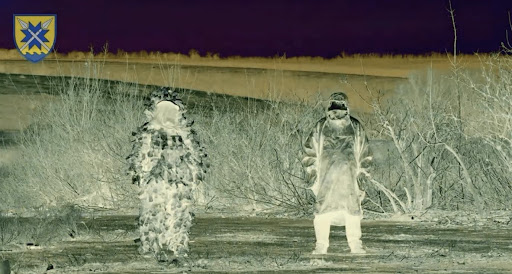
Designed to reduce visibility not only in the visual spectrum but also in near-IR and thermal bands. These are increasingly tailored to specific climatic and seasonal conditions, and to the dominant sensor threats in a theatre. - Thermal management systems
Passive: insulation, heat sinks, exhaust routing and diffusion to blur hot spots and reduce sharp gradients visible to IR sensors.
Active: controlled heating / cooling elements that can reshape a platform’s apparent signature to match background or mimic a different class of object. - Adaptive camouflage concepts
Although still early, there is sustained work on surfaces that can modulate colour, reflectivity, and in some cases temperature distribution. The goal is not invisibility, but to make automated detection algorithms less confident and more error prone.
Example: Armoured fighting or logistics vehicles in exposed positions are now routinely deployed under multi-spectral screens with integrated thermal masking. Some forces are experimenting with conformal thermal treatments that redistribute heat rather than simply insulating it. The effect is to replace a crisp, machine-like thermal outline with a diffuse pattern that blends into environmental noise, reducing the confidence of IR-based detection rather than seeking outright invisibility.
- Electromagnetic Emissions Control (EMCON) by Design
In contemporary operations, emissions are among the most revealing signatures a force produces. Radio traffic, network activity, and even routine digital exhaust can expose location, structure, and intent as clearly as visual observation once did.
- Low-probability-of-intercept/ low-probability-of-detection (LPI/ LPD) communications
Waveforms that spread energy across wide bands, use agile frequency hopping, and exploit directional antennas to minimise detectability and geolocation. - Emission-minimised platforms
Vehicles and command posts designed with strict EM discipline:- Shielded electronics and cabling
- Segregated “no-emission” modes for movement and tactical pauses
- Short, scheduled, high-bandwidth bursts instead of continuous chatter
- Deception in the EM spectrum
Deliberate generation of false RF signatures to suggest non-existent units or to create confusion over true command and control configurations.
Example: Some forward command posts now operate predominantly on wired links and short-range, low-power mesh networks under canopy or in urban clutter, surfacing via high-gain, directional links only at pre-briefed times and for tightly bounded durations. In parallel, decoy transmitters simulate a “noisy” HQ several kilometres away.
- Decoys, Dummies, and Signature Spoofing
As precision munitions become more capable and more plentiful, forcing an adversary to waste them becomes a strategic objective. Survival increasingly depends on shaping the adversary’s picture of the battlespace. This means not only protecting genuine assets but deliberately populating that picture with convincing alternatives: targets that look, emit, and behave plausibly enough to absorb attention and precision fires.
- High-fidelity physical decoys
Inflatable or composite decoys for armour, air defence systems, and logistic nodes, now built with embedded heat sources and reflectors to mimic IR and radar signatures. - Digital decoys
Spoofed emissions, simulated network traffic, and fabricated “patterns of life” in data which can mislead analysts and algorithms. - Deception at the terrain scale
Constructing fictitious logistic hubs or airfields in areas that are cheap to defend but costly for an adversary to ignore.
Example: In recent conflicts, decoy air defence systems and false artillery positions have absorbed substantial numbers of expensive precision-guided munitions. From overhead and through many sensors, their signatures were deliberately engineered to be almost indistinguishable from genuine systems for the crucial decision-making windows.
- Micro-Concealment for a Drone-Saturated Sky
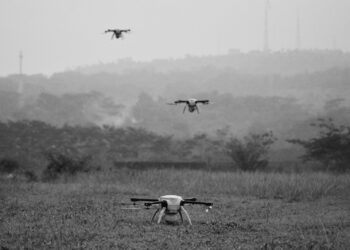
The ubiquity of tactical UAVs – quadcopters up to larger systems – has made micro-terrain and micro-concealment matter again in ways reminiscent of WWI, but against very different sensors.
- Canopy and overhead concealment
Lightweight, rapidly deployable overhead screens and nets to break vertical profiles and scatter IR signatures of small groups, vehicles, and weapon systems. - “Vertical discipline” drills
Units trained to think in three dimensions: avoiding sky lining not just against horizons, but against drone vantage points at 100 – 500m. Movement routes and halt points deliberately chosen for canopy, overhang, or urban clutter. - UAS-aware construction and fieldworks
Trenches, revetments, and fighting positions shaped to minimise direct line-of-sight from common drone loiter heights, with dedicated “drone blind spots” for resupply and casualty handling.
Example: Artillery batteries now routinely relocate more frequently than their Cold War predecessors, using pre-surveyed, concealed firing points. Each site is pre-prepared with overhead cover against small drones, camouflage that breaks up gun outlines from above, and decoy positions nearby which are cheaper to lose than guns.
- Obscurants and Dynamic Masking
Sometimes, the only viable option is to obscure the battlespace itself, degrading sensor performance long enough to manoeuvre or survive.
- Multispectral smoke and aerosols
Modern smoke systems are formulated to be effective not only in the visible band but also in IR and, to a degree, in certain radar frequencies. - Rapid, on-demand obscuration
Vehicle-mounted and area systems capable of generating smoke screens within seconds, supporting break contact drills, repositioning of key assets, or the protection of crossings and choke points. - Urban and industrial obscuration
Leveraging existing infrastructure (steam, exhaust, dust, industrial emissions) deliberately to complicate targeting and ISR in built-up areas.
Example: Bridging operations across rivers are increasingly planned with integrated multispectral smoke generators, timed not only to human observation but to predicted or observed passes of ISR drones and satellites. The aim is to ensure that the most vulnerable phases – bridge emplacement, first crossings – coincide with periods of maximum sensor degradation.
- Behavioural and Logistical Concealment
In a world of pattern-of-life analytics, what you do and when you do it become signatures in themselves.
- Temporal deception
Operating outside of expected cycles: conducting resupply, rotation, and maintenance at irregular and seemingly suboptimal times to confound models trained on “normal” behaviour. - Logistics masking
Dispersing stocks; using civilian-pattern transport where lawful and appropriate; blending movement into wider traffic patterns rather than moving in distinct military convoys. - Data discipline
Minimising traceable digital behaviour – from mobile phones to routine administrative data – that can feed into intelligence models mapping out unit locations and readiness.
Example: Some units now treat fuel and ammunition resupply patterns as sensitive as ORBAT data. Routes, timings, vehicle types, and communication protocols are all deliberately varied to prevent model-based prediction of when and where critical assets will congregate and thus be most targetable.
Novel Technologies Enabling Concealment
Behind these trends is a wave of innovation that is as much software as hardware.
- AI-assisted signature modelling
Tools that simulate how a platform or unit will appear across different sensors, allowing planners to test camouflage schemes and movement plans virtually before committing. - Sensor fusion and red-teaming platforms
Systems that emulate adversary ISR architectures – from space-based assets down to Electronic Warfar and UAS – to stress-test friendly concealment and deception plans. - Smart materials and coatings
Research into coatings that adjust emissivity, reflectivity, or colour in response to environmental cues, aiming to keep signatures within “background noise” without continuous manual adjustment. - Autonomous decoy systems
Small, cheap robotic platforms that move, emit, and behave like high-value assets, creating continually shifting false targets in the adversary’s picture.
These are early days, but the direction of travel is clear: concealment planning will increasingly be informed by simulation and optimisation, rather than intuition and static doctrine alone.
Implications for Forces and for Investors
For armed forces, the message is uncomfortable but unavoidable. Concealment is no longer a specialist niche; it is a core capability that must be integrated into doctrine, training, procurement, and concept development. Signature management must be addressed at platform, unit, and force level – from the design of a single sensor mast to the layout of a corps support area. Deception – physical, electromagnetic, and behavioural – should be treated as a routine, not an exceptional, part of operations.
For those of us in the investment and technology ecosystem, it creates a very specific opportunity set. Companies that understand both sensors and signatures – and can translate that into practical products – are pivotal.
- Dual-use technologies in materials science, AI for perception and simulation, communications, and autonomous systems will be central to the next generation of concealment solutions.
- Successful ventures will be the ones that can operate at the intersection of defence, commercial sectors (e.g. automotive, aerospace, industrial sensing), and regulatory environments.
The historical pattern is that measures force countermeasures. New sensors will drive new forms of camouflage and concealment, which will in turn catalyse new detection techniques. But the asymmetry in this cycle has narrowed: the pace of commercial innovation means that capabilities once restricted to a handful of states can proliferate far more rapidly.
“Nowhere to hide” is not a prediction of inevitable transparency. It is a statement of the default condition if we continue to treat camouflage as paint and netting in a world of multi-spectral, persistent, algorithmic surveillance.
Those who recognise that the contest has changed – and invest accordingly, in technology, doctrine, and human capital – will still be able to create the only kind of concealment that matters: enough uncertainty, for long enough, to survive and to win.
Author: Hugo Jammes is the co- founder of EDT Ventures. He previously ran the investment arm of the UK National Security Strategic Investment Fund (NSSIF). Prior to this, Hugo worked in investment banking and started his career as a professional soldier in the British Military.