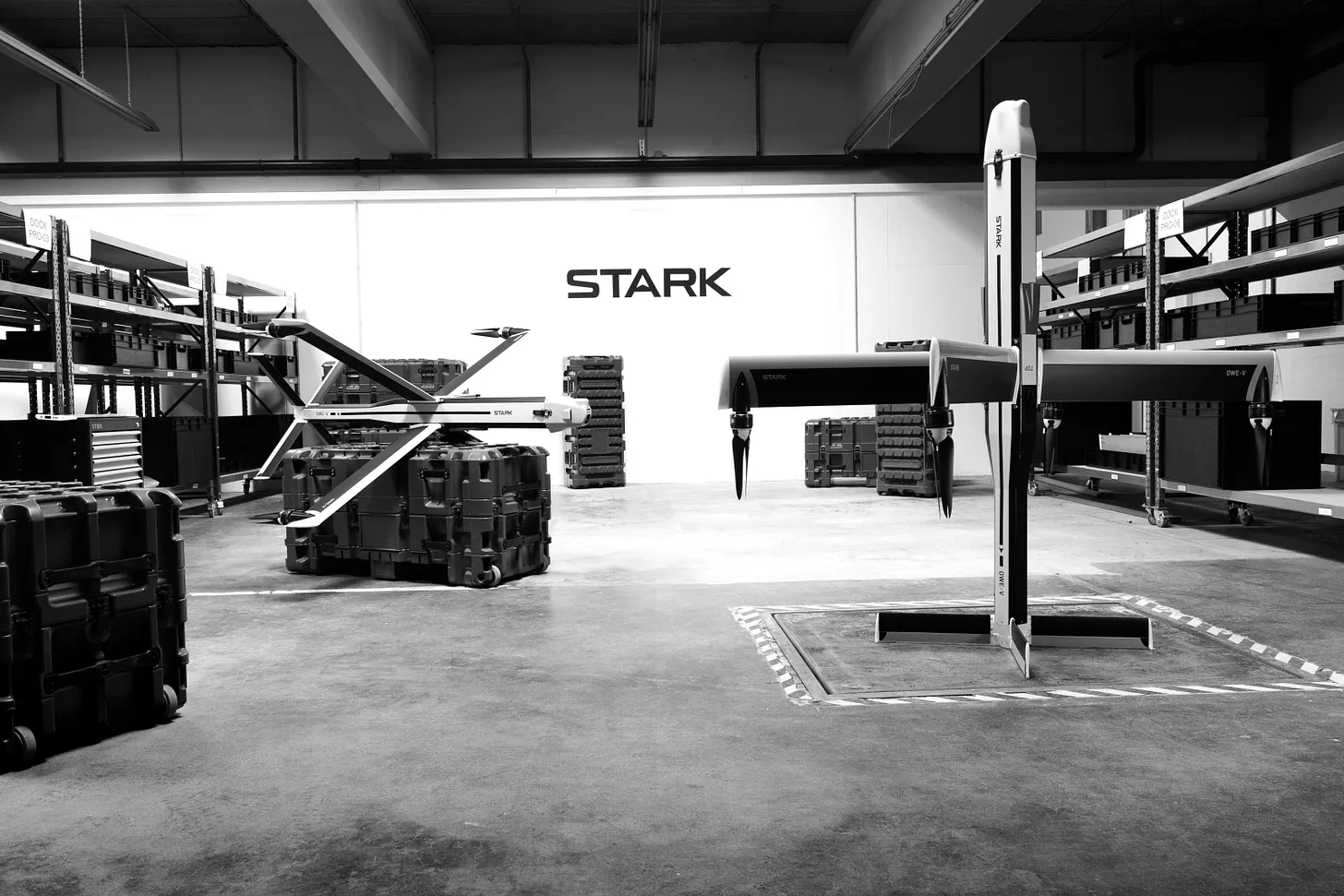
Stark and TDW have successfully conducted the first warhead live firing using Stark’s loitering munition, according to join statements posted on LinkedIn. The test, which was done on a Bavarian drone testing site, was completed using the Stark Virtus loitering munition which carried the TDW Lion Strike 110 (LS110) warhead.
According to a Stark spokesperson, the test was not performed as part of a €900 million contract that the German government is reportedly awarding to Rheinmetall, Helsing, and Stark. Rather, it was an internal demonstration in preparation to bid for contracts.
Stark and TDW initially announced a partnership in August 2025, and since then the two companies have been on paths to produce both drones and weapons at scale. These latest industrial tests, which the two companies say were performed twice over the last week, were carried out to show the penetration potential of TDW’s warhead when fired out of Stark’s Virtus drone. According to Stark, 800mm of armoured tank steel was penetrated in the display, performing above the Bundeswehr’s requirements.
In order for the Bundeswehr to award a contract for a loitering munition system, vendors needs to prove two things.
The first is a flyable system, and the second is a demonstrated warhead detonation.
Stark — which is currently valued at €500 million and counts Sequoia Capital as one of its backers — has a mixed track record to date on the first of these, coming under fire in recent months after bumpy demonstrations first in Germany and then in Kenya. It has since then been working on further proof to show proof of its readiness, and Stark’s leadership said that its Virtus command and control capabilities were shown off successfully to the German Armed Forces in a separate environment.
The second item — demonstrating a warhead detonation — is what Stark and TDW were carrying out in this latest test. Stark said that the pair chose to do so at TDW’s testing centre in Schrobenhausen because it could not be done easily in a Bundeswehr testing environment.
“We are implementing what we announced — faster, more focused, and consistently in the spirit of this new era,” Andreas Seitz, MD of TDW, said in a statement. “The successful test detonation of LS110 in the Virtus proves that we are fully on track. We are working at full speed to equip the German Armed Forces with high-performance warheads for loitering munitions. With LION STRIKE, we are creating market-ready solutions that can be mass-produced and deployed in large quantities in a short time.”
TDW designed a warhead to fit within Stark’s Virtus system, which as shown in the video was mounted onto a fixed Virtus drone and then fired from a standing position into the tank armour at close range.
According to a statement released by both companies, these results ensure that Stark and TDW will be able to produce thousands of systems with the integrated warhead and ignition system. The timing is notable, as NATO has been warned it needs to scale kamikaze drone production in order to prepare for war with Russia.
Partnerships are crucial to developing these capabilities, as we’ve seen from plenty of acquisitions and collaboration announcements. Richard Pass, director of strategy and partnerships at Stark, told Resilience Media that “The pace of this integration will mean that before 2027, we will be able to deliver our Loitering Munition Virtus, with certified warheads that are ready for operational use with NATO Allies. Today’s milestone shows what is possible when industry partnerships work in true alignment.”
We will continue to update this piece as the story develops.