
The UK Government has announced that it’s buying a “significant number” of Skyhammer air defence systems from UK startup Cambridge Aerospace, with deliveries set to begin in May.
The announcement was made Friday in a speech by Secretary of State for Defence John Healey, who said the move forms part of a broader push to accelerate contracts with British defence startups while expanding support to Gulf allies and strengthening the UK’s own capabilities.
“We are applying the approach for UK support to Ukraine and accelerating contracts with the most innovative British businesses to rapidly expand support to Gulf partners and equip our own forces with anti-drone tech,” Healey said in a statement.
Low-cost aerial threats
The deal lands as low-cost aerial threats, particularly Iranian-designed Shahed-style drones, reshape how countries think about air defence. These systems have been used extensively in conflicts across Ukraine and the Middle East, where relatively inexpensive drones can overwhelm traditional, high-cost interception systems.
That mismatch — cheap incoming threats versus expensive defensive missiles — has pushed governments to look for alternatives that can be produced quickly and deployed in larger numbers. The UK has been leaning more heavily on domestic startups to close that gap, opening up procurement to newer entrants able to move from design to testing on compressed timelines.
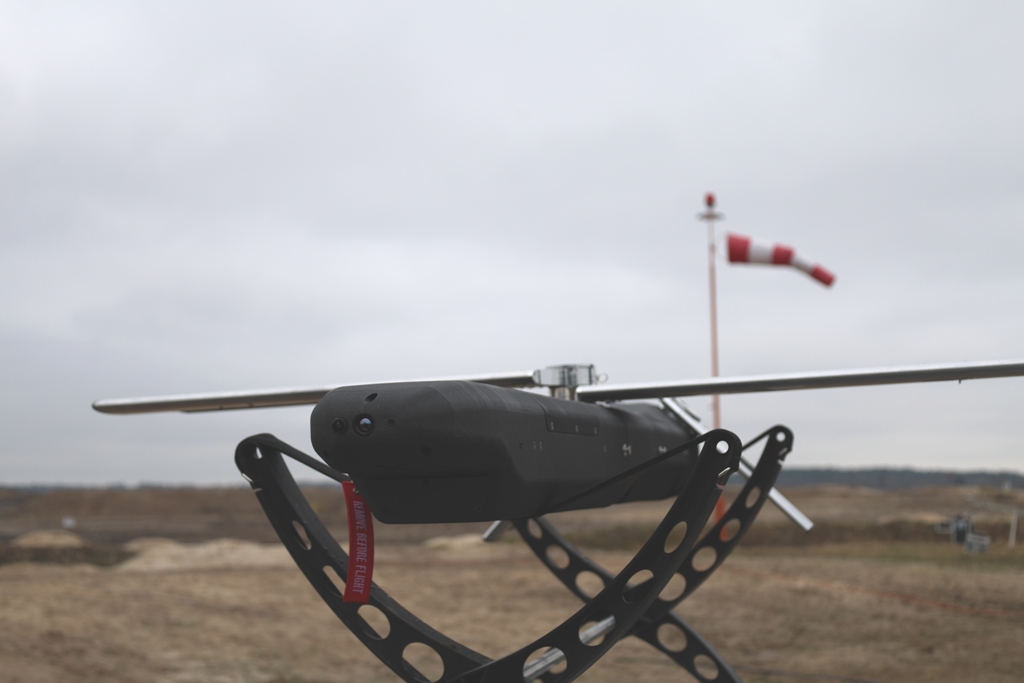
Cambridge Aerospace, founded in late 2024, is one of a new group of defence companies positioning itself around that problem. Its Skyhammer interceptor is designed to target drones and low-speed missiles, with a stated range of more than 30 kilometres and a top speed of 700 km/h.
The company was founded by MIT-trained engineer Steven Barrett, who registered the company while still at the university in Cambridge, Massachusetts. Ultimately, he chose to build it out of a completely different Cambridge – one in the UK.
Speaking at the Resilience Conference in London in 2025, Barrett confirmed the company had raised $136 million across three rounds of funding, including backing from US-based venture firm Never Lift.
Cambridge Aerospace began developing Skyhammer in January 2025 and moved into initial flight testing within six weeks, according to the company. Since then, it says it has carried out weekly test cycles aimed at refining the system’s ability to identify, track and intercept aerial targets, while integrating with different sensor platforms.
That pace of development sits at the centre of the government’s interest. Rather than relying solely on established defence primes, the Ministry of Defence has been widening its supplier base to include newer entrants that can iterate quickly, while also placing greater emphasis on sovereign defence technologies developed in the UK.
Healey pointed to Cambridge Aerospace as an example of that approach, tying rapid development to domestic security and industrial policy.
“Our government backing for Cambridge Aerospace is a prime case of a veteran-founded UK defence startup scaling at pace to deliver new interceptor missiles within weeks for our Armed Forces and Gulf partners, and good jobs and security here in the UK,” Healey said.
Cambridge Aerospace has also been scaling its operations in parallel. The company now employs more than 125 people across the UK and Europe, and is preparing a second production facility to increase output over the coming months.
Export ambitions
The Cambridge Aerospace contract reflects a shift in how the UK is approaching defence procurement and industrial policy. Alongside equipping its own forces, the government has been working to position domestic defence startups as suppliers to allied countries, particularly in the Gulf. Such efforts have included facilitating introductions between UK defence technology firms and Gulf states, as demand grows for counter-drone systems and layered air defence. Cambridge Aerospace was among the companies included in those recent discussions.
“With aerial threats to the UK and our allies increasing by the day, it is critical that we can defend ourselves effectively,” Barrett said in a statement. “Skyhammer was designed to do exactly that – bringing affordable mass to protect our skies.”
In addition to Skyhammer, Cambridge Aerospace is building out a broader portfolio that includes higher-speed interceptors such as Starhammer, alongside radar systems.
For the government, however, the bet is that younger companies can deliver systems quickly enough to keep pace with evolving threats, while also keeping production and supply chains within the UK.