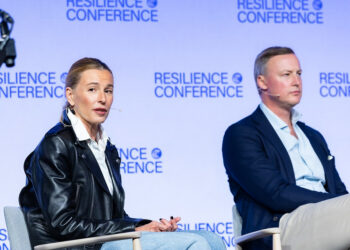
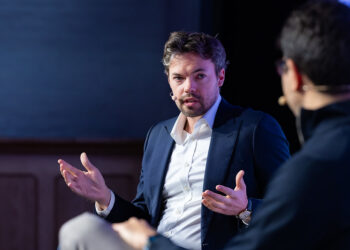
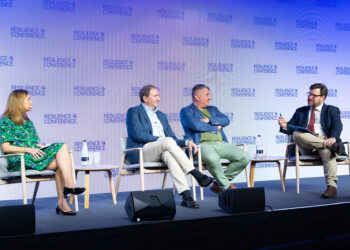
The 26th of April marked Brave1’s second anniversary. Established in 2023, it is a coordinating platform for the Ukrainian Defence Tech ecosystem that has grown significantly over the two years. The queue for Brave1’s anniversary event, Defence Tech Era, was so long that it could barely fit into the hall of the venue. Artem Moroz, Brave1’s Head of Investor Relations, who usually represents the platform abroad, felt obliged to coordinate the queue. As one Western military attaché told me, the event had not been widely advertised outside of Ukraine. Nevertheless, about one hundred foreigners out of up to 1,000 participants attended.
The event was opened by Mykhailo Fedorov, the Ukrainian Minister of Digital Transformation, labelled by the Russian propaganda as the Defence Tech ‘lobbyist in the corridors of power’. He presented a list of steps essential for Ukrainian policy makers in the coming months.
First, the Ukrainian Defence Tech is growing so fast that a regional network of testing grounds must be built. The existing infrastructure is at capacity with queues to test new defence technologies slowing down their deployment.
Second, the outsized volumes of footage and other data created on the frontline must be studied more carefully to spur policy interventions. For instance, constant analysis of drone footage allows a better understanding of which distance from the Ukrainian forward positions the enemy troops are being hit. This, in turn, may help shift resources in a way to strike the enemy as far back from the front line as possible to keep them away from the Ukrainian soldiers.
Third, the ‘war Amazonа’, an online marketplace of Defence Tech products, must be deployed. The military units will be able to procure everything from unmanned ground vehicles to components of UAVs there. This will lessen waste, because most units are not going to buy products that are no longer effective on the battlefield. Additionally, aggregating all the products into a single catalogue will help with knowledge-sharing, because the iteration cycles are so quick that not all units are able to keep up with the pace of product development.
These steps signify Brave1’s willingness to cover the full innovation cycle ‘from analyzing the battlefield application of various technologies to the direct deployment of defence innovations on the front lines’, the CEO of Brave1 Nataliia Kushnerska said.
The next speaker, Deputy Minister of Defence, Capt. Valeriy Churkin, explained that ‘yes, we have a lot of technologies and innovations are developing, but you all see the situation on the frontline’. Drones are no longer a cutting-edge innovation, he continued, so the ecosystem must push on and produce a new technology which will again revolutionise the battlefield.
Another problem Churkin highlighted was the need to consolidate existing product lines. Currently, the market for grenades produced to drop from drones includes 190 products of various shapes and forms which makes effective governmental procurement difficult. Therefore, the Ministry called on the ecosystem for more internal cooperation which will result in standardization and consolidation.
This was echoed by Captain Yury Fedorenko, the commander of 429th Achilles Separate Unmanned Aerial Systems Regiment. This ‘zoo’ of products is a problem not only for the government but also for the frontline troops. Hegot emotional as he explained how the range of components is now so broad, and the components themselves so varied, that a soldier tasked with getting a drone ready for a combat mission struggles to do so under the pressure of close-quarters fighting. Thus, Fedorenko, too, called on producers for more unification.
Every innovation deployed on the frontline triggers a change in tactics, techniques, and procedures, which in turn renders innovations less effective. As the uncontrolled area between the forward positions widens, fibreoptic drones with 10-kilometer range are becoming less effective. More range causes more payload; bigger payload requires bigger frames; bigger frames require better batteries, explained Fedorenko. As a result, a market for Western innovative accumulators is emerging.
Another recent tactic deployed by the enemy is increasing use of motorbikes to pass more quickly through areas that are otherwise denied due to the heavy use of drones. ‘I need an innovation that will help counter this with UAVs’, said Ivan Hlyzhko, the Commander of Unmanned Systems of the Ukrainian Marine Corps.
Any innovation must provide an answer to an existing problem and not create a new problem. At the same time, Ukrainian military encourages cooperation with engineers whose products may not be deployed straight away. ‘We are ready to receive even those innovations that are not really ready for use, Deputy Commander-in-Chief, Col. Andrii Lebedenko said. This happens from time to time, and the military is fine with that. ‘We must accept this product, we must let it be tested, we must try deploying it to see if it is viable.’
Yevhenii Khmara, the head of the elite Centre of Special Operations A, of the Ukrainian Security Service, argued that, as an example, whatever innovative technology is developed to counter motorbike assaults, it will not be developed solely by engineers outside of army. ‘Never ever did we receive a product which was 100% combat-ready’, he said. ‘Everything must be fine-tuned, which requires a synergy between the soldiers and the engineers, who are quite literally sitting in trenches with us’.
This is not new for the Ukrainian producers. ‘Any feedback from the frontline comes from a certain perspective’, argued Roman Knyazhenko. He is the CEO of Skyeton, one of the Ukraine’s oldest and biggest UAV producers. To receive the most unbiased feedback, the experts of Skyeton themselves go to the front and oversee the deployments. Additionally, all the decision-makers within the Skyeton constantly communicate with the military users, ‘even the CFO.’
In other words, foreign Defence Tech companies need a stable representation in Ukraine if they want their products to perform well on the frontline. One way to achieve this is by cooperating with a Ukrainian producer and building an R&D centre here. ‘Ukraine still has a lot of homework to do in this realm’, Minister of Digital Transformation Fedorov argued.
‘We know that some countries are willing to co-finance such cooperations’, Kushnerska of Brave1 said. ‘We are working to create such opportunities and we will keep you updated about them’.
Khmara recounted the words of his commander, the Head of Security Service of Ukraine, Vasyl Maliuk: ‘the enemy has learned how to learn.’