Good afternoon from the team at Resilience Media
Late last week, the UK Ministry of Defence announced the appointment of its much-needed National Armaments Director (NAD). Rupert Pearce is replacing the temporary NAD, Andy Start, and sources tell us that he has immediately immersed himself in the role. We also heard that Pearce was the MoD’s fourth choice for the position, which signals just how difficult this role was to fill. There are a lot of reasons for that, and reasons to be hopeful, which we delve into in Ingrid Lunden’s piece excerpted below in our Dispatches from London section.
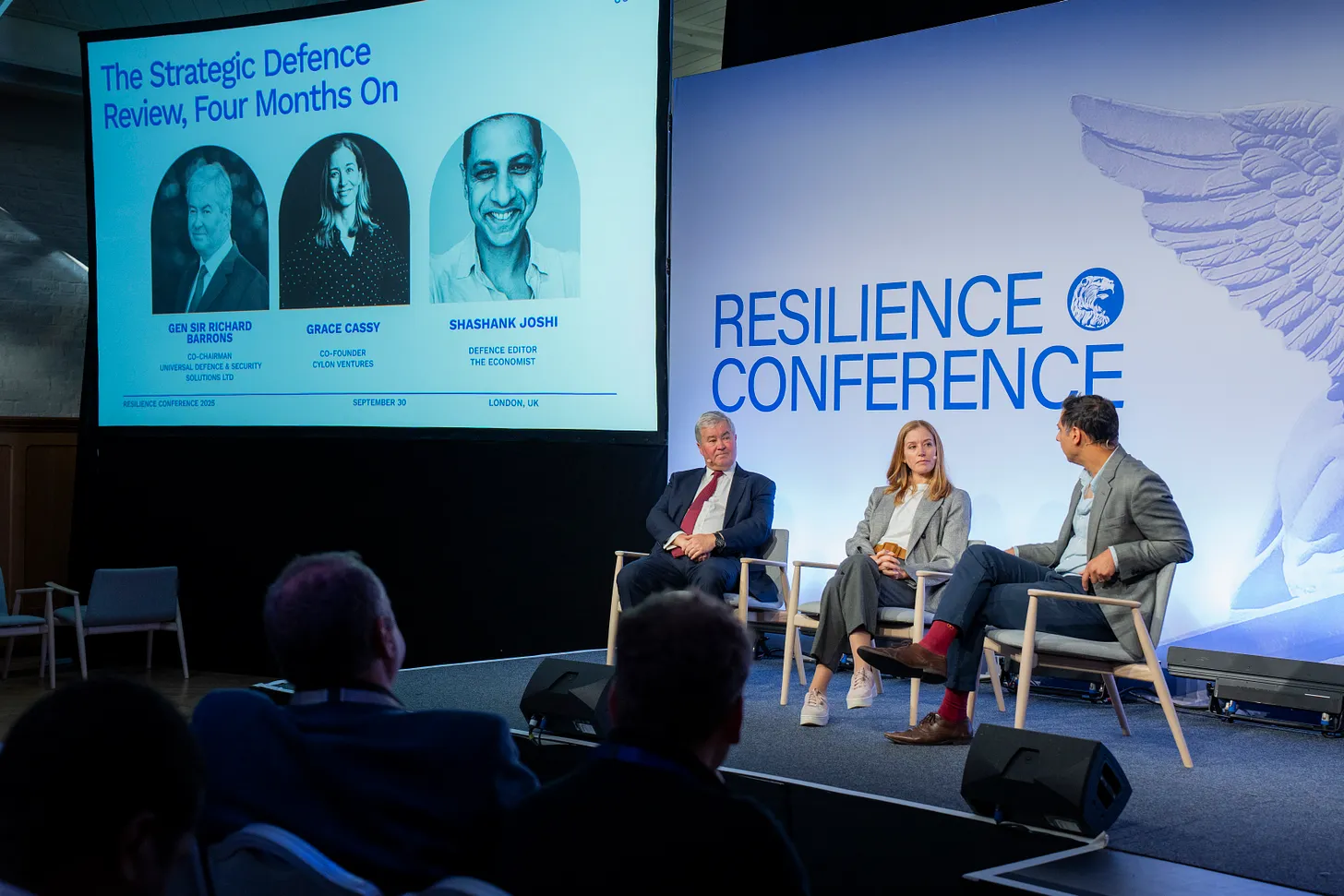
“If that [interview] was on Newsnight, it would have been half of the front page of the Times.” This was whispered to us in September following the Resilience Conference panel “The UK Strategic Defence Review, Four Months On” — which brought together General Sir Richard Barrons and Grace Cassy, two architects of the SDR, in conversation with The Economist Defence Editor, Shashank Joshi. The pair had a clear-eyed — and rather impatient — look back on the process of writing the SDR and the progress to implement the committee’s recommendations since it was published in May 2025. One of Sir Richard and Grace’s main points of frustration was the lack of a NAD appointment. Now that box is ticked, hopefully we will see movement within the UK MoD to realise more SDR recommendations. Read our writeup and watch the panel here.
Elsewhere on Resilience Media:
- Face to Face with Mykhailo Fedorov: Ukraine’s Plan for AI on the Frontline
- Inside Tiberius Aerospace With CSO Andy Baynes
- Lodestar Is Building Satellite “Bodyguards” to Protect the Next Battlefield
- Q-Day Won’t Be Announced: Why Europe Must Act Now
- Russia-Linked Hackers Claim Ransomware Attack on MoD contractor, Allege 4TB Data Theft
Last call. Are you going to Slush? We are and we’re co-hosting a unique side event with Project A, IQT, NIF, Stark, Lakestar, and DIANA. Register to join us here.
I’ll be back in your inboxes next week.
-Leslie Hitchcock, co-founder and Publisher, Resilience Media
Follow Resilience Media on LinkedIn and Bluesky to catch our latest news coverage in your feed. And don’t be shy, bring your voice to the discussion.

The recent Strategic Defence Review by the UK MoD pointed clearly to the need for considerable improvement in defence innovation, and last week, the Ministry of Defence announced a long-expected appointment to support this.
Rupert Pearce was named as the new National Armaments Director. The appointment puts him in a key position to lead how the UK conceives of and procures its next generation of defence, matching priorities to what is needed, as well as how and from whom to get it.
The role of the NAD was discussed on our stage earlier this month during Resilience Conference in a panel that looked at the Strategic Defence Review four months after it was released. (You can see that panel and read about it here.)
Pearce, pictured below, is an interesting pick for NAD, not least because he is not from a strictly defence background but one in the commercial realms of telecoms and technology. His most prominent past role was CEO of the satellite provider Inmarsat; he’s also been a partner with a private investment firm in the US.
One takeaway from this is that Pearce is not an insider, and if anything, more an outsider. Will that give him the chance to shake up the MoD in a good way and bring new thinking to the role? Or will it spell challenges ahead as he grapples with a huge department and a lot of entrenchment? The reality is likely a blend of the two.

High flyer
Pearce trained as a lawyer and has spent a large part of his career in the corporate world. His most high-profile job on that front was working for 16 years at Inmarsat, starting as general counsel and working up to spend the last nine years as its CEO until leaving in 2021.
His past experience also includes leading energy storage company Highview Power for a year and two part-time positions as chairman of broadband service providers.
Leading a satellite company could be a good fit for someone working on procurement on behalf of a defence ministry. Inmarsat counts government as one of its target verticals, and space and satellite have become a key component of “resilience tech.” Militaries are building out communications and computing infrastructure high above the earth, and space exploration represents an important (if still largely unproven) target for finding and mining rare materials used in the building of weapons and other hardware.
Based on interviews Pearce gave during his time at the helm, however, defence and related resilience may not have been top of mind in the years when he led the company. Instead, the focus was more on how satellite could improve connectivity in areas like underdeveloped geographies, natural disasters, and smart cities; and in commercial deals with transportation providers operating in areas terrestrial fixed and mobile providers cannot reach.
“Whether to the cockpit or the cabin, [connectivity] is seen as mission critical by airlines, and I include passenger Wi-Fi now in that attribute,” he said in an interview in 2023 with Satellite Today. “Airlines know that if they don’t install passenger Wi-Fi, their passengers will go elsewhere. Aviation is also a global market, where wide area coverage matters… I think aviation is going to be one of the core competencies of Inmarsat going forward.”
Nonetheless, Pearce would be familiar with how satellite fits into current defence priorities, as well as with the suppliers’ position in any procurement conversation: that conversation in 2023 noted government and military among two growth areas for the satellite provider.
The MoD also touts Pearce’s experience as an investor. Since July 2021, he has been a partner at US-based Columbia Capital, a role that still appears to be active based on his LinkedIn bio. As with Inmarsat, the experience is potentially more adjacent rather than direct: Columbia appears to invest in privately-held companies in telecoms and tech, but not necessarily the kinds of defence and resilience startups that the MoD might want to work more closely with going forward.

From Breakthrough to Build: Scaling Deeptech for a Resilient UK
How do you take a breakthrough idea and turn it into something that can be built at scale? Join Critical Mass on 29 October for a dynamic conversation with trailblazing founders and leading primes as they share the real-world challenges — and opportunities — of scaling dual-use and deeptech.
From early prototypes to full-scale manufacturing, this panel will dive into what it really takes to move from innovation to impact, and and how the UK can position itself to lead on the global stage. Register here.
UK-UA Defence Tech Forum
Resilience Media is once more a Media Partner of the 4th UK-UA Defence Tech Forum, which is taking place on 18th November at RUSI in London with the official support of the Embassy of Ukraine in the UK.
The series of conferences was convened to enhance the collaboration between Ukrainian, British and international defence tech firms, together with the VC community, to scale up production and speed up R&D and new innovations. To date the series has attracted over 750 participants and registration has had to be closed well in advance of each event. Highlights include a pitch session featuring 15 hand-picked leading Ukrainian defence tech companies designed to create partnerships with international counterparts and to meet with leading VCs.
Resilience Media readers receive a 25% discount on the registration fee. When registering on the Forum webpage simply enter the code Resilience25. For any questions contact the organisers at: [email protected] .

Launching the Catalogue of Capabilities (CATOC)
Boeing taps former defense procurement minister for president of its UK arm
Europe’s Most Important Startups Are in Ukraine
Lithuania wins EU bid to set up €130m AI factory
Lockheed considering modifying existing missiles into lower cost designs
Senior German General Says Europe Must Do All It Can to Help Ukraine