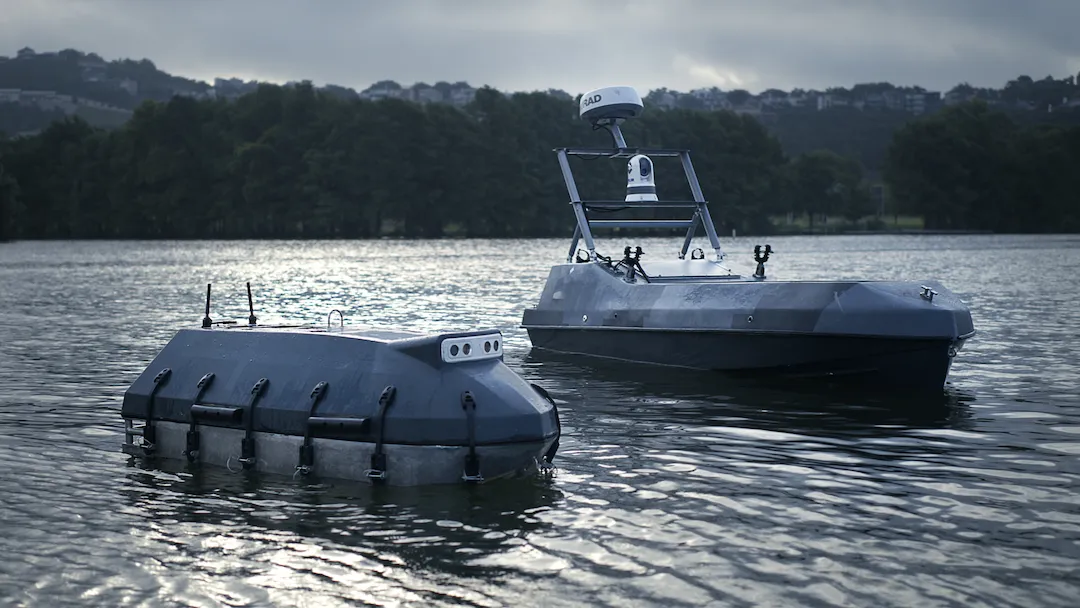
Saronic Technologies, a three-year-old startup developing autonomous surface vessels (ASVs), has partnered with Nvidia to apply the chipmaker’s AI and accelerated computing platforms to its next-gen maritime systems and shipbuilding.
The partnership aims to bring greater speed, automation, and intelligence to how vessels are designed, built, and operated — and test how far edge AI can extend into the maritime domain.
“By combining Saronic’s deep expertise in maritime autonomy and next-generation shipbuilding with Nvidia’s world-class AI and computing capabilities, we’re simultaneously developing the most capable and resilient maritime systems in the world, and building the industrial engine to produce them at scale and pace,” Dino Mavrookas, Saronic co-founder and CEO, said in a statement.
All at sea
Founded out of Austin, Texas, in 2022, Saronic develops both hardware and software for seafaring vehicles. Its lineup spans six ASVs from the 6-foot Spyglass — a modular ASV built for agile deployment in complex maritime environments, through to the 150-foot Marauder, a container-capable vessel built for logistics, payload delivery, and extended operations at sea. Each vessel is developed in-house, pairing Saronic’s own hardware and control systems with AI tools that handle navigation, coordination between multiple vessels, and real-time decision-making at sea.
It’s worth noting that Saronic already runs Nvidia hardware across its vessels, handling onboard computing for perception, navigation, and control — crucial when links to shore are limited, or intermittent. The company also uses Nvidia’s software tools to design, test, and update its autonomy stack, shortening turnaround times for new features and fixes.
The latest tie-up cements that relationship and extends it into joint R&D. The two firms plan to use advanced simulation and accelerated computing to compress design and testing cycles, making maritime development more iterative and fast-moving — advancing what’s known as edge AI, where autonomous systems process data and make decisions locally, without depending on shore-based networks or constant connectivity.
Legacy shipbuilding
At the heart of this effort is a self-proclaimed mission to modernize traditional shipbuilding, with AI and automation at the core. The company is applying this technology to streamline production, shorten build times, and reduce costs — part of a broader goal to reindustrialize American shipbuilding for the era of autonomy.
This aligns well with Washington, under President Trump, which is renewing its focus on rebuilding America’s maritime strength. In recent months, the federal government has issued new executive actions and backed bipartisan efforts in Congress — including the proposed SHIPS for America Act — aimed at restoring US shipbuilding capacity.
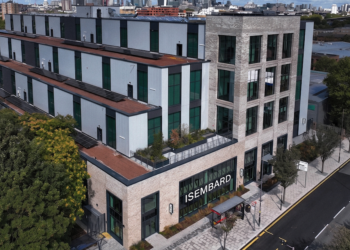
Saronic is already moving at scale. It recently acquired a Louisiana shipyard, which will serve as the production base for its larger autonomous platforms, including the flagship Marauder vessel. This builds on a larger effort dubbed Port Alpha, which Saronic envisions as a “next-generation shipyard” designed to produce new classes of autonomous vessels rapidly and at scale.

Saronic’s expansion isn’t limited to US waters. During the recent US state visit to London, the company said that it planned to invest £25–50 million over the next few years to establish a UK presence, including offices in London and a new operations, testing, and production facility in Portsmouth. The move reflects growing transatlantic demand for autonomous maritime systems, and positions Saronic to serve both US and allied customers.
Capital gains, digital brains
These various efforts will, of course, require significant capital. Saronic has raised some $850 million since its inception, including a $600 million tranche back in February at a lofty $4 billion valuation, with lead investor Elad Gil joined by General Catalyst, Andreessen Horowitz, Caffeinated Capital, and 8VC.
But funding is only part of the equation. A direct artery to Nvidia’s computing and AI architecture gives Saronic the technological backbone to move beyond design and into full-scale deployment.
Such access also places Saronic within a broader wave of tech-driven ventures bringing autonomy and AI to the world’s oceans. A few months back, Resilience Media reported on a new joint venture developing autonomous underwater systems to extend naval reach beneath the surface. And defense-tech heavyweight Anduril, meanwhile, has been quietly expanding its maritime portfolio — from surface and subsurface drones to digital command networks, as it looks to bring software-defined warfare to the sea.
For Saronic, the partnership with Nvidia is less about one product or platform than about pace — bringing the speed of software to one of America’s oldest industries. If successful, it could mark a shift in how the US designs, builds, and commands its ships, with AI woven through every stage of that process.