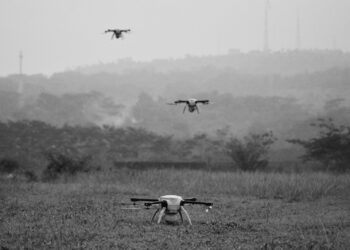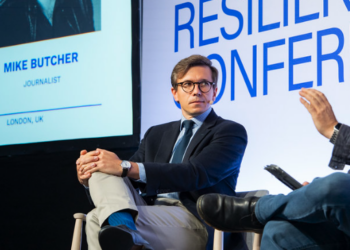
In the same week that Russian drones landed uninvited in Poland, in London I attended a defence conference with 70,000 other people – noisy halls that, for a minute, were completely silenced in remembrance of the victims of September 11. Events of the past and present hit equally deep in the gut and together are a strong reason why so many are flocking to the defence industry right now.
DSEI – the conference I attended this week – is nearly as old as the primes that dominate it, and it’s been taking the pulse of the industry for decades. In my own experience, it has never felt bigger, or as focused on technology, as it does now.
Technology startups, having hardly had a presence at the bi-annual event in years past, effectively pervaded every room of the show this week. But it was in a gigantic pavilion, at the far end of the 100,000 square metre ExCel exposition centre, where tech was really front and centre, with exhibitors showing off hardware and software, cybersecurity, AI, and more.
Investors who have never heard about DSEI were suddenly there, some driven by FOMO. Hell, even I was there, like Alice in “War Land” with tanks, missiles and AI rather than the Cheshire cat, the caterpillar, and the dodo.
As someone born in Soviet Russia, with a history of moving as a refugee, even 22 years later, I’d say the climate is different in a democracy. You can actually feel the cold autumn air fill your lungs. You can taste the freedom. You know the feeling because you remember how you suffocated before: not just your breath, but your dreams and your future decided by others.
Hence, what we do in Factiverse with our focus on fact-checking and why we are here. Democracy doesn’t die in darkness, it fizzles out in the daylight because we take it for granted. It is not a right; it is a privilege we must earn.
And I am really worried. Billions of euros are poured into the industry from private and public coffers to innovate. But billions of euros will also be lost through bureaucracy, inefficiency, and ego-based meddling. It is the best of times, it is the worst of times.
Despite the billions being poured into defence, European governments are not adequately addressing the fact that one of the biggest threats to their democracies, and to NATO’s cohesion, is the escalating information war.
There are not enough tanks and weapons in the world to fight cognitive warfare. When our minds are battlefields, what weapons really work? Our societies keep becoming more polarised. According to Herre (2022), the number of people that have democratic rights has plummeted from 3.9 billion to 2.3 billion people. It happened just between 2016 and 2024. We are asking questions like what is true, and clinging to our phones and social media, slowly letting go of democracy.
I find it appalling how little has been done in the past 15 years to protect Europe against a different type of weaponry. Just as dangerous but less noticeable are poisonous messages and questionable narratives that have no basis in truth. We derail our public debates by discussing the content of narratives, instead of asking who the messengers are and why they want to spread these groundless narratives.
Many of these messengers become really creative – they feed harmful data to AIs like chatbots. It requires minimal effort to achieve effective data poisoning of the chatbots that we have come to depend on in a short time.
Many operate on social media and slip through the drafty gaps of Meta’s “non-editorial-editorial” content guidelines.
Just this summer, during the Norwegian elections, Meta allowed a viral anonymous account to buy paid ads and publish misleading election posts for months. However, the same Meta immediately blocked content by the Norwegian Media Authority (Medietilsynet). This neutral organisation posted information about how to vote and how to analyse information from a critical point of view.
TikTok blocked the content of Ung.no, a government-driven youth website, on how to think critically. They also blocked posts by the National Police Security (PST) on how to detect foreign influence campaigns.
In 2024, CheckFirst and Faktabaari in Finland discovered that YouTube highly recommended Finnish far-right videos during the presidential race, hinting at a serious bias in the algorithm that would otherwise have remained unexposed.
There are many examples like this. Informational content isn’t being permitted, so there is less of it in feeds. The result is that you get more far-right content than before, even though you don’t relate to it, so your AI-chatbot hallucinates and gives you dubious advice. This happens daily. With each blocked post, democracy disappears in a whimper.
Maria Amelie is the CEO and co-founder Factiverse, a B2B startup out of Norway that uses AI for live fact-checking of multimedia and text.