Tuesday 3 February, 2026
[email protected]
Resilience Media
  • About
  • News
  • Resilience Conference
  • Guest Posts
    • Author a Post
  • Subscribe
No Result
View All Result
  • About
  • News
  • Resilience Conference
  • Guest Posts
    • Author a Post
  • Subscribe
No Result
View All Result
Resilience Media
No Result
View All Result

Pete Hegseth, the Battle for Troy, and Remote Drone Operations

Uncrewed systems, battlefield experimentation, & institutional agility are giving two nations the edge — while Western militaries struggle to keep pace. A guest post by Samuel Burrell, Expeditions VC

Resilience MediabyResilience Media
July 23, 2025
in Guest Posts
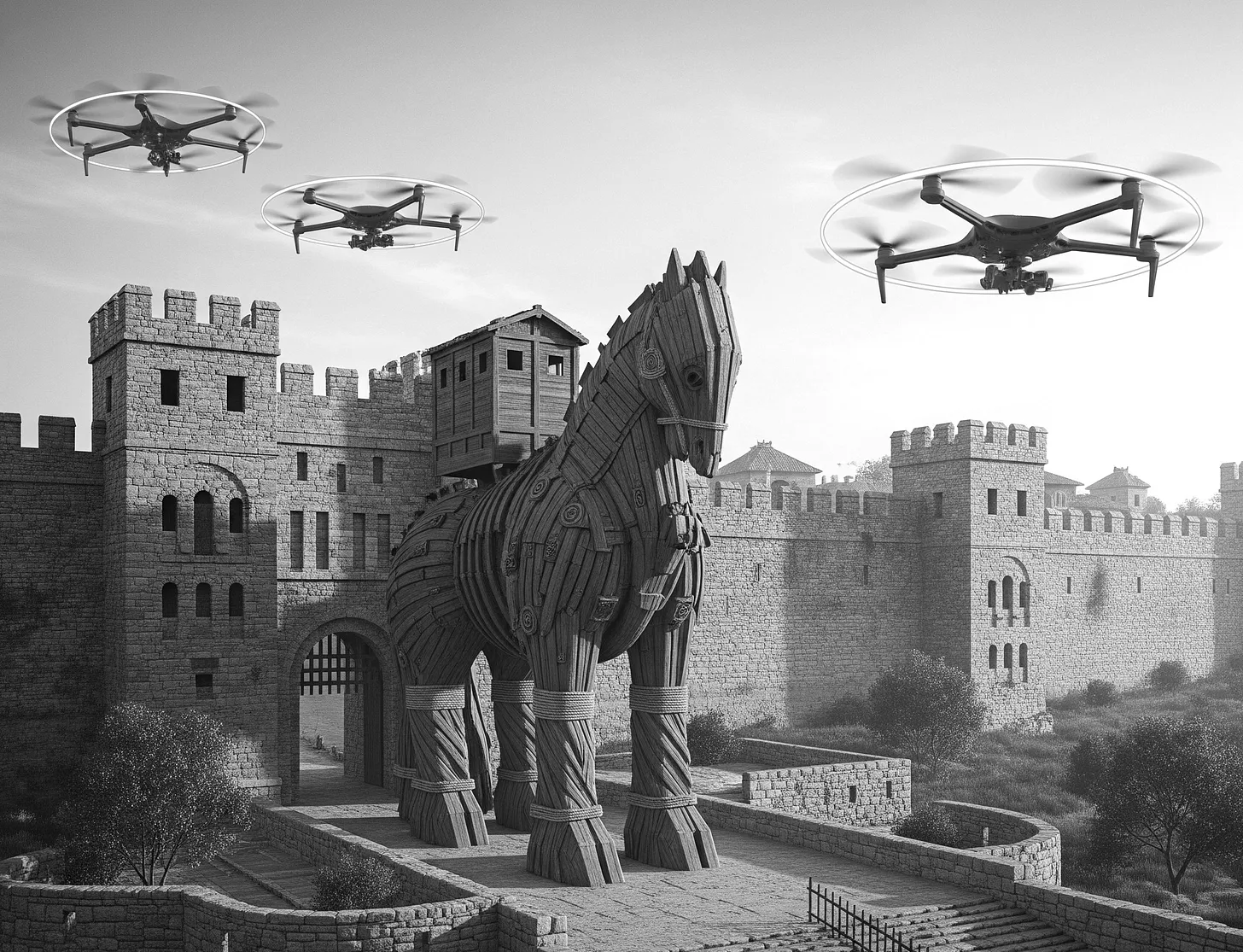
Source: Generated by Gemini

Source: Generated by Gemini

Share on Linkedin

I recently watched Pete Hegseth’s viral video, posted on X, in which he announces a Pentagon memo ‘Unleashing US Military Drone Dominance’. Although he stumbles through the delivery, the video is worth a watch – not least for its fusion of news anchor showmanship with government process.

It got me thinking about the future of drone warfare. That, in turn, got me thinking about the history of the Royal Air Force.

In 1918 the United Kingdom was the first country in the world to create an independent air force, the RAF. It was born at the end of the First World War as rapid technological progress, iterated in the skies above the battlefield, turned a civilian curiosity into a devastating military capability. Air superiority would go on to be a decisive factor in all subsequent conflicts.

In June 2024 Ukraine created the Unmanned Systems Force (USF), a separate branch of the armed forces dedicated to unmanned systems. Hegseth’s video is a nod to the realisation the Ukrainians had a year ago – that we are on the cusp of a new technological era.

You Might Also Like

The second valley of death

Europe’s cloud future is about collaboration

Capital under siege: Sanctions, supply chains and politics now drive VC decisions

But if we wind the clock forwards, what does such an era look like? The remote drone operations recently carried out by Ukraine and Israel could be a window into that future.

Last month, Ukraine and Israel carried out impressive long-range drone operations deep inside enemy territory. In both cases, they concealed fleets of drones inside modified trucks before activating them and piloting them to their targets – modern-day Trojan Horses.

The Trojan template

Most people are familiar with the story of the Trojan Horse. After a decade of failed attempts to breach Troy’s defences, the Greeks changed their strategy. They constructed a massive wooden horse, hollowed out to hold a small group of elite soldiers, and then appeared to retreat.

Believing the war was over, the Trojans brought the horse inside the city as a trophy. That night the hidden soldiers emerged, opened the city gates for the secretly returned Greek army and sacked the city. It was not brute strength that ended the war, but deception and creativity.

What Ukraine and Israel demonstrated was a contemporary version of the same logic. But to understand why only they could do it, we need to examine how they fight and how they build.

The institutionalisation of experimentation

The ancient Greeks had a culture of military innovation which enabled them to experiment with new technology. They famously developed the torsion catapult; a first of its kind, long-range precision weapon. They also designed the trireme; a new type of highly manoeuvrable ship designed for ramming attacks.

Both Ukraine and Israel have embedded similar experimentation directly into their military frameworks. In Ukraine, this is driven by necessity. In Israel, it is a matter of long-term strategic culture.

Ukraine has been fighting Russia for more than three years. Throughout that time it has contended with inferior resources and limited access to conventional firepower. Rather than match Russia gun for gun, it chose to innovate its way around the problem.

Instead of dedicating itself to increased production of artillery munitions, it invested heavily in unmanned systems. The country built a domestic drone industry almost from scratch, producing 300,000 drones in 2023, then 2.2 million in 2024. It aims to produce 4.5 million in 2025.

Israel, by contrast, is not constrained by limited resources but driven by its unique security environment. It has existential threats on multiple fronts and a longstanding doctrine of pre-emption. Its defence and technology ecosystems are tightly intertwined. Programs like Talpiot and Unit 8200 recruit young people with exceptional technical ability and give them both academic education and military responsibility.

These programs serve not only to develop military technologies but also to seed entire industries. Israel’s ability to carry out advanced drone operations is supported by a continuous supply of top-drawer technical talent that can build and operationalise concepts quickly.

Conflict begets innovation

The Greeks only considered the Trojan Horse after ten years of frustration. It was desperation, not brilliance, that gave rise to the strategy that finally ended the war.

The same is true for Ukraine. Facing a resource-rich enemy, Ukrainians have become exceptionally inventive. Amongst other achievements, they have developed uncrewed surface vessels (USVs) which have been so successful at destroying enemy ships that the Russian Black Sea fleet is now effectively confined to port. The war has created a proclivity to experiment that would be difficult to replicate in peacetime.

Israel faces a different kind of pressure. It has been in open conflict with Iranian-backed groups since 7th October 2023 and has lived with the threat of annihilation since its creation in 1948. This has shaped a defence establishment which values speed and first-mover advantage. For decades, it has approached conflict as a testing ground for new technologies, not as a deviation from normal conditions.

Why Western militaries struggle with this

In Ukraine and Israel, there is a tight feedback loop between battlefield experience and technical execution. If a new system works, it is used. If it fails, it is replaced. Success is measured in battlefield victories, not project management green ticks.

By contrast, in countries like the United States and the United Kingdom, procurement cycles can last longer than some wars. Risk aversion, complex chains of command, and strict acquisition protocols all work to slow down innovation. These militaries certainly have the technical capability to build Trojan Horse-style drone systems. What they lack is the institutional flexibility to deploy them in time to matter.

No other government could have pulled off these attacks. Because they haven’t had to. Ukraine and Israel’s systems are designed to adapt quickly and deliver results. The ancient Greeks knew that the willingness to act on a new idea is just as important as the idea itself – something that the Pentagon seems to be starting to understand.

Samuel Burrell is a Partner at Expeditions. He started his career in the military, where he was an officer in the Royal Marines. After leaving the military he joined a startup called ZipJet, before studying for an MBA at INSEAD. He has since been in venture capital, at Octopus Ventures, NKB Group and the National Security Strategic Investment Fund (NSSIF), a UK government fund focused on investing in national security and defence technologies. He joined Expeditions at the beginning of 2025 and is the lead for UK and US investments.


Tags: Expeditions VCPete HegsethSamuel Burrell
Previous Post

Inside Riihimäki: Finland’s emerging defence tech cluster

Next Post

Quadsat Raises €5M to Scale Battlefield Spectrum Intelligence

Resilience Media

Resilience Media

Start Ups. Security. Defense.

Related News

a factory filled with lots of orange machines

The second valley of death

byRobin Dechant
February 2, 2026

Every founder knows about the first valley of death – that phase where you're doing everything possible to find your...

cloudy skies

Europe’s cloud future is about collaboration

byAntti Pennanen
January 30, 2026

For years, data sovereignty had been treated as a theoretical concern – debated in policy circles yet usually deferred behind...

World Economic Forum

Capital under siege: Sanctions, supply chains and politics now drive VC decisions

byHugo Jammes
January 22, 2026

For the last three decades, European venture capital has benefited from a grand assumption that rarely makes it into pitch...

Guest Post: Where are Europe’s female defence tech leaders?

Guest Post: Where are Europe’s female defence tech leaders?

byBenjamin Lussert
December 12, 2025

Kraken Technology recently hired Erica Dill-Russell as its new chief commercial officer – a potential “trailblazer“ of a move in the market, given how...

The Chinese GTG-1002 espionage campaign is an AI security wake-up call

The Chinese GTG-1002 espionage campaign is an AI security wake-up call

byBen Van Roo
December 12, 2025

In September, a Chinese state-sponsored group ran a cyber-espionage campaign where off-the-shelf artificial intelligence tooling was believed to have performed...

The evolution of state sovereignty and national security in the digital age

The evolution of state sovereignty and national security in the digital age

byHugo Jammes
December 11, 2025

Over the last two decades, the nature of sovereignty and warfare has been fundamentally transformed by digital technologies and the...

Five Months After Launch, UK Defence Innovation is Still Missing in Action

Five Months After Launch, UK Defence Innovation is Still Missing in Action

byResilience Media
December 5, 2025

On 1 July 2025, the Ministry of Defence (MOD) launched UK Defence Innovation (UKDI), backed by a £400 million ring-fenced...

Killing is the core function of ‘defense technology’

Killing is the core function of ‘defense technology’

byCharles Eberly von Szecsey
December 2, 2025

I am sure most of us have spent considerable time this year moving through industry conferences where the talk always...

Load More
Next Post
Quadsat Raises €5M to Scale Battlefield Spectrum Intelligence

Quadsat Raises €5M to Scale Battlefield Spectrum Intelligence

Wartime Makes ‘Odd’ Bedfellows In Danish-Ukrainian Partnership

Wartime Makes 'Odd' Bedfellows In Danish-Ukrainian Partnership

Most viewed

InVeris announces fats Drone, an integrated, multi-party drone flight simulator

Twentyfour Industries emerges from stealth with $11.8M for mass-produced drones

Harmattan AI raises $200M at a $1.4B valuation from Dassault

Palantir and Ukraine’s Brave1 have built a new AI “Dataroom”

Hydrosat raises $60M for its thermal satellite imaging tech

Frankenburg has raised up to $50M at a $400M valuation, say sources

Resilience Media is an independent publication covering the future of defence, security, and resilience. Our reporting focuses on emerging technologies, strategic threats, and the growing role of startups and investors in the defence of democracy.

  • About
  • News
  • Resilence Conference
  • Guest Posts
  • Subscribe
  • Privacy Policy
  • Terms & Conditions

© 2026 Resilience Media

No Result
View All Result
  • About
  • News
  • Resilence Conference
  • Guest Posts
  • Subscribe
  • Privacy Policy
  • Terms & Conditions

© 2026 Resilience Media

This website uses cookies. By continuing to use this website you are giving consent to cookies being used. Visit our Privacy and Cookie Policy.