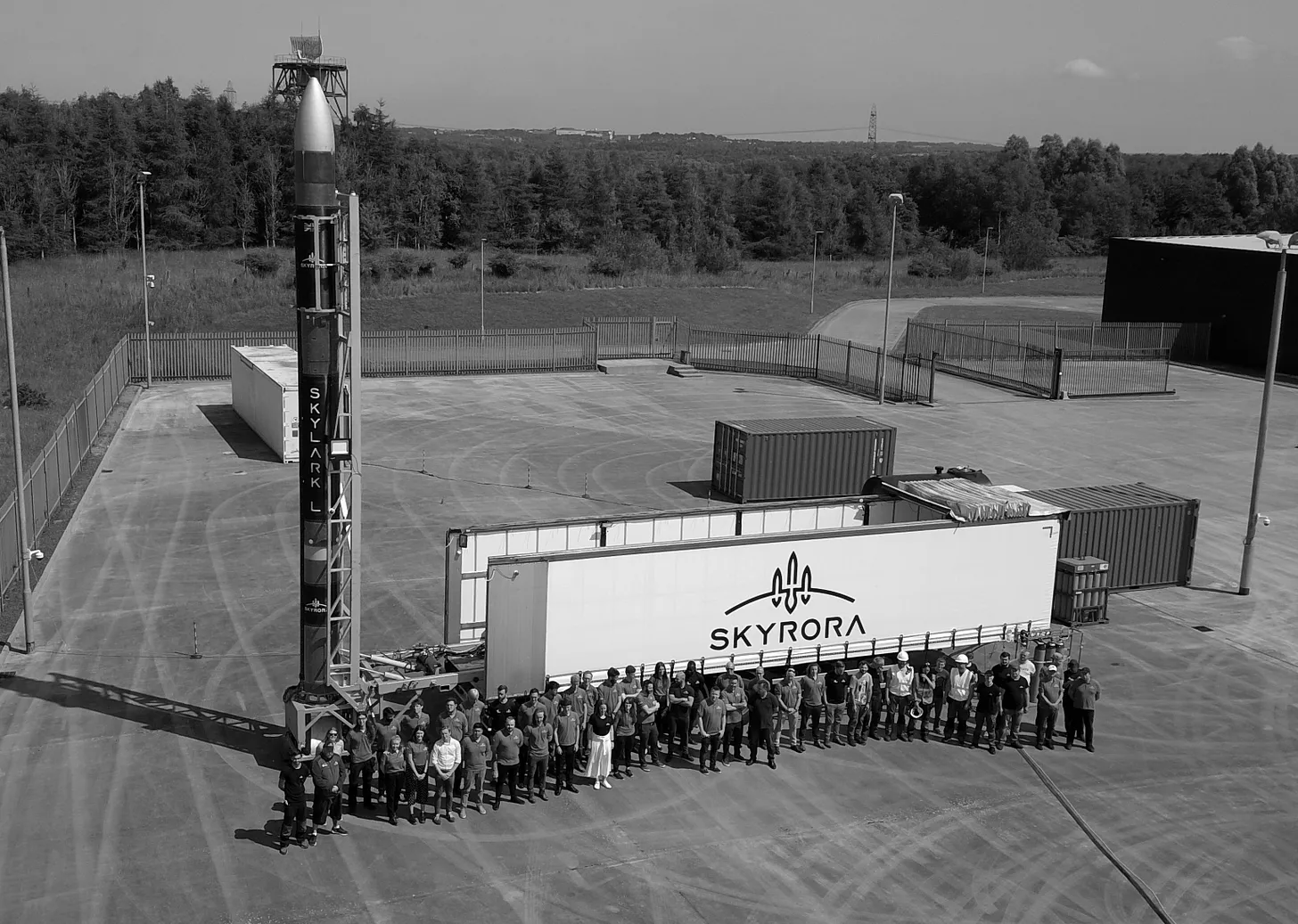
Founded out of Scotland in 2017, Skyrora is the handiwork of CEO and founder Volodymyr Levykin, a Ukrainian-born entrepreneur based in Edinburgh. The company has initiated several test launches through the years, including what was dubbed the “first commercial rocket” test launch from Scotland back in 2018 when Skyrora sent its short-range Skylark Nano vehicle from a site in the Scottish Highlands to an altitude of 6km.
But to carry-out full-scale space missions, especially those aiming for orbit with full payloads, companies need special regulatory approval, which is where Skyrora’s newly-acquired licence comes into play.
Skyrora’s planned launchpad is SaxaVord, a private spaceport on the Shetland Islands that’s licensed for vertical orbital launches. While its own licence means that Skyrora is now able to pursue full-scale operations from UK soil, including higher-altitude sub-orbital missions, the company said that limited launchpad availability will likely delay its first mission to 2026.
“Earlier in the year we were told that there was no longer availability to launch from either of the pads at SaxaVord,” Alan Thompson, head of government affairs at Skyrora, told Resilience Media. “Therefore, despite having a vehicle ready and a launch license, it is unlikely that Skyrora will be able to complete its launch from the UK this year. Skyrora is ready to complete a launch from the first available launch pad next year.”
Thompson added that the company does have an initial payload confirmed for its inaugural sub-orbital launch, but it’s unable to reveal details at present.
Skyrora has developed several rockets and launch vehicles through the years. This includes the Skylark L, which is designed as a developmental vehicle to test subsystems prior to going into the full-scale Skyrora XL – its flagship orbital vehicle which has a target launch date of 2027.
In developing the “prototype” Skylark L vehicle, however, the company may have created a new market for sub-orbital missions such as microgravity science experiments – if the demand is there, that is.
“Skyrora’s strategic goal is to deploy a commercially viable orbital launch service in the first instance,” Thompson said. “If in the process of achieving this goal of orbital launch we are able to better define the sub-orbital market – whether that be for microgravity experiments or other purposes – Skyrora will be glad to make its offering available.”
Skyrora isn’t the first company to receive a launch operator licence in the UK.
Back in January, 2023, Richard Branson’ Virgin Orbit attempted to launch a payload of nine satellites via its LauncherOne rocket, which took off from Spaceport Cornwall in the Southwest of England. However, that mission ended in failure, with the rocket falling short of low-Earth orbit due to an in-flight anomaly. Virgin Orbit ceased operations just a few months later.
Virgin Orbit had used an air-launch-to-orbit (ALTO) method for its mission, which relied on a Boeing 747 to release the rocket mid-air over the Atlantic Ocean from an altitude of 10,700 meters (35,000 feet). Skyrora, for its part, is using a vertical launch approach, deploying its rockets from ground-based pads in a traditional lift-off configuration.
Elsewhere, Germany’s Rocket Factory Augsburg (RFA) recently received a U.K. spaceflight licence, and is planning a test launch from SaxaVord in 2025 — the same spaceport Skyrora intends to use. Orbex, another Scottish aerospace company, is also applying for a domestic licence.
Skyrora, meanwhile, received some €3 million in funding from the European Space Agency (ESA) back in 2021, alongside earlier undisclosed seed investment.
These cross-border efforts highlight how closely the UK’s growing space sector remains linked to Europe’s. Even post-Brexit, cooperation continues to play a central role in building out viable commercial launch infrastructure. More recently, the ESA has been making greater inroads into the UK sector, forging ties with the UK Space Agency to support domestic launch capabilities and expand its presence at the Harwell space cluster.
These developments don’t exist in isolation, however. They represent part of a larger movement across the continent aimed at reclaiming control over critical technologies.
It’s clear that the European space sector is heating up, a trend driven by rising geopolitical tensions in the region, growing commercial demand for satellite-based services, and perhaps most of all — a desire for greater technological independence.
For example, there has been a gradual shift by public sector organizations from the proprietary software ecosystems of Big Tech to open source alternatives. And in aerospace, specifically, the European Union (EU) recently signed a $11 billion deal to create a sovereign satellite constellation to rival Elon Musk’s Starlink.
Ukraine has also been drawn closer into the fold, recently signing an agreement to join key parts of the EU’s space programme to support everything from post-war reconstruction planning, to civil resilience and infrastructure planning.
For the UK, these developments only amplify the urgency of building sovereign capabilities, which for startups like Skyrora could open the door to a swathe of new opportunities.
“If the UK possesses sovereign launch capabilities, we would not depend on third parties for satellite-based activities such as intelligence, reconnaissance and communications,” Thompson explained. “Ultimately, more investment in defence should automatically mean more investment in space. In turn, we will foster greater innovation, boost the economy, and keep the nation safe.”