Resilience Media contributor Thomas Macaulay recently sat down for an in-person conversation with Mykhailo Fedorov, First Deputy Prime Minister of Ukraine and Minister for Digital Transformation. In this exclusive interview, Federov shares the innovative tech Ukraine is using against Russia, and how Ukraine is taking its mission beyond its borders. An excerpt is below, which you can continue reading by following the link to the full piece. We thank our friends at IT Arena for providing space the interview.
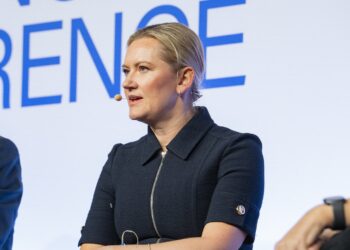
Two months after his promotion to First Deputy Prime Minister and Minister of Digital Transformation of Ukraine, Mykhailo Fedorov took the stage in September at IT Arena, a tech conference in a Lviv football stadium.
He was there to promote his plans for AI in government. There’s a Ukrainian LLM on the way, a smart assistant for the Diia public services app, a strategy to become “the world’s first agentic state,” and even a digital twin of Fedorov himself. But the ambitions go beyond public services. He also unveiled his vision of an AI-powered military to fight what he calls a “tech war” in Ukraine.
In a darkened room filled to the rafters with attendees, a video of defence technologies filled the screen behind him. A narrator boomed in English: “Automated missions are no longer the future — they’re already a feature of the battlefield. Our goal is a fully automated frontline, not held by people but by robots.”
After his talk, Fedorov was whisked into an executive box overlooking the football pitch. Down below, defence tech companies showed off their wares in an expo. From up high, Fedorov outlined Ukraine’s progress to Resilience Media.
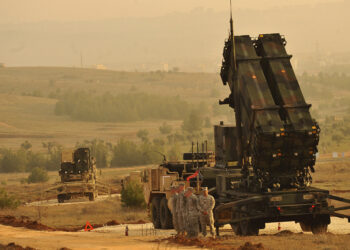
Ukraine’s vision is one of taking a layered approach, complementing more traditional means of defence with autonomous warfare tech ranging from remote-controlled ground robots to drone swarms. The ministry ultimately wants to equip “100%” of frontline drones with machine vision and AI, he said. The priority now is how to use the new generation of drones and weapons in an environment where technology is also being weaponised by Ukraine’s adversary, such as in electronic warfare used to jam signals to autonomous aircraft.
“Right now, we are focusing on making sure that when we have no connection, we can still lead the drone to the target,” Fedorov said. Meanwhile, another level of autonomy is approaching. “The next will be automated missions.”
Aged just 34 – albeit with a few grey hairs appearing beneath his black baseball cap – Fedorov became Ukraine’s youngest-ever minister when he was assigned the Digital Transformation portfolio in 2019. He quickly earned a reputation for innovative public services, especially after the 2020 launch of Diia, a mobile app now seen as a global benchmark for digital government.
His strategy was soon reshaped by war.

The digital pivot
Just two days after Russia’s invasion began in February 2022, Fedorov gained global attention after asking Elon Musk on X for Starlink ground stations. Musk replied 10 hours later: “Starlink service is now active in Ukraine.”
Since then, Fedorov has steered many of the country’s digital initiatives toward defence tech. He’s overseen the development and application of AI-guided drones, battlefield analytics systems, the IT Army of volunteer hackers, and platforms tracking Russian troop movements, embedding tech into the heart of defence.
He’s also become a close ally of President Volodymyr Zelensky.
“The president is really supportive of all the innovations because he’s young, he understands the need, and he strongly believes in all of these changes,” he said.
Like Zelensky, Fedorov is a casual dresser. On the day Resilience Media met him, he was wearing jeans and a hoodie. His black baseball cap was stitched with the logo of Brave1, the government’s defence tech development cluster that was running the event in Lviv.
The cluster has been one of Ukraine’s most successful tech projects since the start of the war. It’s gained a significant international profile in the world of defence tech for helping to bring in international companies to test and develop products and more recently to develop satellite incubating projects outside of Ukraine itself.
And in Ukraine, Brave1 has now registered over 300 AI-based innovations, with more than 70 already used by the military.
Fedorov highlights three favourites.
“The first would be swarm drones,” he says. “This is a very robust means against the attackers.”
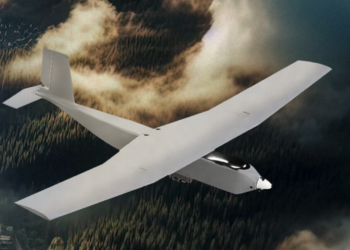
Ukraine has pioneered the battlefield adoption of drone swarm technology, which autonomously coordinates the actions of multiple drones. Several defence tech companies outside of Ukraine building drones are taking note and developing their own swarm solutions.
“It is very time-efficient,” Fedorov said.
Last year, the country deployed the first known routine use of the swarms in combat, analysts told the Wall Street Journal.
Drones deployed in these operations used software from Swarmer, a Ukrainian startup supported by Brave1. The startup recently raised $15 million in funding — the largest publicly-announced investment in a Ukrainian defence tech company since the full-scale invasion began. Fedorov described it as “a historic investment.”
“The message for the investors is to make sure that they invest in defence, because this is going to be market number one,” he said.
His second‑favourite AI innovation is advanced drone targeting. Ukrainian companies have developed a range of these systems, from Dropla’s autonomous threat detector to Farsight Vision’s platform that converts drone footage into 3D maps.
His third pick is a specific targeting technique: pixel‑lock. The technique lets drones visually “lock” onto a specific part of a target, enabling precise tracking even when communications are disrupted. Fedorov says it “helps us a lot with interception.”
A growing list of domestic startups deploy pixel-lock. They include NORDA Dynamics, which applies the technique to guide drones under contested conditions, and Vyriy Drone, whose low-cost system runs on off-the-shelf cameras and computers.