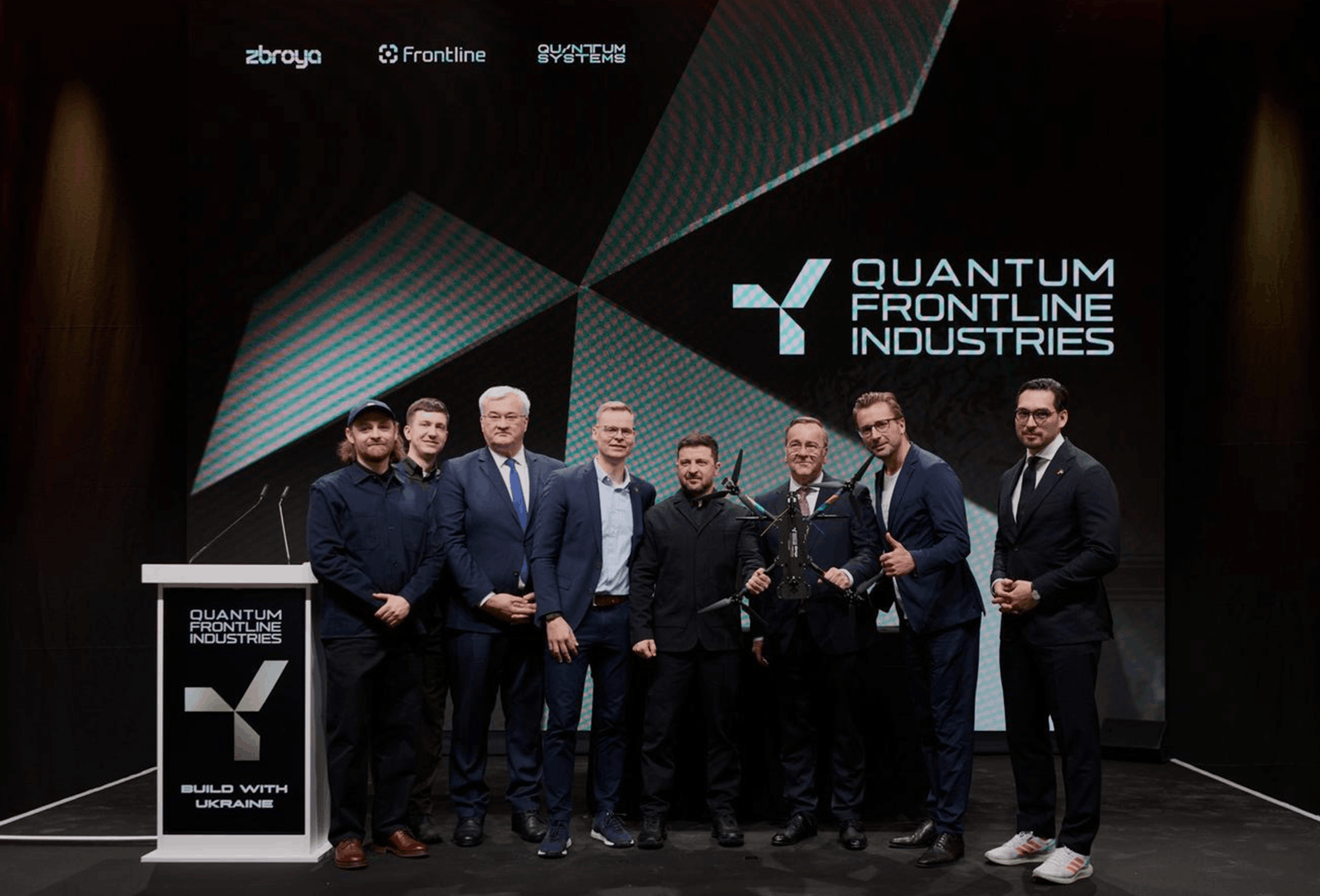
On the eve of the Munich Security Conference, Ukraine and Germany marked a solid step in defense industrial cooperation. President Volodymyr Zelenskyy and German Defence Minister Boris Pistorius visited the new Munich production facility of Quantum Frontline Industries, a joint venture between Quantum Systems and Frontline Robotics, to oversee the handover of the first Ukrainian-designed drone manufactured in Germany.
The platform, the Linza 3.0, is the first Ukrainian drone to roll off a German production line. The joint venture was announced in December 2025. Two months later, early-stage production is underway. The stated objective is to manufacture up to 10,000 drones in Germany within a year for the Ukrainian Armed Forces.
“I want to thank the people of Germany for the support of your nation since the start of the war. Your solidarity means a great deal to us. I also want to congratulate both companies and say how proud I am of the important work they are doing,” said President Zelenskyy during the ceremony.
Pistorius emphasized the speed of implementation and pointed to the reciprocal nature of the partnership, noting that lessons learned on the battlefield are feeding directly into innovation and production cycles in Germany.
“I would like to express my gratitude for this project, which, as someone put it, was implemented at lightspeed,” he said. “We learn from successes achieved on the battlefield and benefit from spillover effects in innovations that are exploited.”
That feedback loop is central to the project. Frontline Robotics developed the Linza 3.0 from operational experience inside Ukraine. More than 60 units are already deployed with Ukrainian defense formations. The drone carries up to 4 kilograms over a range of 15 kilometers, can remain airborne for up to 60 minutes, and integrates an AI-enabled navigation module within a 12-inch frame.
Quantum Frontline Industries plans to automate production capacity to meet Ukrainian demand and scale further, with the longer-term goal of supplying Ukrainian-developed technology to broader European markets. The facility was established with support from the Ukrainian Council of Defence Industry which attempts to bridge the manufacturing gap between Ukraine and Europe.
This model reflects a shift in how European support is structured. Instead of relying solely on transfers of existing stockpiles, it offers shared manufacturing capacity. Ukrainian design and battlefield experience combine with German industrial infrastructure and the result is not just a single drone handover, but the establishment of a cross-border production framework that can expand over time.