
Among the lessons the world has drawn from the Ukraine war, the utility of aerial drones in asymmetric warfare is one of the most important.
But so too is the value of their sea-based counterparts – a lesson taken on board especially in Taiwan.
To build a better multi-layered maritime domain awareness system, Taiwan plans to pair beefed-up radar and other sensor systems with unmanned surface vessels (USV).
The reason for this is clear. Maritime domain awareness has been a weak point for the island republic, and these gaps have sometimes led to high-end operational assets being sortied in response to incursions. This ultimately exhausts personnel and resources and wears down Taiwan’s combat power.
The plan has been to fund a big push into USV production from a special defence budget, but that budget is currently stalled in the opposition-led legislature.
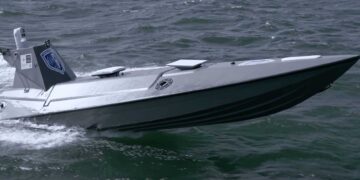
Meanwhile, the country has been testing multiple unmanned surface vessel (USV) models for different functions, with some ready to enter mass production. The two most important are the Endeavour Manta and Kuai Chi. Both of these can carry FPV suicide drones and could be used for kamikaze missions, and the Endeavour Manta can also be equipped with torpedoes.
In December, Taiwanese drone manufacturer Thunder Tiger Group said it had operated six USVs simultaneously from a single control station, pointing towards future swarm capabilities that Taiwan hopes to develop.
Aside from their value for the navy, USVs will be useful for the coast guard, too. With AI-enabled cameras on board, they can investigate potential incursions, quickly identify vessels and threat levels and convey this to operation centres.
Unmanned vessels will help Taiwan improve its maritime domain awareness even while reducing personnel requirements, said Dr Yun-hu Yeh, an Associate Professor at Central Police University in Taiwan, who emphasised that all views he expresses are his own. Taiwan is trying to expand its coast guard to respond to Chinese pressure, but is struggling to attract enough new recruits. Last year, 90 per cent of its ships are understaffed.
As China steps up greyzone incursions to exhaust the Taiwanese coast guard and navy, the most important benefit of USV and UAVs is in reducing costs, said Dr Siong-Ui Tsiam, an Assistant Research Fellow at Taiwan’s Institute for National Defence and Security Research (INDSR).
“This is a long war of attrition.”
Taiwan’s coast guard has some USV assets right now but not enough to make them a consistent feature of its response to incursions, and so it still generally relies on cutters to investigate incursions.
Taiwan is working to beef up its radar and maritime surveillance, and is requiring even small Taiwanese vessels to install Automatic Identification Systems (AIS), thereby making it easier to identify incursions. The Ocean Affairs Council, Taiwan’s top government body for maritime security and governance, secured around $935.6 million in a special budget passed last year, which is funding the construction of 40 new patrol vessels, along with upgrades to maritime surveillance. Monitoring capabilities are being enhanced, too, with island-wide monitoring and 35 infrared imaging systems due to be installed this year, improving the coast guard’s awareness capabilities, particularly at night.
These are no ordinary fishermen
But even as Taiwan steps up its ability to respond, China’s own capabilities and tactics continue to develop apace.
In December and January, China mobilised thousands of fishing vessels at least twice and assembled them into different formations in the East China Sea. In the case in mid-January, China assembled around 1,400 vessels into a 200 mile-long rectangle. Some approaching cargo ships seem to have skirted around them or zigzagged through.
These are no ordinary fishermen. Andrew S. Erickson, a professor at the US Naval War College, wrote that “The vessels’ highly systematic formation cannot be explained by fishing.” It was, he added, likely “an at-sea mobilization and exercise of maritime militia forces,” given the tight coordination of the boats.
China’s maritime militia refers to non-governmental vessels (usually fishing boats), whose mariners are paid and directed by the Chinese government to operate to further the objectives of the PRC, says Dr Philip Shetler-Jones, a Senior Research Fellow at RUSI.
They typically engage in reconnaissance, harassment and other activities in contested waters like the South China Sea.
China has used similar manoeuvres before, for example to block Philippines fishermen and coastguard from entering contested atolls. But the recent mobilisations are on an unprecedented scale, part of a broader push to bolster the maritime militia. In January 2025, Fujian province – the part of China closest to Taiwan – announced financial and other incentives aiming to professionalise its existing maritime militia.
Still, there are questions around how China would use it in a conflict.
In a recent bulletin, the US-China Economic and Security Review Commission stated that in a Taiwan contingency, such mobilisations could be used to “complicate US military operations by overwhelming radars and sensors, confounding targeting for missiles and torpedoes, and complicating navigation.”
But it also highlights that “coordination of civilian vessel mobilization with the recent [December] military drills suggests the maritime militia may begin to play a greater role in grey zone pressure against Taiwan.”
That is closer to where many analysts are focused: how they could be used outside of an invasion scenario.
“There is a good chance that the maritime militia have a role in PRC plans to control waters around Taiwan in the future, for instance to hinder or block the movement of commercial or navy ships coming to Taiwan as part of a quarantine or embargo operation,” said Dr Shetler-Jones.
“The result could be to channel shipping into or away from certain areas, or to put them into a position where even if they could break through a line of ships, they would be reluctant to do so out of a concern of appearing aggressive or escalatory. By using non-governmental ships for this purpose, the PRC could avoid accountability for interfering in freedom of navigation,” says Dr Shetler-Jones.
China could claim that this was a spontaneous protest by patriotic fishermen, practises the Chinese government has used before for anti-Japan protests on land.
Dr Tsiam believes the recent formations may be a rehearsal for a maritime quarantine of Taiwan. Blocking sea lanes would lead to skyrocketing insurance premiums and shipping costs for Taiwan. It could also normalise Chinese maritime activities around Taiwan, changing the status quo and creating a de facto jurisdiction in the seas.
None of this would give China actual control over Taiwan. But it would allow Xi Jinping some limited strategic victories to point to at a time when analysts say the CCP military is not ready for war. Analysts also believe that the US – which focuses on preparing for a military conflict – would struggle to respond to this kind of activity.
Responding even to small-scale maritime militia activities is difficult.
One issue is how to identify them. “It’s a real challenge for us,” said Dr Yeh. He says that sometimes they can only be identified in the moment when they are engaged in what are obviously non-fishing behaviour.
Then there is the thorny issue of whether to recognise them as military vessels. Treating them as civilian ships allows the Taiwanese coast guard to apply Taiwanese law, meaning it can board such vessels.
But if these are military vessels, they have immunity from Taiwanese domestic law. Any response would be governed by the law of armed conflict – which implies that there is a war.
One additional worry is how the maritime militia could be used to frame Taiwan as the aggressor against what China could portray as patriotic civilian fishermen.
Dr Yeh offers a possible scenario where a Taiwanese coastguard vessel is encircled by maritime militia vessels: “If you are the captain on board, what will you do?” The coastguard vessel could end up colliding with a maritime militia vessel – with possible loss of life.