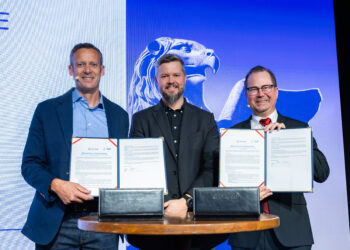
Helsing, the European defence tech startup on the cusp of closing a $1.2 billion funding round at an $18 billion valuation, needs to diversify beyond drones to justify that large figure. Today comes the latest moonshot in aid of that. The company announced a joint venture with OHB, the German space company, to develop an AI-based reconnaissance, surveillance and targeting system that would operate from space.
KIRK, as the project is called, is only coincidentally sharing a name with the captain of the Starship Enterprise (whose middle name is, incidentally, Tiberius, Roman emperor famous for his military prowess). It’s actually an acronym for “Künstliche Intelligenz und Raumfahrt-Kompetenz”, German for Artificial Intelligence and Space Competence.
This is not Helsing’s first efforts in the space of space.
In December 2025, the company announced a partnership with Kongsberg Defence & Aerospace and Hensoldt to build AI-based satellites, with some help also from Isar Aerospace in the form of launch sites. It also said in July 2025 that it would partner with French startup Loft to build Europe’s first “AI-powered multi-sensor constellation.”
The Loft partnership is noticeably not mentioned in today’s news, but the Kongsberg/Hensoldt deal is. KIRK is actually the new name for that consortium, now with Helsing and OHB jointly leading it.
Helsing and OHB are not providing many details beyond announcing this as a joint venture: no product concept, nor timeline for when we might see something deployed, nor budget assigned to this JV, nor interested customers.
OHB however is separately is planning to raise around €1 billion on the stock market, earmarked both for helping it meet an order backlog and for investing in new projects.
(It is not clear if OHB will be participating in the upcoming raise, which is being co-led by Dragoneer and Lightspeed.)
So why is Helsing announcing this news now?
On paper, Helsing is poised to become one of the biggest startups in defence tech globally (and in all of European tech) when its round officially closes in the coming weeks.
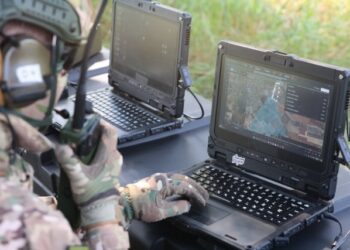
The company has a significant drones business across Europe, including winning a lucrative framework agreement with Germany’s Bundeswehr. That could net it hundreds of billions of euros in revenue if exercised to its fullest, but that is not the same as revenue on the table. So to justify a new $18 billion valuation, Helsing still needs to show it can diversify with a defence tech business in more domains beyond these mainstay operations in drones and the AI systems that underpin them.
In addition to its work in maritime, space is another strategic domain that Helsing has been eyeing for a while. That’s not least because of the lessons of Ukraine, where satellite communications have played a significant role for both Ukraine and Russia.
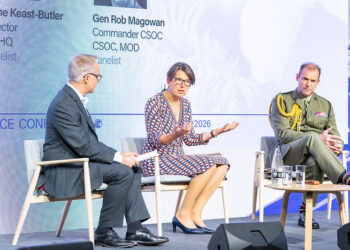
“The war in Ukraine demonstrates how important space-based targeting is,” said Gundbert Scherf, Helsing’s co-CEO and co-founder, in a statement. “It also shows that we have no time to lose and must deliver integrated defence systems in space – systems whose performance is built on software capabilities – as quickly as possible. We must ensure that Europe wins the battle for sovereignty in orbit.”
Space is also potentially very lucrative: Europe as a region is investing around $109 billion into space programmes between now and 2030 to build up its overall defence and communications resilience.
For its part, OHB is a major contractor in European space projects, with products including satellites and also a host of other hardware and software. As with other primes, one key benefit it’s getting out of a JV with a startup is access to new technology — in Helsing’s case, AI systems — that would be harder for OHB to build from scratch in-house.
“Space systems are essential to making the Bundeswehr the strongest and most modern army in Europe,” said Marco Fuchs, the CEO of OHB, in a statement. (Fuchs’ family is the majority owner of OHB.) “For the challenges that armed forces face today, fast, precise data is indispensable – and modern space systems, implemented with artificial intelligence, are a key component of that.”
But KIRK is not without its own dragging forces. Hardware for space is very much a moonshot effort both figuratively and literally. Projects will rely on entire ecosystems to become operational, and so while they may become bigger than the sum of their parts, each of those parts will need to be developed in order for any of it to work.
A lot of what is being built right now by startups is years or even decades out from being realised, but it’s also very possible that many projects will never fly (again, both literally and figuratively).