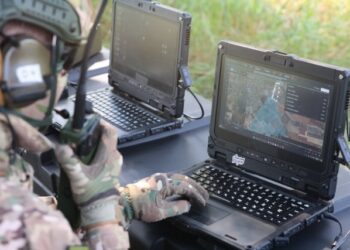
The UK government is throwing its weight behind a list of defence tech startups and awarding a series of contracts to spur more R&D in the country. A total of 13 companies are getting contracts worth up to £4 million each to provide the Ministry of Defence with new products and services.
The awards come as part of the Ministry of Defence’s “Commercial X” initiative to try to speed up procurement activities.
The list of 13 companies includes some better-known tech startups alongside some that are relatively more under the radar.
They are The RC Den Ltd (London), Aquark Technologies Ltd (Hampshire), Aether Aerospace Ltd (Newport, Wales), SpaceAM Ltd (London), Avenue 3 Ltd (West Yorkshire), Nereus Medical Ltd (Devon), Kraken Technology Group (Hampshire), Flowcopter Ltd (Edinburgh), Helyx Secure Information Systems Limited (Buckinghamshire), EP90Group Ltd (Winfrith Newburgh, England), Ritson Reid Ltd (Berkshire), SimCentric Limited (Oxfordshire), and Spectra Group UK Ltd (London).
Some of these, like the quantum tech business Aquark and the heavy-lift drone startup Flowcopter, have raised small amounts of venture funding; others, like Kraken, are building large and visible businesses in multiple markets; others, like The RC Den and Aether Aerospace, are less clear on the funding front and might well be bootstrapped.
The technologies they are collectively producing are very varied, ranging from quantum through to information management and “exploitation”, cybersecurity, consulting, heat management for individuals, logistics, secure communications, and autonomous systems for air and sea.
The awards are part of an ongoing effort at the MoD to hatch a new wave of “defence tech unicorns.” Overall, the government said that it wants to raise defence funding to 2.6% of GDP by 2027.
In relative terms, compared to the capital requirements of the average defence tech startup and the wider defence budget, the sums here are modest. But what the UK backing gives these companies is access to a procurement pipeline that can help them potentially win more business from the UK and elsewhere, as well as pick up larger investments in future funding rounds as a result.
The other objective here for the UK is to show it is trying to cut through some of its own red tape and speed up procurement — and indeed actually speed up procurement.
“These are contracts, not words or promises, and they mean that thirteen British companies, many of them new to defence, are receiving real investment to develop the technology our Armed Forces need,” said John Healey, the UK Secretary for Defence.
The UK has been working for a few months making efforts to ramp up its engagement with startups, which it typically describes (confusingly) as SMEs. That apparently will also include “Dragons Den”-style pitching events down the line.