Saturday 7 March, 2026
[email protected]
Resilience Media
  • About
  • News
  • Resilience Conference
    • Resilience Conference Warsaw 2026
    • Resilience Conference Copenhagen 2026
    • Resilience Conference London 2026
  • Guest Posts
    • Author a Post
  • Subscribe
No Result
View All Result
  • About
  • News
  • Resilience Conference
    • Resilience Conference Warsaw 2026
    • Resilience Conference Copenhagen 2026
    • Resilience Conference London 2026
  • Guest Posts
    • Author a Post
  • Subscribe
No Result
View All Result
Resilience Media
No Result
View All Result

Stanhope AI raises $8M for new approach of AI for physical applications

Built on the 'active inference' concept, Stanhope is testing with drones and robots and says it's more reliable and cheaper than current deep learning models

Ingrid LundenbyIngrid Lunden
February 12, 2026
in News, Startups
Share on Linkedin

A startup spun out of UCL research into how the brain works is building a new kind of AI model — a much better one, it claims — for hardware to help it move more intelligently through the physical world, and it has now raised $8 million in funding to help get its business off the ground.

You Might Also Like

Ukrainian autonomy company The Fourth Law unveils an anti-Shahed drone

Ukraine’s autonomous weapons makers push for industrial scale

MSC got the urgency right. The hard part comes next

Stanhope AI, as the company is called, is certainly not the first company to build AI systems to power autonomous machines. But its approach is different. Based on the neuroscience concept of “active inference,” Stanhope’s AI learns as a human brain is thought to learn: in real time and continuously correcting what it does as a result. Stanhope believes its approach produces systems that are not only easier (and cheaper) to start using in active environments, but also more responsive to spontaneous situations.

If Stanhope’s tech works as it hopes, it could be a major step forward for autonomous systems. Introducing more autonomy has been a major priority in military, industrial and other verticals adopting newer generations of equipment and see AI as the future of their industries.

But the reality of adopting it has been far from perfect in physical scenarios — as events involving two of the highest-profile AI drone startups, Stark and Helsing, have shown. The standard, costly approach to date has been to use huge datasets to “train” an AI. Stanhope thinks its own paradigm for how an AI can “learn” can improve outcomes drastically.

“This is very distinct from deep learning,” Stanhope AI co-founder Professor Rosalyn Moran said in an interview with Resilience Media. “This is actually built by us [to be like] memory in a human brain. You get all the good efficiencies and reasoning, but you also get that fundamental thing: agency. It’s a real generative model.”

Indeed, Moran believes that the current version of “generative AI” is not really generative at all. “They stole that term,” she said curtly of the hyperscalers who use it liberally these days.

GenAI startups have taken more than just a term. Hundreds of billions of dollars have been thrown at the training challenge by companies like OpenAI, Anthropic and self-driving car companies building their models, and they’re not done.

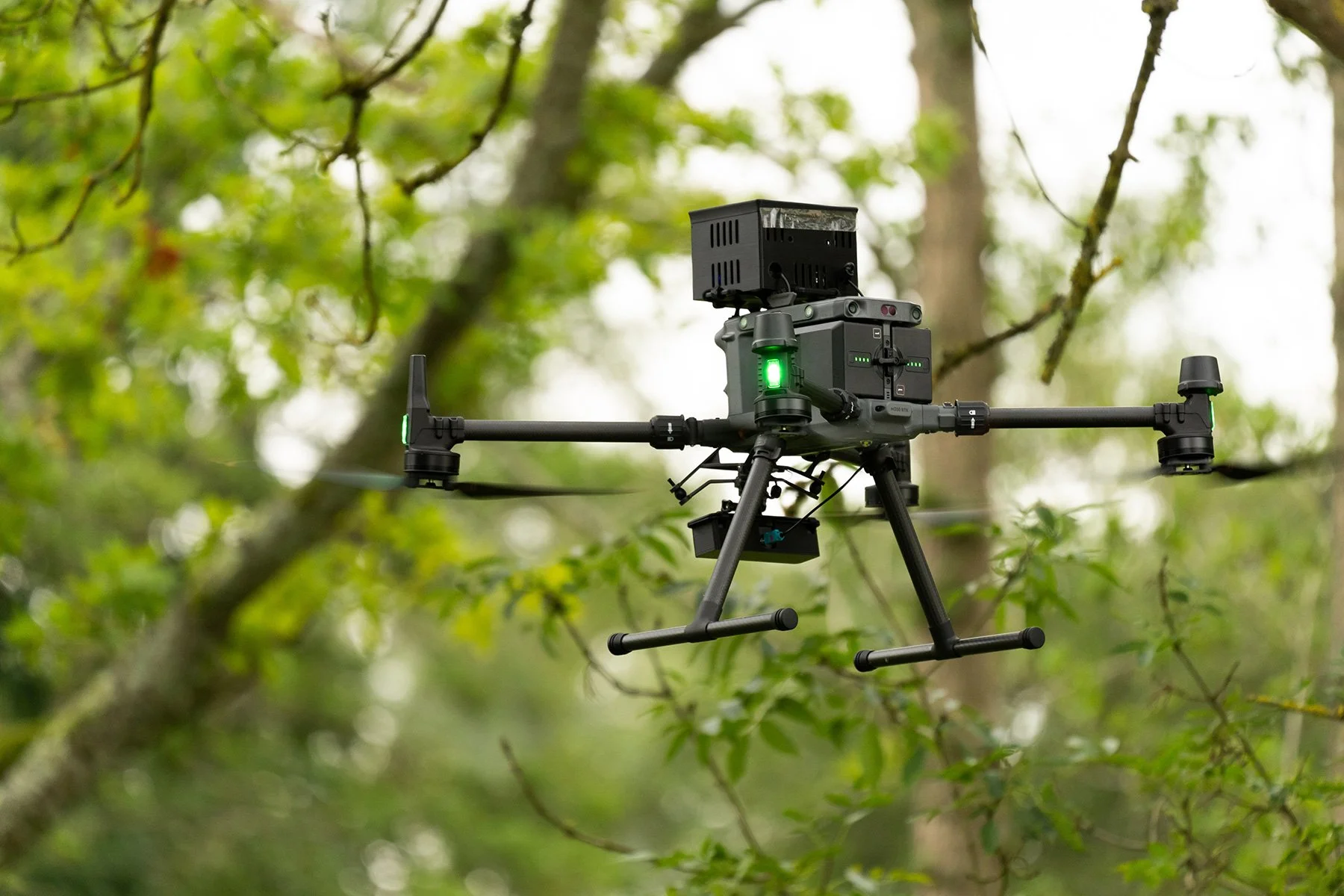
Stanhope’s technology is already being tested with (unnamed) robotics and drone companies, said Moran. You can see some of the tests here, which show how drones powered by Stanhope “agents” are introduced to new environments with obstacles and figure out how to navigate around them to get to their destinations. The startup will be using the seed money to continue expanding its research as well as that business funnel.

Frontline Ventures is leading the seed. New backers Paladin Capital Group and Auxxo Female Catalyst Fund; and previous investors UCL Technology Fund and MMC Ventures are also participating.

A heady time at UCL

Stanhope was the brainchild of Moran and another professor, Karl Friston, who had been working together in the neuroscience department at UCL. Moran had come to studying and working in the field initially from the world of electrical engineering.

Friston’s research into understanding how the brain works was being crystallised into the “free energy” theory, which in a very basic nutshell postulates that self-organising biological creatures, in order to survive, continually learn from the outside environment by matching it against what they already know. Given the brain works by way of a series of electrical impulses, Moran joined the team to grow that angle of his research.

It was a heady time at UCL (pun intended), with Demis Hassabis in the same hallway doing his own neuroscience research that led to him eventually founding DeepMind. So unsurprisingly, perhaps learning from their own environment, the pair saw an opportunity to spin out their ideas as an alternative for physical world AI that better reflected how they saw the brain to work.

One of the unique aspects of how Stanhope’s tech is implemented is that the processing for the systems happen not in the cloud — as is the case with autonomous system training now — but at the “edge,” on the device itself.

That creates a massive reduction in cost and energy usage in building and operating systems. Potentially, it provides a solution to how, say, a military drone work even in electronic warfare environments where communications with operators are cut off.

That also makes the technology much more applicable across a wider range of use cases, something that attracted investors to the problem.

“We’ve looked at so many new hardware vendors in defence tech,” said Nazo Moosa, a partner at Paladin. “What we were really excited about with Stanhope is that this goes beyond drones. Drones are important test bed but we looked at it from a different angle. If you look at the physical or digital world, it’s hard to get data hasn’t already been eaten up, but in the physical world data is the crunch point.” She noted that Waymo had to launch in the market to start to collect physical world training data, and while warehouses are easier environments, war zones are not.

“In a war zone, you get surprises,” she said. “You don’t have the capacity and flexibility to train millions of hours. That is what Roslyn and her team are fixing.”


Tags: DronesFrontlinepaladinphysical AIStanhope AI
Previous Post

Wrecking-ball politics and the end of mutually-assured stability

Next Post

Germany awards Stark and Helsing contracts to deliver next-generation strike drones

Ingrid Lunden

Ingrid Lunden

Ingrid is an editor and writer. Born in Moscow, brought up in the U.S. and now based out of London, from February 2012 to May 2025, she worked at leading technology publication TechCrunch, initially as a writer and eventually as one of TechCrunch’s managing editors, leading the company’s international editorial operation and working as part of TechCrunch’s senior leadership team. She speaks Russian, French and Spanish and takes a keen interest in the intersection of technology with geopolitics.

Related News

Ukrainian autonomy company The Fourth Law unveils an anti-Shahed drone

Ukrainian autonomy company The Fourth Law unveils an anti-Shahed drone

byJohn Biggs
March 6, 2026

Ukraine-based autonomy company The Fourth Law has unveiled Zerov, an autonomous interceptor drone built to engage long-range strike UAVs in...

Ukraine’s autonomous weapons makers push for industrial scale

Ukraine’s autonomous weapons makers push for industrial scale

byLuke Smith
March 6, 2026

In the past five months in Ukraine, Major Maksym Gromov's unit launched 608 autonomous Lupynis drones against Russian adversaries. Four...

asphalt road between trees

MSC got the urgency right. The hard part comes next

byRobin Dechant
March 6, 2026

A few weeks on from the Munich Security Conference, something many of the Resilience Media community no doubt attended, I...

NATO Innovation Fund appoints a president, Ari Kristinn Jónsson

NATO Innovation Fund appoints a president, Ari Kristinn Jónsson

byIngrid Lunden
March 5, 2026

The NATO Innovation Fund, the VC formed out of the strategic alliance of NATO countries that counts most (but not...

SkySafe Wants to Be the Air Traffic Control for Drones

SkySafe partners with major energy sector player to build out drone defence

byJohn Biggs
March 5, 2026

Southern States LLC and SkySafe announced a partnership to integrate real time drone detection and airspace intelligence into Southern States’...

Uforce raises $50M at a $1B+ valuation to build defence tech for Ukraine

Uforce raises $50M at a $1B+ valuation to build defence tech for Ukraine

byIngrid Lunden
March 5, 2026

The United Kingdom and Ukraine look like they may have minted their first defence tech ‘unicorn’. Uforce (stylised ‘UFORCE’) —...

Anthropic, OpenAI, and the new rules of Defence AI

Anthropic, OpenAI, and the new rules of Defence AI

byCarly Pageand1 others
March 3, 2026

Anthropic is facing the prospect of being frozen out of US government work after refusing to relax safeguards on how...

Periphery CEO Toby Wilmington

Periphery and Midgard partner to secure robots against capture and reverse engineering

byPaul Sawers
March 2, 2026

Modern conflict has pushed autonomous machines into some of the most hostile operating environments. Drones are intercepted mid-flight, ground robots...

Load More
Next Post
Stark inks Virtus deal with NATO member in Northern Europe, one week after expanding to Sweden

Germany awards Stark and Helsing contracts to deliver next-generation strike drones

an aerial view of a snowy city at night

Estonia needs to stay on guard, says Estonian Foreign Intelligence Service

Most viewed

InVeris announces fats Drone, an integrated, multi-party drone flight simulator

Twentyfour Industries emerges from stealth with $11.8M for mass-produced drones

Senai exits stealth to help governments harness online video intelligence

Harmattan AI raises $200M at a $1.4B valuation from Dassault

Uforce raises $50M at a $1B+ valuation to build defence tech for Ukraine

Palantir and Ukraine’s Brave1 have built a new AI “Dataroom”

Resilience Media is an independent publication covering the future of defence, security, and resilience. Our reporting focuses on emerging technologies, strategic threats, and the growing role of startups and investors in the defence of democracy.

  • About
  • News
  • Resilence Conference
    • Resilience Conference Copenhagen 2026
    • Resilience Conference Warsaw 2026
    • Resilience Conference 2026
  • Guest Posts
  • Subscribe
  • Privacy Policy
  • Terms & Conditions

© 2026 Resilience Media

No Result
View All Result
  • About
  • News
  • Resilence Conference
    • Resilience Conference Copenhagen 2026
    • Resilience Conference Warsaw 2026
    • Resilience Conference 2026
  • Guest Posts
  • Subscribe
  • Privacy Policy
  • Terms & Conditions

© 2026 Resilience Media

This website uses cookies. By continuing to use this website you are giving consent to cookies being used. Visit our Privacy and Cookie Policy.