Wednesday 15 April, 2026
[email protected]
Resilience Media
  • About
  • News
  • Resilience Conference
    • Resilience Conference Warsaw 2026
    • Resilience Conference Copenhagen 2026
    • Resilience Conference London 2026
  • Guest Posts
    • Author a Post
  • Subscribe
No Result
View All Result
  • About
  • News
  • Resilience Conference
    • Resilience Conference Warsaw 2026
    • Resilience Conference Copenhagen 2026
    • Resilience Conference London 2026
  • Guest Posts
    • Author a Post
  • Subscribe
No Result
View All Result
Resilience Media
No Result
View All Result

To infinity and back: the opportunity for reusable hardware in space

Atmos Space Cargo talks about building long-term plans for deep tech

Resilience MediabyResilience Media
April 15, 2026
in News
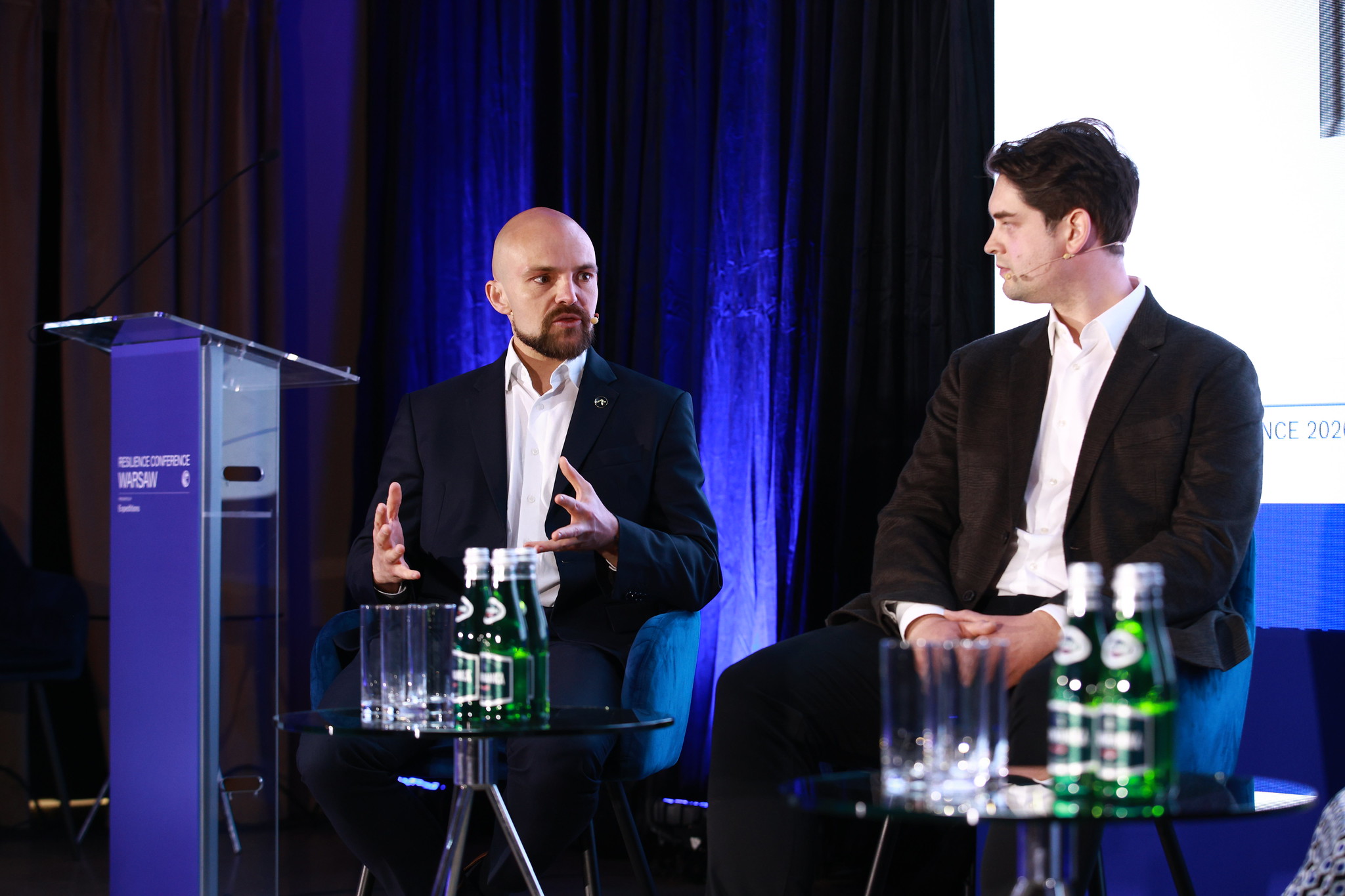
Sebastian Klaus, CEO of Atmos, and Aleksander Dobrzyniecki, Balnord

Sebastian Klaus, CEO of Atmos, and Aleksander Dobrzyniecki, Balnord

Share on Linkedin

Germany’s Atmos Space Cargo is opening an office in Poland focused on defence capabilities, announced CEO Sebastian Klaus during a panel on Resilience Conference in Warsaw. The news comes on the heels of the German startup ramping up production to focus serving ministries of defence, which are focusing on extending defence capabilities that incorporate the space domain.

You Might Also Like

Klaus Hommels of Lakestar talks about defence consolidation and the future of procurement

Danish startup Sapient Perception raises €2M to widen UAV vision for real-time battlefield decisions

ARX Robotics secures British Army contract

Atmos develops reusable spacecraft to deliver any type of cargo from space, promising controlled and precise return capability, on-orbit operations when in space, and subsequent return to Earth. Re-entry technology is crucial for life sciences and biotech research, as well as industrial materials development, and increasingly it also has military applications.

“When you’re in space, you can pretty much reach any place on earth within 60 minutes” said Klaus.

Atmos is still very much an early-stage startup. The company has to date only had one launch into space — ridesharing on a SpaceX rocket to gather research data to develop its commercial product a year ago.

But Klaus said that the company has a roster of several more launches planned for the next couple of years. And he also claimed that the company is further along in its capabilities in its labs. From a technical perspective, he said, Atmos could support strike capacities “in two to three years,” but employment of that capability remains a political question.

Atmos spacecraft use inflatable decelerators that look a little like round rafts, technology that was originally developed by NASA in the US and has been refined by the startup for its purposes. The material and design of the decelerators are meant to help preserve its payloads during re-entry so that they can be re-used in future.

Klaus said that Atmos is “the very first company in Europe to use this type of technology,” adding that their solution is “more scalable, even more lightweight and therefore more cost efficient than what NASA is doing.”

The company launched its first capsule into space last year, with the next one, PHOENIX 2, due to take off in 2027.

Atmos has received funding from a pan-European group of investors and has raised about $20 million to date, per PitchBook data, and we understand it is in the process of raising more than this. Aleksander Dobrzyniecki from Balnord, one of the company’s backers, joined Klaus on the panel.

Dobrzyniecki remarked that space sector investors should prepare for unexpected delays and changes, which are an inherent part of space innovation.

“It’s very important to have alignment between the founding team and the investor base,” said Dobrzyniecki.

Atmos collaborates with a number of other space tech companies, and it recently inked a strategic partnership and MOU with US space technology company Voyager.

The companies said that Voyager Europe will serve as Atmos’ integration and implementation partner, and Atmos will provide its free-flying orbital vehicles to Voyager. Both companies will “mutually refer customers and mission opportunities across their networks,” they added. But while Voyager has a stated mission of M&A, acting as consolidator across the space tech landscape, that may not net in Atmos: Klaus categorically ruled out acquisitions by any American companies.

Klaus underlined that in a conflict scenario, there is an urgent need for sovereign European solutions in space. “It’s extremely important that we develop our own space transportation capabilities.”


Tags: Atmos Space CargoBalnorddual usePolandspace
Previous Post

Danish startup Sapient Perception raises €2M to widen UAV vision for real-time battlefield decisions

Next Post

Klaus Hommels of Lakestar talks about defence consolidation and the future of procurement

Resilience Media

Resilience Media

Start Ups. Security. Defense.

Related News

Klaus Hommels of Lakestar talks about defence consolidation and the future of procurement

Klaus Hommels of Lakestar talks about defence consolidation and the future of procurement

byJohn Biggs
April 15, 2026

Investor and entrepreneur Klaus Hommels, founder of Lakestar, sees a new era of European defence spending and investment. His comment?...

Danish startup Sapient Perception raises €2M to widen UAV vision for real-time battlefield decisions

Danish startup Sapient Perception raises €2M to widen UAV vision for real-time battlefield decisions

byCarly Page
April 15, 2026

A Danish startup promising to give drones a much wider field of view without sacrificing detail has raised €2 million...

Daimler Truck and ARX Robotics Team Up to Bring AI and Autonomy to Military Vehicles

ARX Robotics secures British Army contract

byLuke Smithand1 others
April 15, 2026

ARX Robotics has secured its first British Army contract, delivering UK-manufactured Gereon uncrewed ground vehicles for Recce-Strike experimentation through Task...

Airship startup Kelluu raises €15M from NATO, its first investment in Finland

Airship startup Kelluu raises €15M from NATO, its first investment in Finland

byIngrid Lunden
April 14, 2026

Defence is a multi-modal concept, and today a startup focused on building a stronger pipeline of intelligence data from a...

Rheinmetall and Destinus to ‘bridge the gap’ with new joint venture

Rheinmetall and Destinus to ‘bridge the gap’ with new joint venture

byFiona Alston
April 13, 2026

The CEO of German defence prime Rheinmetall may have stepped out into the spotlight as an outspoken critic of Ukraine's...

Refute report finds coordinated election interference targeting European voters and diaspora

Refute report finds coordinated election interference targeting European voters and diaspora

byJohn Biggs
April 10, 2026

UK-based Refute has published a new report examining foreign interference in recent European elections, drawing on data from Romania, Moldova,...

Tiberius to link Ukraine-validated defence tech with UK manufacturing through GRAIL platform

Tiberius to link Ukraine-validated defence tech with UK manufacturing through GRAIL platform

byJohn Biggs
April 10, 2026

Tiberius Aerospace said it will make Ukrainian battlefield-validated technology available for manufacturing in the United Kingdom through its GRAIL platform,...

Never Lift Revealed as Early Investor in Cambridge Aerospace as Startup Confirms $136M Raised

UK government backs Cambridge Aerospace in Skyhammer anti-drone defence deal

byPaul Sawers
April 10, 2026

The UK Government has announced that it’s buying a “significant number” of Skyhammer air defence systems from UK startup Cambridge...

Load More
Next Post
Klaus Hommels of Lakestar talks about defence consolidation and the future of procurement

Klaus Hommels of Lakestar talks about defence consolidation and the future of procurement

Most viewed

InVeris announces fats Drone, an integrated, multi-party drone flight simulator

Uforce raises $50M at a $1B+ valuation to build defence tech for Ukraine

Auterion, the drone software startup, eyes raising $200M at a $1.2B+ valuation

Senai exits stealth to help governments harness online video intelligence

Palantir and Ukraine’s Brave1 have built a new AI “Dataroom”

Twentyfour Industries emerges from stealth with $11.8M for mass-produced drones

Resilience Media is an independent publication covering the future of defence, security, and resilience. Our reporting focuses on emerging technologies, strategic threats, and the growing role of startups and investors in the defence of democracy.

  • About
  • News
  • Resilence Conference
    • Resilience Conference Copenhagen 2026
    • Resilience Conference Warsaw 2026
    • Resilience Conference 2026
  • Guest Posts
  • Subscribe
  • Privacy Policy
  • Terms & Conditions

© 2026 Resilience Media

No Result
View All Result
  • About
  • News
  • Resilence Conference
    • Resilience Conference Copenhagen 2026
    • Resilience Conference Warsaw 2026
    • Resilience Conference 2026
  • Guest Posts
  • Subscribe
  • Privacy Policy
  • Terms & Conditions

© 2026 Resilience Media

This website uses cookies. By continuing to use this website you are giving consent to cookies being used. Visit our Privacy and Cookie Policy.