Good afternoon from Resilience Media.
Resilience Conference Copenhagen is a wrap! Pictures from the event are here. (And yes, there was a piano on the stage.) Highlights included:
- An electrifying opener about the actualities of supporting Ukraine with Ragnar Sass (Darkstar), Esben Gadsbøll (Defense Innovation Highway), and Perry Boyle (MITS Industries)
- A fireside chat between EIFO CEO Peder Lundquist and D3 Managing Partner Eveline Buchatskiy
- The leading Ukrainian-British academic Peter Pomeranzev on two panels about information warfare
- Ambassador Celia Kuningas-Saagpakk and Nordic Air Defence’s Tobias Billström on Nordic-Baltic collaboration
- Erica Dill-Russell (Kraken Technology Group), RADM (Ret) Nils Wang, and RADM Rich Harris (Royal Navy) diving deep into maritime tech and hybrid navies
We’ll upload videos from the day soon. Thanks to our attendees, speakers, sponsors, and partners. Next stop Resilience Conference London, 5-6 October 2026. Early Bird tickets are live and we’ll be announcing the first round of speakers soon.
Expeditions led a $10M pre-seed round into frontier defence AI lab Twin Prime. We unpack that in our Deals section below. In Partnerships ARX Robotics expands its Ukraine presence, Noah Labs is bringing air gapped AI to militaries and governments, and a Munich facility gives Spire a base for sovereign space capabilities.
Elsewhere on Resilience Media, we cover a lot of geopolitics.
All eyes are on the historic meeting between the US and China, especially in how it might affect Taiwanese sovereignty. In light of that contributor Paddy Stephens examines Taiwan’s drone industry and comes to the conclusion that international exports are driving its success. Read an excerpt in our Dispatches from Taiwan section below. Also:
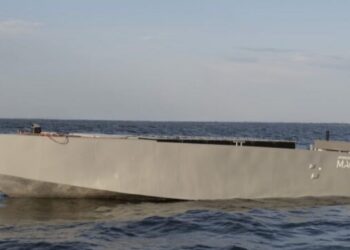
- Ukrainian Magura sea drone found in Greek cave near Lefkada
- Two drones entering from Russia and armed with warheads land in Latvia
- Analysis: Europe’s chip ambitions risk going stale
I’ll be back in your inboxes next week. Thanks for reading.
-Leslie Hitchcock, co-founder and Publisher, Resilience Media

Expeditions backs frontier defence AI lab Twin Prime in $10m pre-seed raise
- European defence-focused VC firm Expeditions has led a $10 million pre-seed investment into Twin Prime, a newly launched frontier AI company developing specialised models for defence and security applications.
- The funding round also included investment from European defence manufacturer Theon International, alongside American and European venture firms, family offices, and angel investors connected to companies including Palantir, Anduril Industries, and Quorum.
- Twin Prime says it’s building AI models designed specifically for defence and national security environments, with a focus on analysing and reasoning across large volumes of sensor data generated by military and security systems.
- The company said its models are intended to help operators make faster decisions in real time across complex operational environments.


Taiwan’s drone industry is booming — thanks to international exports
Paddy Stephens, Contributor
Among the low-rise offices and monochrome factories of Taichung – a sprawling industrial powerhouse in central Taiwan – nestled down a quiet street between LNG, insurance and electricals companies, one facility stands out for the bright red-tipped autonomous submarine model and silver unmanned surface vessel sat on its forecourt.
This is the headquarters of Thunder Tiger, one of Taiwan’s most important drone companies. Founded in 1979, the company began life making radio-controlled models for hobbyists. Publicly listed, now it makes military-grade drones certified by the US military.
Taiwan’s drone industry is currently in the spotlight – not just because of how it could be used to help the country defend itself against China, and not just as an example of how a new export industry is taking shape in the country. Also because, as China’s leader Xi Jinping prepares to meet with US president Donald Trump, China is expected to put a lot of pressure on the US to disengage with Taiwan as an arms supplier, and that, by extension, could impact a variety of companies working in the area of drones, just at a time when they are stepping up activity.
As the importance of drones to Ukraine’s defence has become clear, interest in autonomous systems has surged in Taiwan. Even local companies with no previous links to the drone industry are getting involved: I-Mei, a ubiquitous food brand, is now co-developing drones and robot dogs.
Thunder Tiger is also not entirely out of place among the traditional manufacturers in Taichung. The company’s other revenue streams come from making dental equipment and “injection molding” aseptic bottle caps. It pours the profits from these activities into R&D, specifically to work on drones. These range from underwater systems to FPVs and “helicopter” drones.
In its current ramp-up in production – with a new “megafactory” due to be operational by the end of the year in Chiayi, a key hub for Taiwan’s dronemakers – Thunder Tiger mirrors the overall boom in Taiwan’s drone industry.
Faced with Chinese threats of annexation, Taiwan is keenly aware of how Ukraine has leveraged drones to resist Russia, a much larger country. Following that paradigm, Taiwan has been working to build out its own drone industry since 2022.
But with funding for significant drone procurements by the Taiwanese military blocked by the legislature, Taiwan’s drone industry growth is driven by exports. Over 140,000 drones exported in the first quarter of this year, more than in the whole of 2025, and momentum continues apace. (And to put that figure into some context, at present, Taiwan’s armed forces have access to only around 5,000 drones in total, according to estimates by the Research Institute for Democracy, Society, and Emerging Technology.)
European markets are currently the destination for the vast majority of Taiwan’s drone exports, but Thunder Tiger is doing something slightly different: it has become the first Taiwanese drone maker on the US Department of Defence’s cleared UAS “Blue List”, allowing it to supply the US military. Now, it is taking that one step further and shifting to mass production there.
“If there’s not enough internal demand in Taiwan to scale up, then companies have to find a market in other places,” said Samara Duerr, a policy analyst at Taiwan’s government-funded DSET think tank. “They sell [abroad] and get feedback and expertise. It is one way to scale up and bring costs down.”
Partners elsewhere are clearly interested in buying Taiwan’s exports. A new proposed US Senate bill, the “Blue Skies for Taiwan Act”, would support UAS supply chain development in Taiwan. It states that “the vast majority of commercially available UAS contain PRC-sourced components, creating significant cybersecurity, supply chain, and operational risks for both Taiwan and the United States.”
Bill or no bill, US companies are already laying groundwork for more collaboration and development. Just on Wednesday, ahead of Trump’s arrival in China, US-based Shield AI announced an MOU to incorporate its Hivemind autonomy software across Thunder Tiger’s drone portfolio, starting with its unmanned surface vessels.
And Auterion, which makes operating systems for autonomous and unmanned drones and other devices, has been working with the Taiwanese government to power its military’s defence drones since last year.
Introducing Paid Subscriptions
Resilience Media now offers extra, in-depth content designed for people building, operating, and investing in defence and security. Paying subscribers will receive access to premium content, early discounted tickets for Resilience Conference events, and invitations to exclusive, closed-door sessions at our conferences.
We’re offering an introductory rate of £80/year for the next three months, after which the annual price will increase to £120/year. This supports independent journalism by experienced writers in a world of increasingly AI-generated content and click-bait. We value your support for our work in this way.
Many of you pledged support for Resilience Media when we first launched. We really appreciate that early trust in our work, and want to thank you, our early subscribers, and the many people who have signed up for a paid subscription in the last week.

Our Strategic Partner, European Defense Tech Hub is awash with hackathons this year. Will we see you there?
EDTH Eurosatory Paris
Paris, France | June 12–14, 2026
Held alongside Eurosatory, one of the world’s leading defence and security exhibitions, EDTH Eurosatory Paris brings together founders, engineers, operators, and investors for a flagship hackathon focused on the future of defence technology. Participants will collaborate on next-generation solutions across autonomy, AI, resilience, and battlefield innovation.
EDTH Poland
Warsaw, Poland | June 19–21, 2026 EDTH Poland convenes builders, researchers, and defence innovators in Warsaw for a weekend dedicated to rapid experimentation and practical problem-solving. The event strengthens regional collaboration while showcasing Poland’s growing role in Europe’s defence tech ecosystem.
EDTH Munich
Munich, Germany | June 26–28, 2026 Hosted in one of Europe’s leading deep-tech and industrial hubs, EDTH Munich brings together engineers, founders, and operators to develop cutting-edge defence and resilience technologies. The event celebrates the growing momentum of Europe’s defence innovation community through hands-on collaboration and rapid prototyping.
EDTH London
London, UK | June 26–28, 2026 EDTH London gathers the UK’s leading builders, technologists, and defence innovators for a collaborative weekend focused on solving real-world security challenges. The hackathon connects talent across startups, academia, and industry to accelerate the development of next-generation defence capabilities.