Good afternoon from Warsaw.
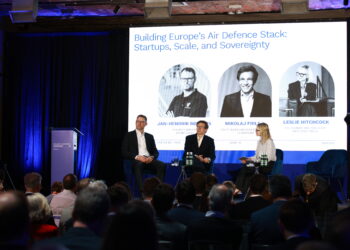
Yesterday at Resilience Conference Warsaw we welcomed 250 attendees from Poland, elsewhere in Europe, Ukraine, the UK, and America. Over 30% of the audience were from outside Poland. The event was a unique gathering of the leaders in defence tech from Poland and across Europe. The venue was in the heart of the Warsaw Ghetto; a reminder of the horrors of war and the shadows of history.
Across 15 panels, we covered how startups are scaling through partnerships with primes, how Poland is financing the next generation of defence tech, and how companies are winning defence contracts locally. Sessions also explored the buildout of Europe’s air defence capabilities and what it will take to strengthen them in the years ahead.
What made the day special was the mix of people in the room. Founders, investors, policymakers, and operators weren’t just presenting, they were in direct conversation with each other, exchanging ideas and building relationships that will continue beyond the event. Thank you to Expeditions for your partnership, as well as OTB Ventures and NATO Innovation Fund. We also couldn’t have done this event without our strategic partners at Lakestar, Snake Island Institute, Casimir Pulaski Foundation, Eastern Flank Institute, and Athena.
Dr Klaus Hommels, founder and director of Lakestar delivered a keynote about the future of the defence tech ecosystem in Europe, predicting a new era of European defence spending and investment. Expanding on Ukrainian Minister of Defense Mykhailo Federov’s Key Performance Indicator of Cost Per Kill, Hommels says that modern militaries need to start working like startup funders. Read more from Editor at Large, John Biggs here.
Our next event is Resilience Conference Copenhagen, on May 11. We are thrilled to announce participation from Kraken Technology Group, Systematic, Arctic Research and Defence, D3, Final Frontier, and more. The last day for Early Bird ticket prices is Friday 17 April so get yours today.
We pay for our events through tickets and sponsorship. We don’t have paid content, and we don’t take government money. This allows us to remain independent and curate challenging and impactful content. You can support our work by sponsoring our events. To discuss this, please contact me.
Outside of Poland, it was a big week for partnerships, joint ventures, and the awarding of defence contracts; plus we unpack some Deals in the section below. We’ve covered some big ones which you can find here:
- Rheinmetall and Destinus to ‘bridge the gap’ with new joint venture
- ARX Robotics secures British Army contract
- Tiberius to link Ukraine-validated defence tech with UK manufacturing through GRAIL platform
- UK government backs Cambridge Aerospace in Skyhammer anti-drone defence deal
I’ll be back in your inboxes next week. Thanks for reading.
-Leslie Hitchcock, co-founder and Publisher, Resilience Media

Danish startup Sapient Perception raises €2M to widen UAV vision for real-time battlefield decisions
- The Danish startup promising to give drones a much wider field of view without sacrificing detail has raised €2 million in pre-seed funding, as demand grows for faster, edge-based decision-making in defence and security operations.
- Sapient Perception ApS, a Danish developer of AI sensor systems for UAVs, said the round was co-led by Balnord and FORWARD.one.
- The company plans to use the funding to push ahead with its software-defined camera tech, hire more engineers, and get its systems in front of early customers across defence, security, and emergency response.
Airship startup Kelluu raises €15M from NATO, its first investment in Finland
- Kelluu, which is developing airship fleets for intelligence, surveillance, and reconnaissance needs, has raised a Series A of €15 million.
- The NATO Innovation Fund (NIF) is leading the round, its first investment in a startup in Finland.
- Kelluu does not disclose who its customers are, but CEO and co-founder Janne Hietala said in an interview that it sells to both government and non-government customers, with the former of those growing much faster and now accounting for some 80% of revenues.
Share this newsletter with the military!
We set up Resilience Media to help bridge between the military and the tech sector. As we have seen in Ukraine, it is essential the two work closer together, and in particular that the military understands venture funded defence tech companies and the role they play in defence.
If you are reading this newsletter, you are already interested in this topic. We need to spread this agenda further, into parts of the military not already actively engaged with tech. To help us achieve this mission, please share this newsletter with colleagues and friends in the military.

To infinity and back: the opportunity for reusable hardware in space
Germany’s Atmos Space Cargo is opening an office in Poland focused on defence capabilities, announced CEO Sebastian Klaus during a panel on Resilience Conference in Warsaw. The news comes on the heels of the German startup ramping up production to focus serving ministries of defence, which are focusing on extending defence capabilities that incorporate the space domain.
Atmos develops reusable spacecraft to deliver any type of cargo from space, promising controlled and precise return capability, on-orbit operations when in space, and subsequent return to Earth. Re-entry technology is crucial for life sciences and biotech research, as well as industrial materials development, and increasingly it also has military applications.
“When you’re in space, you can pretty much reach any place on earth within 60 minutes” said Klaus.
Atmos is still very much an early-stage startup. The company has to date only had one launch into space — ridesharing on a SpaceX rocket to gather research data to develop its commercial product a year ago.
But Klaus said that the company has a roster of several more launches planned for the next couple of years. And he also claimed that the company is further along in its capabilities in its labs. From a technical perspective, he said, Atmos could support strike capacities “in two to three years,” but employment of that capability remains a political question.
Atmos spacecraft use inflatable decelerators that look a little like round rafts, technology that was originally developed by NASA in the US and has been refined by the startup for its purposes. The material and design of the decelerators are meant to help preserve its payloads during re-entry so that they can be re-used in future.
Klaus said that Atmos is “the very first company in Europe to use this type of technology,” adding that their solution is “more scalable, even more lightweight and therefore more cost efficient than what NASA is doing.”
The company launched its first capsule into space last year, with the next one, PHOENIX 2, due to take off in 2027.

Our Strategic Partner, European Defense Tech Hub is awash with hackathons this year. Will we see you there?
EDTH Porto
Porto, Portugal | April 24–26, 2026
Set in one of Europe’s most vibrant startup cities, EDTH Porto convenes top technical talent to tackle pressing defence and resilience challenges. Expect a high-energy environment with hands-on building, mentorship, and collaboration across borders.
🔗 https://luma.com/edth-2026-porto
EDTH Stockholm
Stockholm, Sweden | April 24–26, 2026
EDTH Stockholm gathers Nordic engineers, founders, and defence innovators for a weekend of rapid prototyping and experimentation. The event focuses on dual-use technologies and scalable solutions to strengthen regional and global security.
🔗 https://luma.com/edth-2026-stockholm
EDTH Kyiv (Flagship)
Kyiv, Ukraine | April 27 – May 3, 2026
As a flagship event, EDTH Kyiv offers a unique opportunity to build alongside one of the world’s most battle-tested defence tech ecosystems. Participants will work on urgent, real-world problems, with direct relevance to modern conflict and resilience.
🔗 https://luma.com/edth-2026-kyiv