Wednesday 14 January, 2026
[email protected]
Resilience Media
  • About
  • News
  • Resilience Conference
  • Guest Posts
    • Author a Post
  • Subscribe
No Result
View All Result
  • About
  • News
  • Resilience Conference
  • Guest Posts
    • Author a Post
  • Subscribe
No Result
View All Result
Resilience Media
No Result
View All Result

DefHack takes defence tech to the streets

Jälle, building a camouflage supercloth out of old lithium batteries, was the big winner on the day

Fiona AlstonbyFiona Alston
December 18, 2025
in News, Startups
Share on Linkedin

The recent DefHack: Resilience edition hackathon in Tallinn, Estonia was all about extendability. Builders and startups showed off interesting projects in areas like sustainability in defence, ideas that touch the everyday person and the average community and the role they play in defence. Signal jamming, civilian crisis response, thermal camouflage, and disinformation all took stage.

You Might Also Like

Tech champion Mykhailo Fedorov named new defence minister of Ukraine

Defense Unicorns lives up to its name: $136M round lifts valuation past $1B

Touchwaves brings wearable haptics to the military cockpit

The 48-hour hackathon was organised by the Ministry of Defence of Estonia, the Estonian Business School and clean tech accelerator Beamline. The theme was resilience and start-ups and projects were to be “innovative solutions for material reuse, circular supply chain design, product redesign, and environmentally sustainable disposal methods in the defence sector.”

But in one significant way, it was not your typical hackathon: many of the 12 teams were preloaded with ideas and populated with members counting years of experience at dual-use companies. 

(Disclosure: Resilience Media was a proud media partner of the event.) 

Kodus, a platform to prepare civilians for wartime by training for ‘resilience’ among communities, caught the eye of Darkstar’s Kasper Gering.

“I especially liked this team as what they are doing is exactly right,” he said. “We already have our defence forces and our defence league with established roles for wartime, but what Kodus is doing is adding an extra layer on top, because we have lots of people who have a strong will to defend.” 

He said that there was a study commissioned recently in Estonia where 62% of the population said they are willing to participate in defence activities. Specifically, 12% in direct military roles, 23% in supportive roles to military (e.g., rear-area support, logistics, etc.), and 26% in non-military defence activities (e.g., the medical field or organizing evacuations). Also, a whopping 82% of the population considers armed resistance necessary in the event of an attack. “So there really is an untapped resource,” he added.

Gering was joined on the jury by Major General Ilmar Tamm, Commander of the Estonian Defence League; Lieutenant Colonel Asso Treksler, Commander of the Logistics Battalion at the Estonian Defence Forces; and Mart Habakuk, Chancellor of Estonian Business School. 

Jälle Technologies, the overall winners of the event, brought a very interesting project to life over the weekend. Already established in the climate tech space, Jälle recycles materials from batteries (the name means “again” in Estonian). Founded in 2023 the start-up recently raised a €2 million funding round that included funding from Kiilto Ventures and 2C Ventures, angel investment and grants from Enterprise Estonia (EIS) and the Environmental Investment Centre (KIK)

The EU is aiming for a 70% recycling efficiency to be achieved by recyclers of lithium-based batteries by 31 December 2030. Jälle Technologies is tackling the problem by transforming used batteries into reusable and sustainable metals and graphene-like materials. 

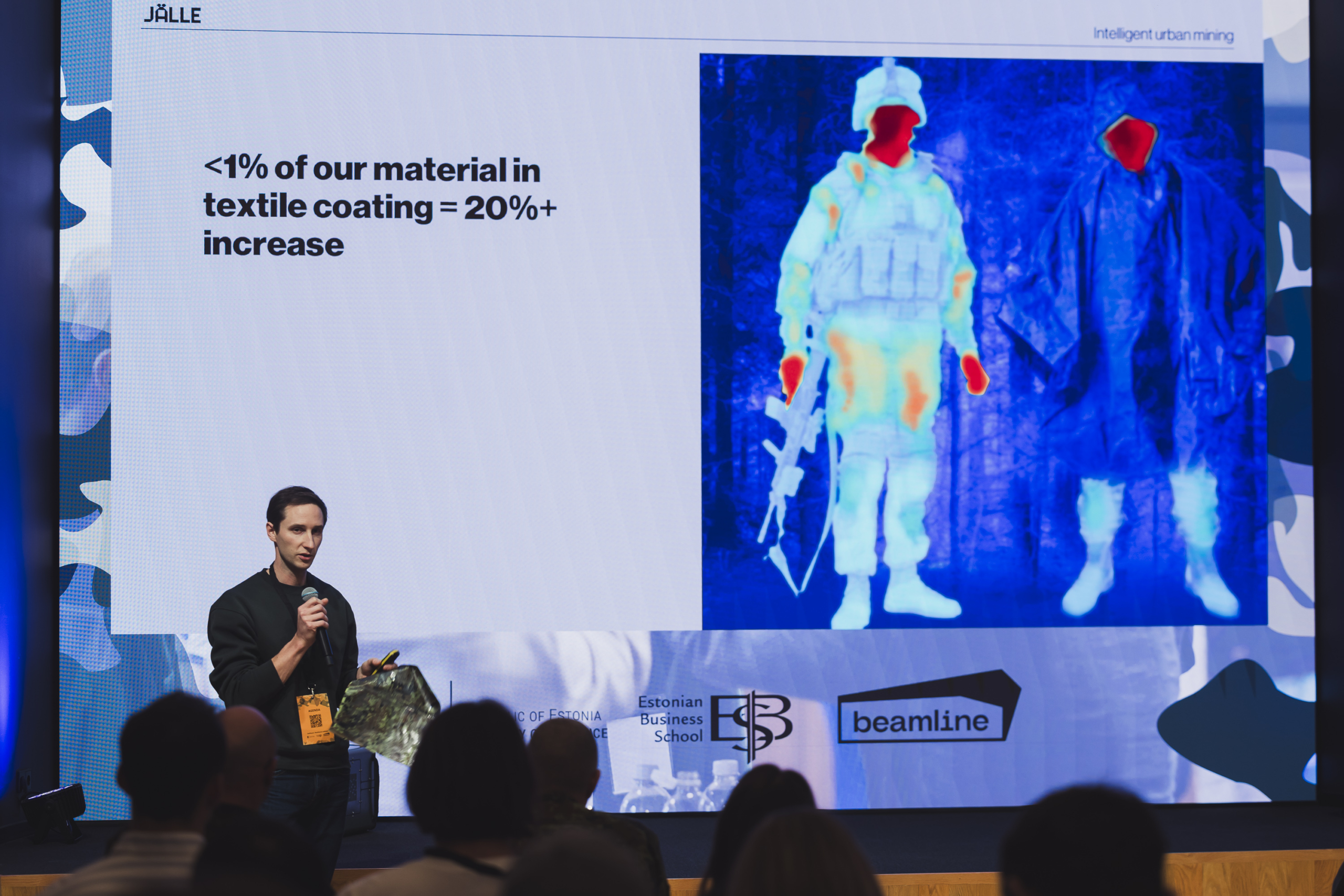
During the hackathon, this graphene was used to prove its efficiency in reducing thermal energy detection when applied to clothing. 

With its focus coating a piece of army apparel material, Jälle focused on four main categories: thermal camouflaging, electromagnetic interference, shielding, and strength of material. Impressing the jury with the initial results, they walked away with the top spoils which included €1,000 worth of legal advice, tickets to EstMil.tech 2026 and a plan to tackle the breathability of the coated material. 

“We’ll be looking into actually electro spinning our carbon material into a fibre,” said Eriki Ani, the CEO. 

Among the other projects under construction during the hackathon were Swiss drone company Avientus, which has developed a quiet electric drone aimed at delivering supplies to challenging areas. 

Considering a move to Estonia to get involved in defence due to the Swiss neutrality laws, Avientus is now set up. Part of the second place prize they collected is office space in Tallinn. 

Other notable projects included LessonLock, an offline reporting system that delivers lessons from the frontline; ResilientMesh, a dual-use, device-agnostic, low-cost, AI-driven mesh network for disaster or wartime environments; EDIE Estonian Defence Innovation Exchange for defence procurement; and Trinode Systems, which is building customized AI solutions to enhance decision-making, automate workflows, and improve operational efficiency. 

Tags: defence techEstoniahackathonsustainability
Previous Post

Exein, the embedded security startup, nabs €100M at ~€700M valuation

Next Post

Welcome to the greyzone of warfare in space

Fiona Alston

Fiona Alston

Fiona Alston is a defence tech, innovation and business journalist based in Estonia. With over a decade of experience covering tech, business and sustainability for Irish and European publications, she has a knack for bringing interesting and technical stories to an everyday audience.

Related News

Defence Tech Valley 2025: Kicking Around Military Innovation at a Football Pitch

Tech champion Mykhailo Fedorov named new defence minister of Ukraine

byIngrid Lundenand1 others
January 14, 2026

Ukraine on Wednesday made a significant shift in its leadership that signals just how central technology is to the country...

Defense Unicorns lives up to its name: $136M round lifts valuation past $1B

Defense Unicorns lives up to its name: $136M round lifts valuation past $1B

byCarly Page
January 13, 2026

Defense Unicorns, the US startup that builds environments for defence and other industries to build and use open source and...

Touchwaves' founders Martin Romero and Charlotte Kjellander

Touchwaves brings wearable haptics to the military cockpit

byPaul Sawers
January 13, 2026

From fighter jet cockpits to surgical theaters, humans remain a critical point of failure in high-stress, high-stakes environments. Cognitive overload, physiological...

yellow electric sign

Berlin power grid attack underscores fragility of Europe’s critical networks

byCarly Page
January 12, 2026

Berlin spent days in the dark earlier this month after an arson attack crippled part of its power grid, marking...

white and black airplane flying under blue sky

MoD weighs £20M laser investment for UK air defences

byCarly Page
January 12, 2026

The Ministry of Defence is exploring whether laser weapons could bolster UK air defences, as officials look at new ways...

Harmattan AI raises $200M at a $1.4B valuation from Dassault

Harmattan AI raises $200M at a $1.4B valuation from Dassault

byIngrid Lunden
January 12, 2026

Defence tech startups in Europe that are inking deals with government customers continue to pick up major funding with strategic...

person standing at the edge of a rock mountain facing the mountains during day

Terra Industries raises $12M to become ‘Africa’s first neo-prime’

byIngrid Lunden
January 12, 2026

A startup with ambitions to become the first defence tech “neo” prime in Africa has armed itself with $12 million...

Babcock and Frankenburg will build a containerized launch system for anti-drone missiles

Babcock and Frankenburg will build a containerized launch system for anti-drone missiles

byJohn Biggs
January 9, 2026

Babcock and Frankenburg Technologies have announced that they will work together on a low cost maritime counter drone system to...

Load More
Next Post
Welcome to the greyzone of warfare in space

Welcome to the greyzone of warfare in space

Scout Ventures GP Brad Harrison talks about funding the future of defence

Scout Ventures GP Brad Harrison talks about funding the future of defence

Most viewed

Harmattan AI raises $200M at a $1.4B valuation from Dassault

Defense Unicorns lives up to its name: $136M round lifts valuation past $1B

InVeris announces fats Drone, an integrated, multi-party drone flight simulator

Terra Industries raises $12M to become ‘Africa’s first neo-prime’

Accenture acquires Faculty to build out its AI offence

Scout Ventures GP Brad Harrison talks about funding the future of defence

Resilience Media is an independent publication covering the future of defence, security, and resilience. Our reporting focuses on emerging technologies, strategic threats, and the growing role of startups and investors in the defence of democracy.

  • About
  • News
  • Resilence Conference
  • Guest Posts
  • Subscribe
  • Privacy Policy
  • Terms & Conditions

© 2026 Resilience Media

No Result
View All Result
  • About
  • News
  • Resilence Conference
  • Guest Posts
  • Subscribe
  • Privacy Policy
  • Terms & Conditions

© 2026 Resilience Media

This website uses cookies. By continuing to use this website you are giving consent to cookies being used. Visit our Privacy and Cookie Policy.