
A recurring theme emerged from the chatter at the World Economic Forum (WEF) in Davos this week, with questions around sovereignty looming large.
There was no escaping the thorny matter of Greenland, in the wake of a push by US President Donald Trump for Washington to take control of the Danish territory. Finland’s president, Alexander Stubb, addressed the issue head on during a fireside chat in Switzerland, outlining three potential outcomes he dubbed the “good, the bad, and the ugly,” ranging from de-escalation to outright confrontation.
Ultimately, Stubb suggested we’ll end up somewhere in the middle.
“What has been proposed flies against basic international law, territorial integrity and sovereignty, and among allies this should be discussed diplomatically,” Stubb said.
Greenland, however, was merely the most visible expression of a wider concern running through Davos, with sovereignty now intersecting with technology, infrastructure and national preparedness.
Asked whether Europe is now facing state-on-state wars in the same way previous generations did, Stubb pointed to Finland’s approach to deterrence, arguing that it now extends well beyond the battlefield.
“Prepare for the worst to avoid it – strong defence removes incentives to invade,” he said. “If the electricity goes down, we know what to do. If telecoms and networks go down, we know what to do. We have a secure supply of food.”
‘Digital infrastructure resilience is a necessity’
From a defence perspective, the concept of “sovereignty” has taken on a whole new meaning far beyond that of territorial turf.
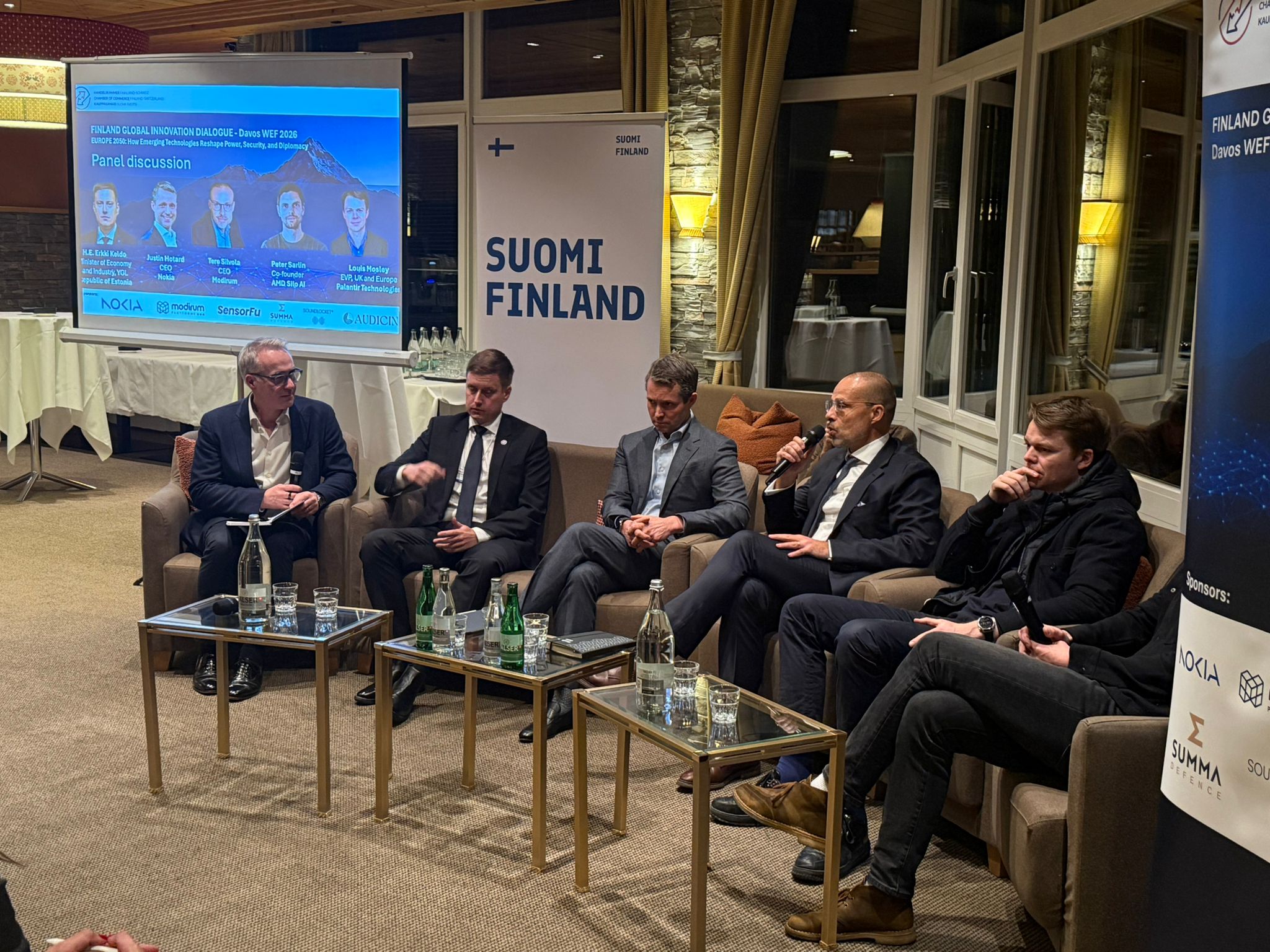
A separate panel, hosted by the Finnish-Swiss Chamber of Commerce, examined how emerging technologies are reshaping Europe’s power and security landscape. Policymakers and executives argued that control over digital infrastructure, data and industrial capacity is now inseparable from national security and autonomy.
Erkki Keldo, Estonia’s minister of economy and industry, described how years of exposure to cyber threats shaped the country’s approach to statehood in the digital age in the panel moderated by Resilience Media‘s Dr Tobias Stone.
“If you ask what the difference is between us and other European states, I would say that digital infrastructure resilience is not a nice-to-have – it’s a necessity,” Keldo explained.
Keldo pointed to the large-scale cyberattacks Estonia faced some two decades ago, when government websites, banks, media outlets and public services were hit by coordinated distributed denial-of-service (DDoS) attacks, disrupting essential digital systems across the country.
“Estonia faced its first really big cyber attack in 2007 from our eastern neighbour,” Keldo said. “We didn’t make it a secret, we made it public – what happened, how all the safeguards held up, how the firewalls worked, and we learned what to do better next time.”
That experience, Keldo suggested, reinforced a key lesson: sovereignty in a digital society depends as much on public trust as it does on technical prowess.
“If you want to be a digital society, trust is a key enabler,” he said. “People have to feel that their services, their data, are safe and that it can’t be accessed by the wrong hands… Nordic [and] Baltic countries maybe get that more than Southern or Western European Union countries.”
While Estonia’s experience shows how sovereignty can be shaped by resilience at a state level, others argued that it also depends on how national technology ecosystems develop over time. Peter Sarlin, CEO and co-founder of AMD’s Finnish AI lab Silo AI, acknowledged a shared foundation across the Nordic and Baltic regions, but he stressed that this has often produced very different outcomes in practice.
Finland, he noted, has tended to produce deep tech companies such as satellite imaging firm ICEYE, quantum computing startup IQM and Silo AI itself, while Estonia has generated platform and fintech successes including Wise and Skype. Sweden is also increasingly home to AI application-layer companies such as Lovable and Legora, reflecting different engineering strengths and industrial paths.
“So I guess we have this commonality in terms of trust, resilience, digital infrastructure and so forth, but then [we] eventually thrive in terms of different companies,” Sarlin said.
Control critical infrastructure, control society
From there, the discussion moved from individual firms to the foundational systems they depend on. With digital technologies embedded across energy, transport, communications and public services, control over critical infrastructure has become a central strategic concern for European states.
“I’m a huge believer that the next battle that we have will not be drawn by lines on a map – it will be drawn by critical infrastructure,” Nokia CEO Justin Hotard explained. “And there’s two things that will be attacked – power and communications – because if you control those two things, you control a society.”
Nokia itself is leaning into this. In recent months, the company has expanded its defence portfolio with new tactical communications systems and set up a dedicated defence unit, mirroring a broader shift towards technologies that serve both civilian and military needs. Core network infrastructure, after all, underpins everything from emergency services and logistics to battlefield coordination.
“We recognise that what we are building is dual-use,” Hotard said. “It’s not by choice, it’s by definition.”
That dual-use nature has been made stark by the war in Ukraine, where civilian communications infrastructure has become a critical military asset.
“The things that are helping Ukraine fight, defend and protect its sovereignty are communications,” Hotard continued. “There’s obviously a lot of other technology — there are drones, there’s a great amount of data and analytics and AI — but without connectivity, none of those things actually work.”
The concept of sovereignty surfaced in other, less obvious ways during Davos.
One example came from US data analytics company Palantir, which announced a new AI “dataroom” built in collaboration with Ukraine’s Brave1 defence innovation initiative, designed to aggregate and operationalise battlefield data collected over the course of the war. This data emanates from sources such as sensors, satellites, SIGINT radio frequencies, and drone footage.
While the involvement of US technology firms like Palantir in European defence systems continues to stoke debates around data control and sovereignty, its Ukraine partnership switches the conversation toward the strategic role of data itself.
Louis Mosley, who runs Palantir’s business across the UK, Europe and the Middle East, said the effort illustrates how data has become a valuable resource in modern conflict.
“It’s a completely unique data asset library, four years of data that nobody else in the world has,” Mosley said. “And off of that data, they have started to train extraordinary algorithms that are essential for detecting enemy movements, predicting enemy activity, also powering autonomous drones, for example. This is the bleeding edge of military technology.”
Alongside the value of data and infrastructure, Mosley also highlighted the importance of “human capital” in building and sustaining advanced technological capabilities at scale.
“Europe, especially in the engineering field, is just blessed with extraordinary human capital,” Mosley said. “Palantir employs a quarter of its workforce in the UK. There is no economically rational reason for that — it’s simply a function of the talent that it can access.”
In Mosley’s view, that talent advantage is among Europe’s hardest assets to replicate elsewhere, particularly when it comes to building the next generation of trillion-dollar technology companies.
“There is no reason why they couldn’t be built in Europe, because really the most important, non fungable input is the human capital – the rest you can buy,” he said.
Drones, satellites and the new realities of modern warfare
Across the way at Davos, Resilience Media moderated a panel hosted by the Polish Business Hub, which examined the growing role of drones and satellites in contemporary conflict.
Unmanned aerial systems and space-based surveillance now underpin intelligence gathering and battlefield coordination, particularly in environments shaped by electronic warfare. Ukraine, naturally, was a centerpiece for much of the discussion, cited as the clearest real-world test of how quickly these systems must be fielded, adapted and replaced in a live conflict.
“We should be learning, because if the equipment is not battlefield proven in Ukraine, then you may not say that it will withstand the current warfare conditions,” Radosław Piesiewicz, founder of counter-drone company Advanced Protection Systems, said, adding that both drone technology and enemy tactics are in constant flux.
“So if you don’t adapt your technology, then after month two or three, it’s simply not up to the task,” he said.
That need for regular iteration was reinforced by Rafał Modrzewski, founder and CEO of ICEYE, whose satellites have been used extensively in Ukraine.
“The satellites we were using three years ago are jammed every day now,” he said. “The satellites we launched two days ago are not. If you don’t keep adapting your technology, you’re immediately behind.”
That dynamic, where systems degrade almost as soon as they are deployed, has shortened defence timelines significantly. Technologies are often now tested in live electronic warfare conditions from day one, leaving little margin for slow replacement cycles. And this has put particular strain on Europe’s procurement models.
While defence budgets are rising, speakers argued that the way equipment is bought remains poorly suited to technologies that evolve in months rather than decades.
“We are still used to buying, say, ships that have a 50-year lifetime, and because something has a 50-year lifetime, we can easily take five years to buy it,” Modrzewski said. “When you think of drones or satellites, during a five year period we are doing two generations, so you are just going to get old stuff if your procurement takes so long.”
Others echoed that concern, warning that the bottleneck is less about technological capability than it is the ability to deploy and adapt at speed — with procurement processes misaligned with how modern conflict evolves.
“The technology is not moving fast…. the application of technology is moving fast,” said Srdjan Kovacevic, co-founder and CEO of Croatian drone company Orqa. “There’s no way to ‘procure’ a capability of taking a technology from where it exists, and putting it where it needs to be employed.”
In Ukraine, that gap has been narrowed via unusually direct links between frontline units and technology suppliers, allowing systems to be adapted and redeployed as conditions change. Kovacevic argued that the wider European region still lacks any comparable pathway.
“There’s no modality in current European procurement to make that happen on a scale, and pace, which is needed in the next war,” he said.
By the end of the discussions in Davos, the message was clear: territorial control remains a big part of the sovereignty picture, but in an interconnected world, power also rests on who can build, adapt and sustain the technologies of modern warfare.
“Considering the geopolitical environment in which we are at the moment, which is dynamically changing, technological and operational sovereignty and independence in Europe is a must,” Piesiewicz said. “It’s as simple as that.”